Physical and Cognitive Predictors of Badminton Short Serve Mastery in High School

https://doi.org/10.51574/ijrer.v5i4.4706
Keywords:
Badminton, Cognitive Predictors, High School Students, Physical Predictors, Short Serve MasteryAbstract
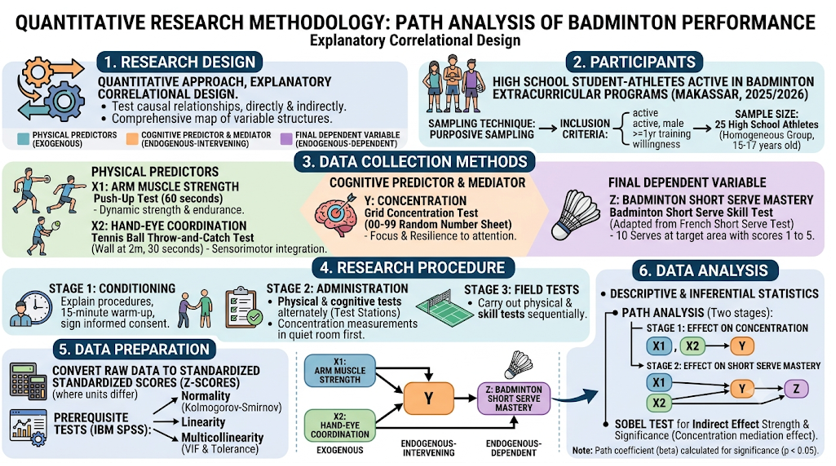
Mastery of open-motor skills like the badminton short serve is often hindered by an incomplete understanding of cognitive-motor interactions. This study evaluated physical (arm muscle strength, X1; hand–eye coordination, X2) and cognitive (concentration, Y) predictors of badminton short serve mastery (Z) among high school student-athletes (N=25, aged 15–17), positioning concentration as a mediator. Utilizing a quantitative explanatory correlational design, data were collected via validated field tests and analyzed using path analysis. The empirical model accounted for 58.8% of the total variance in serving proficiency. Arm muscle strength acted as a dominant predictor, exerting significant direct effects on concentration (beta = 0.514, p < 0.05) and short serve mastery (beta = 0.421, p < 0.05). Sobel tests confirmed that concentration significantly and partially mediated the relationship between arm strength and serving performance (Z = 1.978, p = 0.047), amplifying the total integrative effect to 0.659, alongside its own direct impact on mastery (beta = 0.463, p < 0.05). Conversely, hand–eye coordination yielded no significant direct or indirect effects (p > 0.05). These findings demonstrate that technical mastery relies on both biomechanical readiness and cognitive control, where upper-body strength underpins the cognitive stability required for precise execution. Consequently, sports pedagogy should integrate targeted physical conditioning with structured cognitive training.
References
Abedanzadeh, R., Becker, K., & Mousavi, S. M. R. (2022). Both a holistic and external focus of attention enhance the learning of a badminton short serve. Psychological Research, 86(1), 141-149. https://doi.org/10.1007/s00426-021-01475-9 DOI: https://doi.org/10.1007/s00426-021-01475-9
Amri, M. F. L. (2025). Relationship Between Student-Centered Learning, Physical Education Dagogical Approach And Badminton Service Skill Improvement Among Senior High School Students. COMPETITOR: Jurnal Pendidikan Kepelatihan Olahraga, 17(3), 3477-3487. https://doi.org/10.26858/cpjok.v17i3.591
Dhahbi, W., Briki, W., Heissel, A., Schega, L., Dergaa, I., Guelmami, N., ... & Chaabene, H. (2025). Physical activity to counter age-related cognitive decline: benefits of aerobic, resistance, and combined training—a narrative review. Sports Medicine-Open, 11(1), 56. https://doi.org/10.1186/s40798-025-00857-2 DOI: https://doi.org/10.1186/s40798-025-00857-2
Duncan, M. J., Chan, C. K., Clarke, N. D., Cox, M., & Smith, M. (2017). The effect of badminton-specific exercise on badminton short-serve performance in competition and practice climates. European Journal of Sport Science, 17(2), 119-126. https://doi.org/10.1080/17461391.2016.1203362 DOI: https://doi.org/10.1080/17461391.2016.1203362
Guo, H., Xue, R., Chai, H., Long, Y., Lê, T. T., Nong, G., ... & Tang, X. (2026). Development and application of a physical fitness pedagogy model based on the sport education model framework: an instructional innovation in physical fitness curriculum. BMC Public Health, 26(1), 1397. https://doi.org/10.1186/s12889-026-26976-3 DOI: https://doi.org/10.1186/s12889-026-26976-3
Jayantilal, K., & O’Leary, N. (2017). (Reinforcing) factors influencing a physical education teacher’s use of the direct instruction model teaching games. European Physical Education Review, 23(4), 392-411. https://doi.org/10.1177/1356336X16652081 DOI: https://doi.org/10.1177/1356336X16652081
Kasmad, M. R., & Badaru, B. (2020). The effect of hand-eye coordination, wrist flexibility, and self-confidence on serve ability in badminton on Senior High Schools Students. In 3rd International Conference on Education, Science, and Technology (ICEST 2019) (pp. 245-248). Atlantis Press. https://doi.org/10.2991/assehr.k.201027.051 DOI: https://doi.org/10.2991/assehr.k.201027.051
Kurniawan, A. W., Wiguno, L. T. H., & Amrullah, M. H. F. (2022). Development of application-based badminton material teaching media for middle school level PJOK teachers. Journal of Science and Education (JSE), 3(2), 82-93. https://doi.org/10.56003/jse.v3i2.162 DOI: https://doi.org/10.56003/jse.v3i2.162
Liang, Z. (2025). Psychomotor Ability. The ECPH Encyclopedia of Psychology (pp. 1232-1232). Singapore: Springer Nature Singapore. https://doi.org/10.1007/978-981-97-7874-4_1249 DOI: https://doi.org/10.1007/978-981-97-7874-4_1249
Lijin, Z. (2025). Development of Eye-Hand Coordination. The ECPH Encyclopedia of Psychology (pp. 379-380). Singapore: Springer Nature Singapore. https://doi.org/10.1007/978-981-97-7874-4_736 DOI: https://doi.org/10.1007/978-981-97-7874-4_736
Iino, Y., Wilkie, J. C., Fukashiro, S., Yoshioka, S., & Vial, S. (2025). Two strategies to improve stability in a precision-based task: Insights from the badminton short serve. Journal of biomechanics, 113059. https://doi.org/10.1016/j.jbiomech.2025.113059 DOI: https://doi.org/10.1016/j.jbiomech.2025.113059
Pompa, D., Carson, H. J., Beato, M., di Fronso, S., & Bertollo, M. (2024). Attentional focus effects on lower-limb muscular strength in athletes: A systematic review. The Journal of Strength & Conditioning Research, 38(2), 419-434. https://doi.org/10.1519/JSC.0000000000004714 DOI: https://doi.org/10.1519/JSC.0000000000004714
Portaz, M., Cabestrero, R., Quirós, P., & Santos, O. C. (2024). AI-powered psychomotor learning through basketball practice: Opportunities and challenges. Mind, body, and digital brains, 193-215. https://doi.org/10.1007/978-3-031-58363-6_13 DOI: https://doi.org/10.1007/978-3-031-58363-6_13
Portillo, J., Abián, P., Bravo-Sánchez, A., Dorado-Suárez, A., & Abián-Vicén, J. (2023). Effects of the comprehensive and technical models of sports teaching in secondary school students. Sustainability, 15(8), 6752. https://doi.org/10.3390/su15086752 DOI: https://doi.org/10.3390/su15086752
Rajab, A., Fahrizal, F., Kamaruddin, I., Adil, A., & Hudain, M. A. (2025). Influence of Arm Muscle Strength and Concentration on Badminton Long Service Ability in Elementary Schools. ETDC: Indonesian Journal of Research and Educational Review, 4(2), 349-361. https://doi.org/10.51574/ijrer.v4i2.2949 DOI: https://doi.org/10.51574/ijrer.v4i2.2949
Ramadhan, R., & Saparia, A. (2026). Shooting Skill Level in the Extracurricular Football Team at MTS Al-Khairat Sandana Tolitoli. Journal of Education Review Provision, 6(1), 14-23. https://doi.org/10.55885/jerp.v6i1.950 DOI: https://doi.org/10.55885/jerp.v6i1.950
Saleh, H. A., Hasyim, H., & Fauzan, M. M. (2024). Influence Learning Strategies to Enhance Physical Condition and Focus in Young Badminton Players During Matches. EDUKASIA Jurnal Pendidikan Dan Pembelajaran, 5(2), 311-322. https://doi.org/10.62775/edukasia.v5i2.1429 DOI: https://doi.org/10.62775/edukasia.v5i2.1429
Sitorus, A. A., Simaremare, A., Arjuna, A., Buulolo, B., Pandia, B. P., Karo, A. A. P. K., ... & Laia, Y. P. (2025). Learning Outcomes Associated with the Execution of Short Service in Badminton Among Junior High School Students: The Proficiency of Eye-Hand Coordination in Motor Activities. Journal of Foundational Learning and Child Development, 1(01), 12-16. https://doi.org/10.53905/ChildDev.v1i01.3 DOI: https://doi.org/10.53905/ChildDev.v1i01.3
Song, S. H. (2026). Relationship Between Quiet Eye and Kinematic Characteristics Based on Expertise in Badminton Backhand Serve. Perceptual and Motor Skills, 133(2), 443-464. https://doi.org/10.1177/00315125251346882 DOI: https://doi.org/10.1177/00315125251346882
Suchomel, T. J., Nimphius, S., & Stone, M. H. (2016). The importance of muscular strength in athletic performance. Sports medicine, 46(10), 1419-1449. https://doi.org/10.1007/s40279-016-0486-0 DOI: https://doi.org/10.1007/s40279-016-0486-0
Vial, S., Cochrane, J., J. Blazevich, A., & L. Croft, J. (2019). Using the trajectory of the shuttlecock as a measure of performance accuracy in the badminton short serve. International Journal of Sports Science & Coaching, 14(1), 91-96. https://doi.org/10.1177/1747954118812662 DOI: https://doi.org/10.1177/1747954118812662
Yu, L. (2025). The correlation between biomechanical adaptation changes and teaching effectiveness in adolescents participating in sports dance training during physical education. Molecular & Cellular Biomechanics, 22(3). DOI: https://doi.org/10.62617/mcb927
Downloads
Published
How to Cite
Issue
Section
License
Copyright (c) 2026 Nur Najemunnisa, Ahmad Adil, Andi Ridwan

This work is licensed under a Creative Commons Attribution-ShareAlike 4.0 International License.