Development of Augmented Reality-Based Rotametry Learning Media for 3D Shape Topics in Elementary Schools

https://doi.org/10.51574/kognitif.v6i3.5797
Keywords:
Augmented Reality, Elementary School, Learning Media, Rotametry, Spatial BuildingAbstract
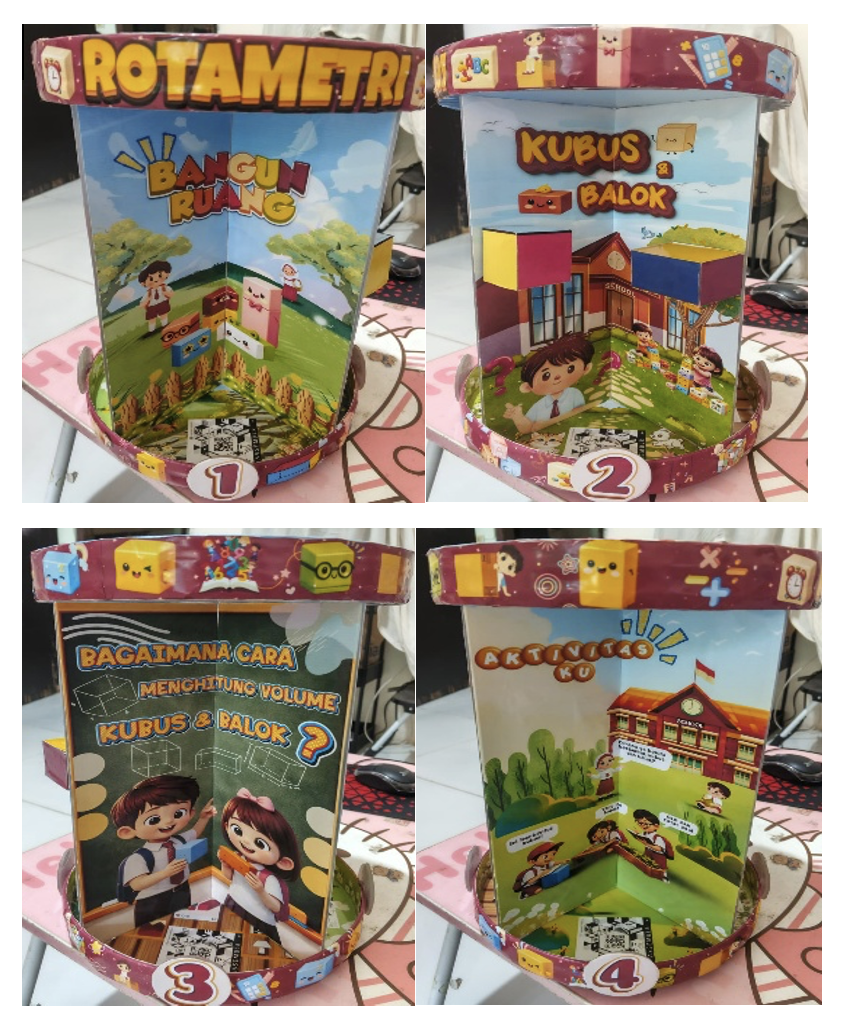
This research is motivated by the limitations of interactive learning media on spatial building materials in elementary schools, which cause students to have difficulty visualizing the abstract concepts of spatial buildings. This research aims to develop and determine the feasibility and practicality of the Rotametri learning media based on Augmented Reality (AR) for spatial building material in fifth grade at UPT SDN 12 Pinrang, UPT SDN 9 Pinrang, and UPT SDN 172 Pinrang. The method used is Research and Development (R&D) with the ADDIE model, limited to the Analysis, Design, and Development stages. In the Development stage, a limited trial is conducted to determine the practicality of the product. Data were analyzed descriptively quantitatively by calculating the percentage of validation results and practicality tests. The Rotametri media was developed in the form of a tube that can rotate 360° and is equipped with AR technology to help students visualize spatial geometry material more concretely and interactively. The results of the validation by subject matter experts and media experts each obtained a percentage of 100% with very feasible criteria. The practicality test involving 3 teachers and 61 students obtained percentages of 91.12% from teachers and 92.93% from students with very practical criteria. Thus, the AR-based Rotametri media meets the feasible and practical criteria based on the results of limited trials in the fifth-grade elementary school spatial building learning.
Downloads
References
Braak, D. ten, Lenesa, R., Purpurab, D. J., Schmittb, S. A., & Størksen, I. (2022). Why do early mathematics skills predict later mathematics and reading achievement? The role of executive function. Journal of Experimental Child Psychology, 214(105306), 1–18. https://doi.org/10.1016/j.jecp.2021.105306
Daryono, R. W., Rochmadi, S., & Hidayat, N. (2020). Development and validation of video-based learning media to increase competency achievement in civil engineering education. Journal of Physics: Conference Series, 1833(1). https://doi.org/10.1088/1742-6596/1833/1/012022
Dwinitia, S., Hartati, Y. S., & Melita. (2023). Validity of Learning Module Development Designing Scientific Work Proposals Based on Project Based Learning. Journal of Asian Studies: Culture, Language, Art and Communications, 4(2). https://ojs3.haqipub.com/index.php/jas/article/viewFile/320/153
Fauziyah, S., Sudatha, I. G. W., & Sudarma, I. K. (2024). Interactive Learning Multimedia Using Contextual Approach for Students in Fifth Grade of Elementary School. Jurnal Pedagogi Dan Pembelajaran, 7(2), 369–380. https://doi.org/10.23887/jp2.v7i2.82398
Fransisca, M., Yunus, Y., & Sutiasih, A. D. (2019). Practicality of E-Learning as Learning Media in Digital Simulation Subjects at Vocational School in Padang Practicality of E-Learning as Learning Media in Digital Simulation Subjects at Vocational School in Padang. Journal of Physics: Conference Series, 1339(1). https://doi.org/10.1088/1742-6596/1339/1/012077
Humaira, T., & Ninawati, M. (2023). Development of Contextual Media Diorama of Water Cycle in Science Subject in Elementary School. Jurnal Cakrawala Pendas, 9(4), 631–641. https://doi.org/10.31949/jcp.v9i4.5653
Lestari, W., & Dafik. (2025). Development of learning media based on augmented reality. JDIME : Journal of Development and Innovation In Mathematics Education, 3(1), 48–56. https://doi.org/10.1201/9781003353423-11
Melinda, W., & Ariyani, Y. D. (2024). Development of diorama based learning media to improve Eeementary school students’ creative thinking ability. Indonesian Journal of Classroom Action Research, 2(20), 5–9. https://reposister.almaata.ac.id/id/eprint/461/4/Bukti Kinerja_Artikel Penelitian.
Mukhlisa, N. (2021). Miskonsepsi Pada Peserta Didik. SPEED Journal : Journal of Special Education, 4(2), 66–76. https://doi.org/10.31537/speed.v4i2.403
Nasrulloh, I., Rahadian, D., Hamdani, N. A., Imania, K. A. N., & Rikaldi, P. B. R. (2021). A comparative study: Multimedia interactive use on contextual and cooperative approaches in increasing mathematical understanding. Journal of Physics: Conference Series, 1987(1). https://doi.org/10.1088/1742-6596/1987/1/012015
Pagarra, H., Syawaluddin, A., Krismanto, W., & Sayidiman. (2022). Media Pembelajaran. In Badan Penerbit UNM. Badan Penerbit UNM.
Putrie, S. N., & Syah, M. N. S. (2023). Development of 3D Math AR Applications as Mathematics Learning Media Augmented Reality Based. Hipotenusa : Journal of Mathematical Society, 5(1), 72–81. https://doi.org/10.18326/hipotenusa.v5i1.6401
Rahmiati, D., Sarwi, Sudarmin, & Cahyono, A. N. (2020). The Use of Augmented Reality Diorama Media in Natural and Social Sciences Subjects for Fourth Grade Elementary School. JOURNAL LA EDUSCI, 01(04), 16–25. https://doi.org/10.37899/journallaedusci.v1i5.256
Rohendi, D., Ramadhan, M. O., Rahim, S. S. A., & Zulnaidi, H. (2025). Enhancing student’s interactivity and responses in learning geometry by using augmented reality. Eurasia Journal of Mathematics, Science and Technology Education, 21(1), 1–14. https://doi.org/10.29333/ejmste/15796
Rusmayana, T. (2021). Model Pembelajaran ADDIE Integrasi Pedati Di SMK PGRI Karisma Bangsa Sebagai Pengganti Praktek Kerja Lapangan Di Masa Pandemi Covid-19 (R. Hartono.Bogor: Widina Bhakti Persada Bandung.
Saputra, R. A., Alfarizi, M., Saputri, F. H., & Ferawati. (2025). Development of Augmented Reality-Based Learning Media with MDLC Model for Solid Geometry for Elementary School Students. Jurnal Dan Penelitian Teknik Informatika, 9(2), 615–624. https://doi.org/10.33395/sinkron.v9i2.14601
Saraswati, S., Nugroho, M. W., Saraswati, E., & Hartiningrum, N. (2026). Pembelajaran PBL Berbasis Ethno-STEM dan Augmented Reality : Proses dan Respon Mahasiswa PBL Learning Based on Ethno-STEM and Augmented Reality : Student Process and Response. Jurnal Axioma: Jurnal Matematika Dan Pembelajaran, 11(1). https://doi.org/10.56013/axi.v11i1.5372
Sidyawati, L., Masruroh, R., & Siregar, I. E. (2021). Development of Diorama Learning Media for Fourth Grade Elementary School. Journal of Teaching and Learning in Elementary Education (Jtlee), 4(2), 211. https://doi.org/10.33578/jtlee.v4i2.7897
Syafril, S., Asril, Z., Engkizar, E., Zafirah, A., Agusti, F. A., & Sugiharta, I. (2021). Designing prototype model of virtual geometry in mathematics learning using augmented reality. IOP Conference Series: Earth and Environmental Science, 1796(1). https://doi.org/10.1088/1742-6596/1796/1/012035
Tarng, W., Huang, J. K., & Ou, K. L. (2024). Improving Elementary Students’ Geometric Understanding Through Augmented Reality and Its Performance Evaluation. Systems, 12(493), 2–28. https://doi.org/10.3390/systems12110493
Tuta, B. B., Harta, J., & Purwasih, S. S. (2022). Development of Assemblr Edu-Assisted Augmented Reality Learning Media on the Topic of Effect of Reactant’S Concentration and Catalyst on Reaction Rate. JCER (Journal of Chemistry Education Research), 6(1), 58–71. https://doi.org/10.26740/jcer.v6n1.p58-71
Utami, N. F., & Irawati, R. K. (2024). Effectiveness of Ethnomathematics-Based Learning Media on Students ’ Understanding of Geometry Material Concepts in Grade IV. Journal of Educational Research and Practice, 2(3), 21–34. https://doi.org/https://doi.org/10.70376/jerp.v2i3.203
Yang, Y., Du, W., Mavrikis, M., & Geraniou, E. (2025). Spatial Skill Development Through Augmented Reality in Mathematics Education : A Scoping Review. Digital Experiences in Mathematics Education, 0123456789. https://doi.org/10.1007/s40751-025-00187-8
Yusup, M., Fathurohman, I., & Khamdun. (2024). Development of Diorama Media Containing Psychomotoric and Cognitive Skills in Science Learning Based on Local Wisdom in Fourth Grade Students of Baturno State Primary School. ICCCM-Journal Of Social Sciences And Humanities, 3(3), 94–99. https://doi.org/10.53797/icccmjssh.v3i3.14.2024
Zahrah Jamilah. (2021). Pengembangan Media Pembelajaran Mobile Apps. Skripsi dipublikasikan. Universitas Islam Negeri Syarif Hidayatullah.
Zainal, Z., Halik, A., Sultan, M. A., & Resa, A. (2021). Development of Geometry Flipbook Multi 4533 Words Journal of Educational Science and Technology Development of Geometry Flipbook Multimedia Learning Media for Elementary School Students. Journal of Educational Science and Technology, 7(2), 207–215. https://doi.org/10.26858/est.v0i0.20443
Zainal, Z., Rudy, S., & Hasan, K. (2025). Development of Pop-Up Book Geometry Integrated with. AIP CONFERENCE PROCEEDINGS, 020029. https://doi.org/https://doi.org/10.1063/5.0262335
Downloads
Published
How to Cite
Issue
Section
License
Copyright (c) 2026 This is an open-access under the CC-BY-SA license

This work is licensed under a Creative Commons Attribution-ShareAlike 4.0 International License.
Education and Talent Development Center of Indonesia (ETDC Indonesia)
e-mail: kognitif@gmail.com, website : https://etdc-indonesia.com

Kognitif: Jurnal Riset HOTS Pendidikan Matematika dengan Situs: https://etdci.org/journal/kognitif berlisensi Creative Commons Attribution-ShareAlike 4.0 International License







.png)