Development of School Environment-Based Math City Map on Congruence and Similarity Material

https://doi.org/10.51574/kognitif.v6i3.5648
Keywords:
Congruence and Similarity, Contextual Learning, Learning Media, Math City MapAbstract
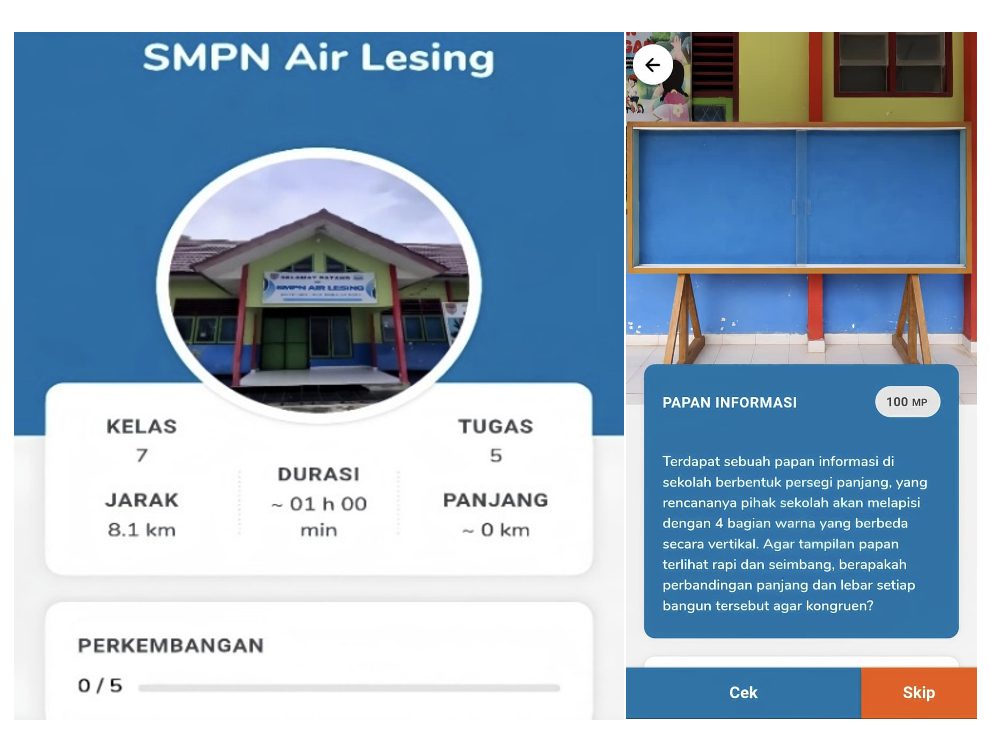
This study aims to develop learning media based on Math City Map with the context of the SMP Negeri Air Lesing school environment on congruence and similarity material and to determine the media quality based on validity, practicality, and the improvement of student learning outcomes. This study used the Research and Development (R&D) method with the ADDIE model consisting of Analysis, Design, Development, Implementation, and Evaluation. Validation involved three experts: content expert, media expert, and language expert. Validation results showed that the media was in the very valid category, with percentage scores of 86.66% from the content expert, 86.15% from the media expert, and 97.14% from the language expert. Media practicality based on teacher and student responses reached 90.66% and 92.22% respectively, both falling into the very practical category. A trial involving 26 students showed an increase in average learning outcome scores from 26.38 in the pretest to 71.23 in the posttest. These results indicate that the use of media in the research trial context was accompanied by an improvement in learning outcomes in the moderate category. The implication of this study suggests that Math City Map-based learning media can serve as an alternative for teachers in applying contextual mathematics learning through the utilization of the school environment as a learning resource for congruence and similarity topics
Downloads
References
Adha, I., & Refianti, R. (2020). Pengembangan LKS Berbasis Konteks Lubuklinggau Ditinjau dari Segi Kevalidan dan Kepraktisan. Edumatica: Jurnal Pendidikan Matematika, 10(1), 36–43. https://doi.org/10.22437/edumatica.v10i01.7668
Branch, R. M. (2009). Intructional Design: The ADDIE Approach.
Cahyono, A. N., & Ludwig, M. (2019). Teaching and Learning Mathematics around the City Supported by the Use of Digital Technology. EURASIA Journal of Mathematics, Science and Technology Education, 15(1), 1–8. https://doi.org/10.29333/ejmste/99514
Coletta, V. P., & Steinert, J. J. (2020). Why normalized gain should continue to be used in analyzing preinstruction and postinstruction scores on concept inventories. Physical Review Physics Education Research, 16(1), 10108. https://doi.org/10.1103/PhysRevPhysEducRes.16.010108
Febrian, S. A., Rahmawati, F., & Adna, F. (2023). Pengaruh Missouri Mathematics Project Berbantuan Math City Map terhadap Kemampuan Berpikir Kritis Matematis. Juring (Journal for Research in Mathematics Learning), 6(3), 307–316. https://doi.org/10.24014/juring.v6i3.23567
Fitriyani, Sakur, & Maimunah. (2020). Media Pembelajaran Matematika Berbasis Komputer pada Materi Kesebangunan dan Kekongruenan bagi Siswa SMP / MTs Kelas IX. Juring (Journal for Research in Mathematics Learning), 3(1), 81–90. https://doi.org/10.24014/juring.v3i1.9006
Friansah, D., Sukasno, Yanto, Y., Alfian, Z. A., & Anjelina, S. (2025). Pelatihan Guru SD Dalam Mengembangkan Pembelajaran Matematika Kontekstual Berbasis Wisata Edukasi Melalui Math City Map Di Taman Beregam, Musi Rawas. Jurnal Cemerlang: Pengabdian Pada Masyarakat, 8(1), 137–149. https://doi.org/10.31540/jpm.v8i1.3875
Hake, R. R. (1998). Interactive-engagement versus traditional methods : A six-thousand-student survey of mechanics test data for introductory physics courses. American Journal of Physics, 66(1), 64–74. https://doi.org/10.1119/1.18809
Ilahi, T. D. W., Mufit, F., Hidayati, H., & Afrizon, R. (2021). Desain dan Validitas Multimedia Interaktif Berbasis Konflik Kognitif pada Materi Vektor untuk Kelas X SMA / MA. Jurnal Penelitian Pembelajaran Fisika, 12(2), 182–195. https://doi.org/10.26877/jp2f.v12i2.9324
Jablonski, S., Barlovits, S., Gurjanow, I., Larmann, P., Ludwig, M., Oehler, X. K., & Wetzel, S. (2023). Mobile Learning Outside The Classroom With. 193–196. https://doi.org/10.37626/GA9783959872522.0.24
Ludwig, M., & Jablonski, S. (2021). Passo a passo : simplificando e matematizando o mundo real com o MathCityMap. Quadrante: Revista de Investigação Em Educação Matemática, 30(2), 243–268. https://doi.org/10.48489/quadrante.23604
Maheswari, G. A., Saraswati, E., & Rudhito, M. A. (2023). Pengembangan Media Pembelajaran Menggunakan Mathcitymap Dalam Kemampuan Pemecahan Masalah Berbasis Etnomatematika Konteks Benteng Vredeburg Yogyakarta. Jurnal Pendidikan Matematika, 9(2), 187–198. https://doi.org/10.33474/jpm.v9i2.20037
Mardhiyah, R. H., Sekar Nurul Fajriyah Aldriani, Chitta, F., & Zulfikar, M. R. (2021). Pentingnya Keterampilan Belajar di Abad 21 sebagai Tuntutan dalam Pengembangan Sumber Daya Manusia. Lectura: Jurnal Pendidikan, 12(1), 29–40. https://doi.org/10.31849/lectura.v12i1.5813
Mataheru, E. E. (2025). Kemampuan Koneksi Matematis Peserta Didik pada Materi Kesebangunan dengan Menggunakan Aktivitas Math Trail. Jurnal Riset HOTS Pendidikan Matematika, 5(2), 634–644. https://doi.org/10.51574/kognitif.v5i2.3130
Miftah, H. R. Z., Ardiansyah, A., Dewi, M. S., & Fatimah, N. (2022). Analisis Respon Siswa dan Guru Terhadap Pengembangan Media Pembelajaran Flipbook Online Pada Pelajaran Al-Qur’an Hadist di Madrasah Aliyah Negeri (MAN) Kota Baru. Jurnal Literasiologi, 8(2), 17–31. https://doi.org/10.47783/literasiologi.v8i2.365
Paramitha, W., Pujiastuti, E., Sri, T., & Asih, N. (2024). Analisis Kemampuan Berpikir Kritis Matematis Pada Pembelajaran Project Based Learning Berbasis Aplikasi MathCityMap Ditinjau Dari Gaya Belajar Siswa. Teorema: Teori Dan Riset Matematika, 09(01), 1–14. http://dx.doi.org/10.25157/teorema.v9i1.13962
Pramudita, F. A., & Pratini, H. S. (2024). Pengembangan Aktivitas Pembelajaran Matematika Konteks Gardu Pandang Kaliurang Menggunakan Mathcitymap Untuk Meningkatkan Kemampuan Berpikir Kritis Siswa. Asimtot: Jurnal Kependidikan Matematika, 5(2), 149–158. https://doi.org/10.30822/asimtot.v5i2.3404
Rahmah, Ikashaum, F., & Cahyo, E. D. (2020). Pemahaman konsep dan perspektif siswa terhadap geometri. Linear: Journal of Mathematics Education, 1(2), 135–143. https://doi.org/10.32332/linear.v1i2.2950
Samudra, D. A., Mahfudy, S., & Negara, H. R. P. (2025). Kemampuan Berpikir Kritis Mahasiswa Calon Guru Matematika dalam Menyelesaikan Masalah Geometri ditinjau dari Gaya Kognitif. Jurnal Riset HOTS Pendidikan Matematika, 5(2), 522–540. https://doi.org/10.51574/kognitif.v5i2.3260
Suprih, A. (2020). Upaya Meningkatkan Hasil Belajar Siswa Dalam Pembelajaran Matematika Materi Kesebangunan Dan Kekongruenan Melalui Strategi Pembelajaran Problem Based Learning Pada Siswa Kelas IX C MTS Negeri 5 Demak. G-COUNS: Jurnal Bimbingan Dan Konseling, 5(1), 111–118. https://doi.org/10.31316/g.couns.v5i1.1193
Suryati, Surningsih, & Mashami, R. A. (2022). Pengembangan E-Modul Interaktif Reaksi Redoks Dan Elektrokimia Berbasis Nature Of Science Untuk Penumbuhan Literasi Sains Siswa. Reflection Jurnal, 2(1), 26–33. https://doi.org/10.36312/rj.v2i1.847
Tyas, A. M. W., Cahyanti, A. H. A. P., & Rudhito, M. A. (2024). Development Of Mathematics Learning Activities Using Mathcitymap At Sindu Kusuma Edupark To Learn Contextual Problem-Solving. Jounal Of Mathematics Edication, 10(2), 168–183. https://doi.org/10.33474/jpm.v10i2.22225
Victory, C. G., & Rudhito, M. A. (2025). Pengembangan Aktivitas Pembelajaran Matematika Menggunakan MathCityMap Dalam Mengembangkan Kemampuan Pemecahan Masalah Kontekstual. JNPM (Jurnal Nasional Pendidikan Matematika), 9(3), 189–199. https://doi.org/10.33603/jnpm.v9i3.9405
Wulan, S. S., Badu, S. Q., & Takaendengan, B. R. (2026). Penerapan Media Pembelajaran Berbasis Augmented Reality Untuk Meningkatkan Hasil Belajar Siswa Kelas VIII pada Materi Bangun Ruang Sisi Datar. JP2M (Jurnal Pendidikan Dan Pembelajaran Matematika), 12(1), 778–789. https://doi.org/10.29100/jp2m.v12i1.8561
Wulandari, E., Himmah, W. I., Diamudrika, E. S., & Lu’luah, Z. (2024). Pengembangan Soal Matematika Kontekstual Berbasis Local Environment Berbantuan Aplikasi MathCityMap untuk Guru Matematika SMP. Indonesian Journal of Community Services, 6(1), 57–65. https://www.researchgate.net/publication/382814257
Downloads
Published
How to Cite
Issue
Section
License
Copyright (c) 2026 This is an open-access under the CC-BY-SA license

This work is licensed under a Creative Commons Attribution-ShareAlike 4.0 International License.
Education and Talent Development Center of Indonesia (ETDC Indonesia)
e-mail: kognitif@gmail.com, website : https://etdc-indonesia.com

Kognitif: Jurnal Riset HOTS Pendidikan Matematika dengan Situs: https://etdci.org/journal/kognitif berlisensi Creative Commons Attribution-ShareAlike 4.0 International License






.png)