Students' Mathematical Problem-Solving Skills in Statistics Using an E-LKPD-Assisted Problem-Based Learning Model

https://doi.org/10.51574/kognitif.v6i3.5503
Keywords:
E-LKPD , Mathematical Problem-Solving Skills, Problem Based Learning, Polya's StagesAbstract
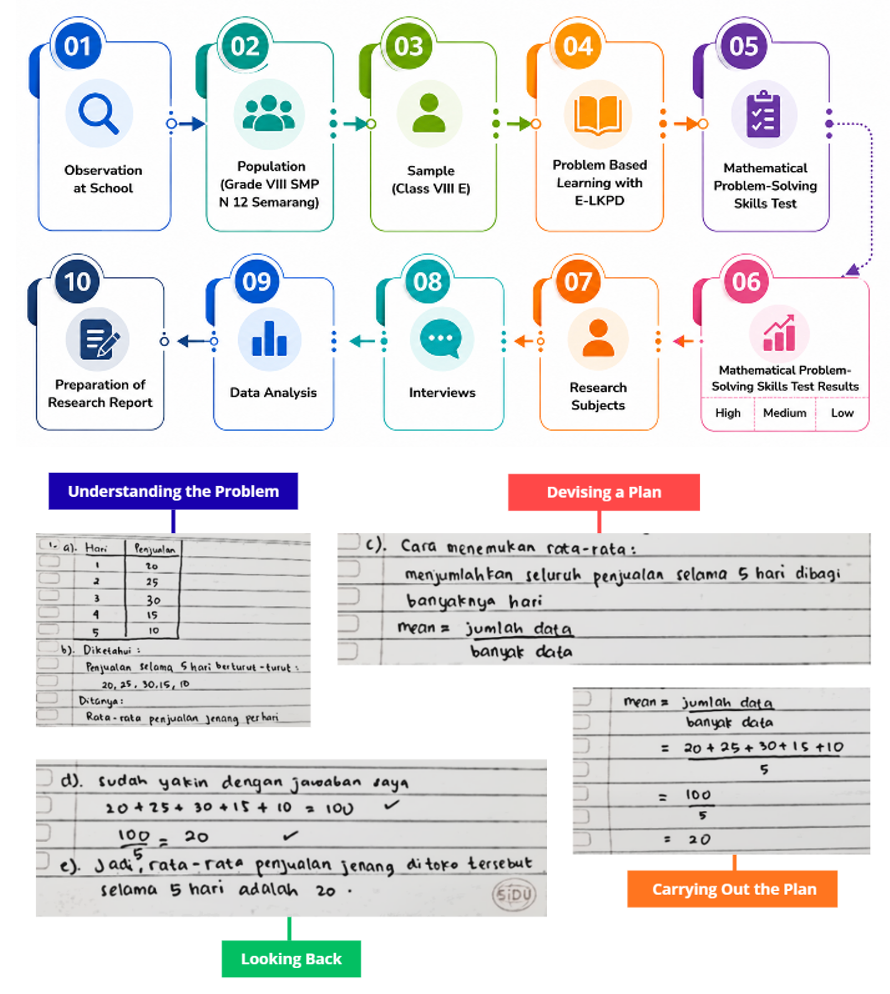
Mathematical problem-solving skills are one of the key competencies that need to be developed in mathematics education because they support students in understanding problems, formulating strategies, carrying out solutions, and evaluating results systematically. However, these skills remain a challenge for students, particularly in mathematics learning involving contextual problems. This study aimed to describe students' mathematical problem-solving skills in statistics using a Problem-Based Learning (PBL) model supported by Electronic Student Worksheets (E-LKPD) based on Polya's problem-solving stages. The study employed a qualitative descriptive case study involving 32 eighth-grade students from Class VIII E at SMP Negeri 12 Semarang who participated in PBL supported by E-LKPD. Based on the mathematical problem-solving test results, three students representing the high, moderate, and low categories were purposively selected as the research subjects. Data were collected through mathematical problem-solving tests and semi-structured interviews and analyzed using the interactive analysis model of Miles, Huberman, and Saldaña, including data reduction, data display, and conclusion drawing and verification. Data credibility was strengthened through method triangulation. The results showed that students in the high category completed all four stages of Polya's problem-solving process. Students in the moderate category completed the stages of understanding the problem, devising a plan, and carrying out the plan but had difficulties in the looking-back stage. Meanwhile, students in the low category were unable to complete all four stages. These findings indicate that students' mathematical problem-solving skills differed across the three categories after participating in PBL supported by E-LKPD. The looking-back stage was the most challenging for students and therefore requires greater attention during the mathematics learning process.
Downloads
References
Afdillah, Izzati, N., & Febrian. (2024). Implementasi Pembelajaran Terdiferensiasi Menggunakan Model PjBL untuk Meningkatkan Kemampuan Pemecahan Masalah Matematis. JKPM: Jurnal Kajian Pendidikan Matematika, 2682(2), 169–178. http://dx.doi.or/10.30998/jkpm.v9i2.22082
Ahmad, M., & Wilkins, S. (2025). Purposive sampling in qualitative research : a framework for the entire journey. Quality & Quantity, 59(2), 1461–1479. https://doi.org/10.1007/s11135-024-02022-5
Anggrayni, U. Y. (2025). Pengaruh Model Problem Based Learning Berbantu LKPD Interaktif terhadap Kemampuan Pemecahan Masalah Matematis Siswa. Jurnal Cendekia: Jurnal Pendidikan Matematika, 09(March), 395–408. https://doi.org/10.31004/cendekia.v9i1.3961
Fauziah, N., Muhtadi, D., & Herawati, L. (2024). Kesulitan Peserta Didik dalam Menyelesaikan Masalah pada Materi Pemusatan Data di SMP. Jurnal Inovasi Pembelajaran Matematika: PowerMathEdu (PME), 03(02), 163–176. https://doi.org/10.31980/pme.v3i2.1464
Fitriyana, D., & Sutirna. (2022). Analisis Kemampuan Pemecahan Masalah Matematis Siswa Kelas VII Pada Materi Himpunan. Jurnal Educatio, 8(2), 512–520. https://doi.org/10.31949/educatio.v8i2.1990
Haeni, P. I. N., & Jatisunda, M. G. (2026). Indonesian Grade 11 Students ’ Conceptual Difficulties with Measures of Central Tendency : An Nvivo-Assisted Qualitative Study of Representativeness , Visualization , and Decision Making. Journal of Advanced Sciences and Mathematics Education, 6(1), 218–237. https://doi.org/10.58524/jasme.v6i1.1072
Handayani, A. P., Paloloang, M. F. B., & Sugita, G. (2026). Meta-Analysis : The Influence Of Contextual Teaching And Learning Approaches On Mathematical Problem-Solving. Prima: Jurnal Pendidikan Matematika, 10(1), 1–19. https://doi.org/10.31000/prima.v10i1.15172
Hasibuan, C. M., Simanungkalit, R. H., & Pangaribuan, F. (2026). Meningkatkan Kemampuan Pemecahan Masalah Matematis Siswa Pada Materi Persamaan Kuadrat Kelas IX. Jurnal Imu Pendidikan Dan Sosial (JIPSI), 50(4). https://doi.org/10.58540/jipsi.v4i4.1167
Hidayah, R. N., & Murti, R. C. (2025). Evaluating Mathematical Problem-Solving Skills in Primary School Students : Challenges and Insights from Polya ’ s Framework. Al-Ishlah: Jurnal Pendidikan, 17, 4984–4993. https://doi.org/10.35445/alishlah.v17i3.6534
Miles, M. B., Huberman, A. M., & Saldaña, J. (2020). Qualitative data analysis: A methods sourcebook (4th ed.). SAGE Publicationsn.
Mtisi, S. (2022). The Qualitative Case Study Research Strategy as Applied on a Rural Enterprise Development Doctoral Research Project. International Journal of Qualitative Methods, 21, 1–13. https://doi.org/10.1177/16094069221145849
NCTM. (2000). Principles and Standards for School Mathematics. National Council of Teachers of Mathematics.
OECD. (2023). Kerangka Kerja Penilaian dan Analisis PISA 2022. OECD Publishing. https://doi.org/10.1787/dfe0bf9c-en
Panjaitan, J., Mathematic, F. O., & Sains, N. (2026). Development Of E-LKPD Based on Problem Learning (PBL) to Improving Students’ Mathematical Problem-Solving Ability On Statistics Material Class VIII Junior High School. Jurnal Theorems (The Original Reasearch Of Mathematics), 11(1), 73–89. https://doi.org/10.31949/th.v11i1.16263
Polya, G. (2014). How to Solve It: A New Aspect of Mathematical Method. Princeton University Pressko.
Rani, T. P., Sutiarso, S., & Firdaus, R. (2024). Integrating problem-based learning in e-lkpd : Enhancing problem-solving ability and adversity quotients. Al-Jabar: Jurnal Pendidikan Matematika, 15(02), 505–519. https://doi.org/10.24042/ajpm.v15i2.23302
Ruslin, Mashuri, S., Rasak, M. S. A., Alhabsyi, F., & Syam, H. (2022). Semi-structured Interview : A Methodological Reflection on the Development of a Qualitative Research Instrument in Educational Studies. IOSR Journal of Research & Method in Education (IOSR-JRME), 12(1), 22–29. https://doi.org/10.9790/7388-1201052229
Setiawati, A., Pertiwi, C. M., & Hidayat, W. (2024). Kemampuan Pemecahan Masalah Matematis, Model Problem Based Learning, Platform Book Creator: Muatan Pembelajaran Inovatif Abad 21 Bagi Siswa SMP. Jurnal Pembelajaran Matematika Inovatif, 7(3), 555–566. https://doi.org/10.22460/jpmi.v7i3.23002
Silalahi, E. D. Y., & Marethi, I. (2026). Systematic Literature Review: Pemanfaatan Geogebra Dalam Model Problem Based Learning Terhadap Kemampuan Pemecahan Masalah Matematis Siswa. Pendas : Jurnal Ilmiah Pendidikan Dasar, 11(2). https://doi.org/10.23969/jp.v11i02.49630
Siswanto, E., & Rahayu, W. (2025). Optimalisasi Kemampuan Pemecahan Masalah Matematika melalui Implementasi Pembelajaran Problem Based Learning ( PBL ): Systematic Literature Review. 09(01), 181–195. https://doi.org/10.35706/sjme.v9i1.185
Wahab, A., Kusuma, Y. S., & Juandi, D. (2024). Jurnal Pendidikan Progresif Understanding Students ’ Struggles in Solving Mathematical Problems : A Systematic Literature Review Using Polya ’ s Framework. Jurnal Pendidikan Progresif, 14(03). https://doi.org/10.23960/jpp.v14.i3.202411
Wulan, D., Rakhmawati, F., & Reflina. (2025). Pengaruh Model Pembelajaran Problem Based Learning Terhadap Kemampuan Pemecahan Masalah Matematika Siswa. Relevan: Jurnal Pendidikan Matematika, 5(2). https://ejournal.yana.or.id/index.php/relevan
Downloads
Published
How to Cite
Issue
Section
License
Copyright (c) 2026 This is an open-access under the CC-BY-SA license

This work is licensed under a Creative Commons Attribution-ShareAlike 4.0 International License.
Education and Talent Development Center of Indonesia (ETDC Indonesia)
e-mail: kognitif@gmail.com, website : https://etdc-indonesia.com

Kognitif: Jurnal Riset HOTS Pendidikan Matematika dengan Situs: https://etdci.org/journal/kognitif berlisensi Creative Commons Attribution-ShareAlike 4.0 International License






.png)