Effect of Using Geogebra-Based Interactive Media on Junior High School Students' Understanding of Geometry Concepts

https://doi.org/10.51574/kognitif.v6i2.5083
Keywords:
Conceptual Understanding, Interactive Media, Geogebra, GeometryAbstract
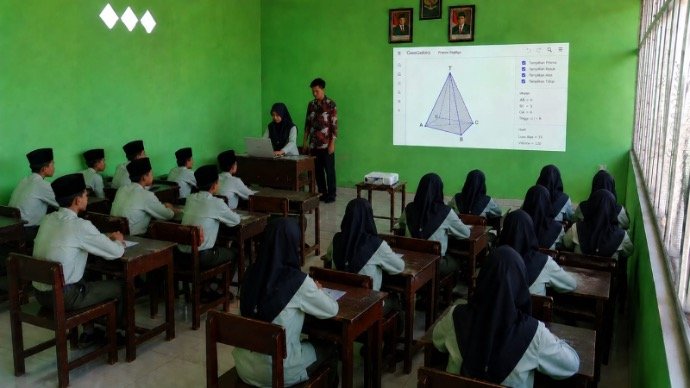
Inovative and engaging learning media are needed to improve students’ participation and conceptual understanding, particularly using GeoGebra-based interactiv media. This research aimed to investigate the effec of GeoGebra-based interactiv media on students understanding of spatial geometry concept. The study employed aaquantitative method using a quasi-experimental approach with a pretest–posttestccontrol group design. The population consisted of allaeighth-grade student of SMPIT Jihadul Muslimin Batu Pengilik, East Lombok, in the 2025/2026 academic year. Samples were selecteduusing a cluster random sampling techniqe, with class VIII A assigned as theeexperimentaligroup and class VIII B assthe control group, each consisting of 20 students. The experimentallgroup received instruction throught GeoGebra-based interactive media, while the control group used PowerPoint media. The research instrument was a validated test of students understanding of spatial geometry concept. Data analysis was conducted using descriptive statistics, the Shapiro–Wilk normality test, Levene’s Test for homogeneity and the Independent Sample t-test with the assistance of SPSS 25. The findings revealed that the experimental group achieved an average posttest score of 83.70, while the control group obtained 75.90. Hypothesis testing produced a significanc value of 0.001 < 0.05, indicating that GeoGebra-based interactive media significantly affected students’ conceptual understanding. In addition, the pretest analysis showed no significan differenc between the two group (Sig. = 0.128 > 0.05), indicating relatively equivalent prior abilities. Effec size analysis using Cohen’s d showed aamoderate effec on the pretest (0.50) and a strong effect on the posttest (1.17). These results demonstrate that GeoGebra-based interactive media effectively improves students’ understanding of spatial geometry concepts through interactive and meaningful learning experiences.
Downloads
References
Ahmad Suhaifi, Rufi'i Rufi'i, and Hari Karyono, The Effect of Using the Geogebra Application on Mathematics Learning Outcomes, Journal of Educational Technology Innovation 8, no. 2 (2022): 220 230 . https://doi.org/10.21831/jitp.v8i2.45080
Anggraeni, E.R, Ma'rufi, M.R, & Suaedi, S. (2021). Development of Geogebra-Based Mathematics Learning Media to Improve Students' Conceptual Understanding. Proximal: Journal of Mathematics Research and Mathematics Education, 4(1), 43-55. https://doi.org/10.30605/proximal.v4i1.503
Arbain, N., & Shukor, N. A. (2015). The Effects of GeoGebra on Students Achievement. Procedia - Social and Behavioral Sciences, 172, 208–214. https://doi.org/10.1016/j.sbspro.2015.01.356.
Asnawi, M.H, & Qohar, M.A, et al. (2025). GeoGebra-based mathematics learning media . Publica Indonesia Utama. .pdf.
Bicer, A., Capraro, R. M., & Capraro, M. M. (2014). The effects of computer-assisted instruction on mathematics achievement in K-12 classrooms. Journal of Educational Technology Systems, 42(4), 331–349. https://doi.org/10.2190/ET.42.4.b
Daryanto . (2021). Learning Media . Yogyakarta: Gava Media .
Fitriani ., & Kurniawan . (2022). The Influence of GeoGebra on Junior High School Students' Understanding of Geometry Concepts. Indonesian Journal of Mathematics Education , 7(1), 55–63. https://doi.org/10.62872/aej.v2i2.23
Hohenwarter, M., & Preiner, J. (2007). Dynamic mathematics with GeoGebra. Journal of Online Mathematics and Its Applications, 7. https://doi.org/10.13140/RG.2.2.10167.09129
Julita, Lalu Sucipto, and Ahmad Nasrullah. The Effectiveness of Using Geogebra Media Reviewed from Students' Mathematical Concept Understanding on 3-Dimensional Material. Journal of Math Tadris 2, no. 1 (2022): 19–28. https://doi.org/10.55099/jurmat.v2i1.38.
Kilpatrick, J., Swafford, J., & Findell, B. (2001). Adding It Up: Helping Children Learn Mathematics. Washington, DC: National Academy Press. https://doi.org/10.17226/9822
Kutluca, T. (2013). The effect of geometry instruction with dynamic geometry software GeoGebra on geometry achievement of students. Educational Research and Reviews, 8(9), 400–407. https://doi.org/10.5897/ERR11.145
Lubis, T. A. (2024). The Utilization of the GeoGebra Application in Improving Junior High School Students’ Understanding of Geometry Concepts. Aksioma Education Journal https://doi.org/10.62872/aej.v2i2.23
Mawardi, G., Iriani, T., & Daryati, D. (2019). Pengembangan Media Pembelajaran Berbasis Multimedia pada Mata Kuliah Kompetensi Pembelajaran Pokok Materi Keterampilan Dasar Mengajar. Jurnal Pensil: Pendidikan Teknik Sipil, 8(1), 24–30. https://doi.org/10.21009/jpensil.v8i1.8485
Ministry of Education, Culture, Research, and Technology. (2021). Results of the Minimum Competency Assessment (AKM) and Character Survey for Junior High School Level in 2021. Center for Assessment and Learning, Research and Development and Books. https://pusmendik.kemdikbud.go.id/publikasi/hasil-akm-smp-2021.
Nasrulloh, M., & Sugandi, A.I (2023). Development of teaching materials for three-dimensional geometry using a scientific approach assisted by GeoGebra. JPMI (Journal of Innovative Mathematics Learning) , 6 (4), 1747–1756. https://doi.org/10.22460/jpmi.v6i4.18051.
Nuril Huda et al., “The Effectiveness of Geogebra Application on Students’ Mathematical Critical Thinking Skills,” Journal on Education 5, no. 4 (2023): 13307–14, https://doi.org/10.31004/joe.v5i4.2331.
OECD 2023. (2022). PISA 2022 Results Malaysia. Journal of Education , 10. https://www.oecd.org/publication/pisa-2022-results/country-notes/malaysia-1dbe2061/DOI: https://doi.org/10.1787/53f23881-en
Octaviani, K. D., Indrawatiningsih, N., & Afifah, A. (2021). Kemampuan Visualisasi Spasial Siswa Dalam Memecahkan Masalah Geometri Bangun Ruang Sisi Datar. International Journal of Progressive Mathematics Education, 1(1), 27–40. https://doi.org/10.22236/ijopme.v1i1.6583
Putri, E.Y, Khairunnisa, & Nurhayati, N. (2023). The Effect of GeoGebra Media on Student Learning Outcomes in Coordinate System Material. Journal of Mathematics Education, 8 (1), 45–52. https://ejournal.unp.ac.id/index.php/jpm/article/view/120155 .
Putri, F. P., & Pasaribu, R. L. (2025). Kajian Literatur Sistematis: Efektivitas Penggunaan GeoGebra sebagai Media Visualisasi Interaktif terhadap Pemahaman Konsep Bangun Ruang. Buana Matematika. https://doi.org/10.36456/buanamatematika.v15i2.11009
Rahmatudin, J., & Serlina, S. (2024). The Effectiveness of Computer Assisted Instruction (CAI) Supported by GeoGebra in Enhancing Students' Mathematical Representation Ability. … in Mathematics Education , 27–37. https://ejournal.papanda.org/index.php/ijarme/article/view/2276%0A
Retta, A.M, & Fitriasari, P. (2022). Development of Geogebra-Assisted Student Worksheets on Three-Dimensional Material for High School Students. AKSIOMA: Journal of Mathematics Education Study Program , 11 (2), 819. https://doi.org/10.24127/ajpm.v11i2.4249.
Salim, M. (2022). Improving the Activeness and Mathematics Learning Outcomes of 8th Grade Students of Mts Negeri 1 Pati Through Learning with Geogebra Media. JIEBAR: Journal of Islamic Education: Basic and Applied Research , 3 (1), 64–85. https://doi.org/10.33853/jiebar.v3i1.264.
Sugiyono, (2019) Qualitative Quantitative Research Methods and R&D , Bandung: Alfabeta.
Susanto . (2022). Learning and Teaching Theory in Schools . Jakarta: Prenadamedia Group.
Tatar, E. (2013). The effect of dynamic software on prospective mathematics teachers’ perceptions regarding plane geometry. Educational Sciences: Theory & Practice, 13(1), 381–392. https://doi.org/10.12738/estp.2013.1.1306
Yasifati Hia, & Nainggolan, E.K.B (2023). Development of GeoGebra Interactive Learning Media in Spatial Ability to Build Flat Side Spaces of Cubes and Beams at SMPN 1 Sunggal. Jurnal Ilmiah Pendidikan Holistik (JIPH) , 2 (1), 29–54. https://doi.org/10.55927/jiph.v2i1.2801.
Zengin, Y., Furkan, H., & Kutluca, T. (2012). The Effect of Dynamic Mathematics Software GeoGebra on Student Achievement in Teaching of Trigonometry. Procedia - Social and Behavioral Sciences, 31, 183–187. https://doi.org/10.1016/j.sbspro.2011.12.038.
Downloads
Published
How to Cite
Issue
Section
License
Copyright (c) 2026 This is an open-access under the CC-BY-SA license

This work is licensed under a Creative Commons Attribution-ShareAlike 4.0 International License.
Education and Talent Development Center of Indonesia (ETDC Indonesia)
e-mail: kognitif@gmail.com, website : https://etdc-indonesia.com

Kognitif: Jurnal Riset HOTS Pendidikan Matematika dengan Situs: https://etdci.org/journal/kognitif berlisensi Creative Commons Attribution-ShareAlike 4.0 International License






.png)