Students’ Understanding of Algebraic Concepts and High Self-Efficacy: A Case Study in Junior High School

https://doi.org/10.51574/kognitif.v6i3.4948
Keywords:
Algebraic Thinking, Conceptual Understanding, Junior High School Mathematics, Qualitative Case Study, Self-EfficacyAbstract
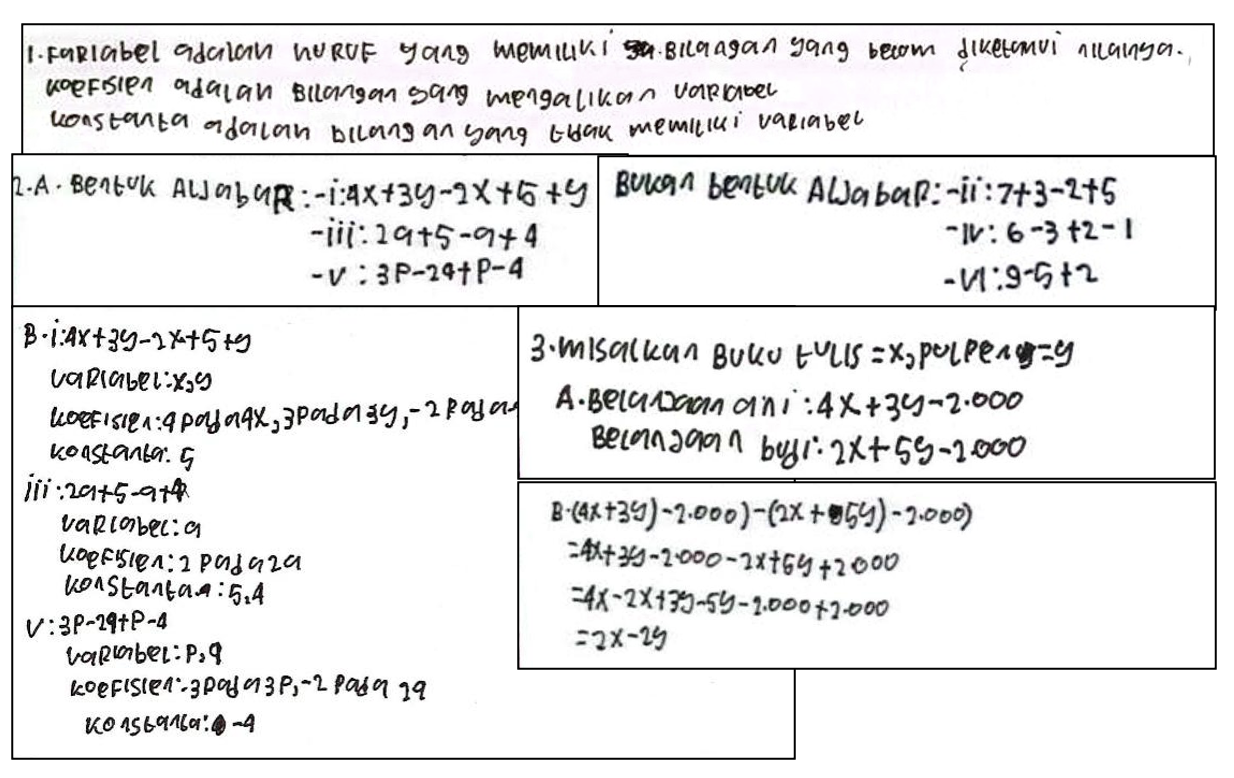
Research on self-efficacy in mathematics learning has thus far focused primarily on students with low self-efficacy or those experiencing learning difficulties; consequently, the conceptual understanding profiles of students with high self-efficacy particularly regarding algebraic concepts at the junior high school level remain largely unexplored. This study aims to describe the mathematical conceptual understanding of students categorized as having high self-efficacy in algebraic expressions. The study employed a qualitative case study approach with a single seventh-grade student who had the highest self-efficacy score as the sole subject, selected purposively based on the results of a validated self-efficacy questionnaire and teacher recommendations. Data were collected through a conceptual understanding test and in-depth interviews, analyzed using Miles’ procedures for data condensation, data presentation, and data verification, with data validity ensured through methodological triangulation. The results showed that the subject consistently met all seven indicators of mathematical concept understanding, as reflected in his ability to reconstruct the meaning of concepts in his own words, logically analyze the necessary conditions of an algebraic expression, translate real-world contexts into algebraic models, and explain the reasoning behind each step in solving algebraic subtraction problems. The results showed that the subject consistently met all seven indicators of mathematical concept understanding, as reflected in his ability to reconstruct the meaning of concepts in his own words, logically analyze the necessary conditions of an algebraic expression, translate real-world contexts into algebraic models, and explain the reasoning behind each step in solving algebraic subtraction problems. These findings suggest that high self-efficacy serves as a cognitive resource that supports coherent and self-regulated conceptual reasoning, providing an initial profile that can serve as a basis for comparative studies across levels of self-efficacy.
Downloads
References
Bandura, A. (1997). Self-Efficacy: The Exercise of Control.
Bandura, A. (2012). On the Functional Properties of Perceived Self-Efficacy Revisited. Journal of Management, 38(1), 9–44. https://doi.org/10.1177/0149206311410606
Creswell, J. W., & Poth, C. N. (2018). Qualitative inquiry and research design: Choosing among five approaches (4th ed.). SAGE Publications. https://www.sagepub.com/shop/buy-a-book/qualitative-inquiry-and-research-design-5-266033
Fajar, A. P., Kodirun, K., Suhar, S., & Arapu, L. (2019). Analisis Kemampuan Pemahaman Konsep Matematis Siswa Kelas VIII SMP Negeri 17 Kendari. Jurnal Pendidikan Matematika, 9(2), 229. https://doi.org/10.36709/jpm.v9i2.5872
Fitri, I. (2017). Peningkatan Self-Efficacy terhadap Matematika dengan Menggunakan Modul Matematika Kelas VIII SMP Negeri 2 Bangkinang. Journal Cendekia: Jurnal Pendidikan Matematika Volume, 1(2), 25–34. https://doi.org/10.31004/cendekia.v1i2.17
Giawa, L., Gee, E., & Harefa, D. (2022). Analisis Kemampuan Pemahaman Konsep Matematis Siswa Pada Materi Bentuk Pangkat Dan Akar Di Kelas XI SMA Negeri 1 Ulususua Tahunpembelajaran 2021/2022. AFORE: Jurnal Pendidikan Matematika, Vol 1(1). https://jurnal.uniraya.ac.id/index.php/Afore/article/view/437/366
Halim, S. N. H., A, S. A. A., & Mahmud, R. S. (2023). Pengaruh kecerdasan logis-matematis dan efikasi diri terhadap hasil belajar matematika siswa kelas VII SMP Negeri 3 Sungguminasa. AKSIOMA: Jurnal Pendidikan Matematika, 12(2). https://doi.org/10.22487/aksioma.v12i2.4332
Hanifa, U. N., Suhendra, S., & Jauhari, muhammad fakhri. (2023). Probing-Prompting Learning: Its Effect On Improving Conceptual Understanding In Mathematics. Kalamatika: jurnal pendidikan Matematika, 8(2), 205–218. https://doi.org/10.22236/KALAMATIKA.vol8no2.2023pp207-220
Hendriana, H. (2017). Hard Skills dan Soft Skills Matematik Siswa (N. F. Atif (ed.); 2nd ed.). PT Refika Aditama.
Herawati, E., & Kadarisma, G. (2021). Analisis Kesulitan Siswa Smp Kelas Vii Dalam Menyelesaikan Soal Operasi Aljabar. JPMI (Jurnal Pembelajaran Matematika Inovatif), 4(2). https://doi.org/10.22460/jpmi.v4i2.p%25p
Isfayani, E. (2023). Analisis Kesulitan Belajar Matematika Materi Bentuk Aljabar Pada Siswa Kelas VII. Jurnal Pendidikan Matematika Malikussaleh, Volume 3(1), 31–05. https://doi.org/10.29103/jpmm.v3i1.11177
Jupri, A., Drijvers, P., & Heuvel-Panhuizen, M. van den. (2014). Difficulties in initial algebra learning in indonesia. Math Ed Res J. https://link.springer.com/article/10.1007/s13394-013-0097-0
Marni, & Pasaribu, L. H. (2021). Peningkatan Kemampuan Berpikir Kreatif dan Kemandirian Siswa Melalui Pembelajaran Matematika Realistik. Jurnal Cendekia : Jurnal Pendidikan Matematika, 05(3), 1902–1910. https://doi.org/10.36987/jes.v9i3.3433
Miles, M. B., Huberman, A. M., & Saldana, J. (2014). Qualitative Data Analysis.
Nurani, M., Riyadi, R., & Subanti, S. (2021). Profil Pemahaman Konsep Matematika Ditinjau Dari Self Efficacy. AKSIOMA: Jurnal Program Studi Pendidikan Matematika, 10(1), 284–292. https://doi.org/10.24127/ajpm.v10i1.3388
Piaget, J., & Inhelder, B. (1972). The Psychology of the Child.
Pratiwi, A. F., & Imami, A. I. (2022). Analisis self-efficacydalam pembelajaran matematika pada siswa smp. AKSIOMA: Jurnal Matematika dan Pendidikan Matematika, 13(3). https://journal.upgris.ac.id/index.php/aksioma/article/view/13973
Rahmi, Febriana, R., & Putri, G. E. (2020). Pengaruh Self-Efficacy terhadap Pemahaman Konsep Matematika Siswa Pada Pembelajaran Model Discovery Learning. Jurnal Pendidikan Matematika, 10(1), 27–34. https://online-journal.unja.ac.id/edumatica/article/view/8733
Sardin, Kusumah, yaya sukjaya, & Martadiputra, B. A. P. (2025). Membangun Percaya Diri Siswa dalam Matematika: Tinjauan Sistematis Model Pembelajaran untuk Meningkatkan Self-Efficacy. Juring (Journal For Research in Mathematics Learning), 8(1), 085–098. http://dx.doi.org/10.24014/juring.v8i1.35431
Sihombing, S., Silalahi, H. R., Sitinjak, J. R., & Tambunan, H. (2021). Analisis Minat dan Motivasi Belajar, Pemahaman Konsep dan Kreativitas Siswa Terhadap Hasil Belajar Selama Pembelajaran dalam Jaringan. pendidikan matematika : Judika Education, 4, 41–55. https://doi.org/10.31539/judika.v4i1.2061
Skemp, R. (1976). Relational understanding and instrumental understanding mathematics teaching.
Sugiyono. (2019a). Memahami Penelitian Kualitatif: Dilengkapi Contoh Proposal dan Laporan Penelitian.
Sugiyono. (2019b). Metode Penelitian Kuantitatif, Kualitatif dan R&D.
Utami, R. W., & Wutsqa, D. U. (2017). Analisis Kemampuan Pemecahan Masalah Matematika dan Self-Efficacy Siswa SMP Negeri di Kabupaten Ciamis. Jurnal Riset Pendidikan Matematika, 4(2), 166–175. https://scholarhub.uny.ac.id/jrpm/vol4/iss2/5/
Wirdania, W., Pathuddin, P., Lefrida, R., & Alfisyahra, A. (2024). Profil Pemahaman Konsep Matematika Siswa dalam Menyelesaikan Soal Persamaan Garis Lurus Ditinjau dari Self Efficacy. Jurnal Pendidikan Matematika (JUDIKA EDUCATION), 7(1), 9–18. https://doi.org/10.31539/judika.v7i1.9414
Downloads
Published
How to Cite
Issue
Section
License
Copyright (c) 2026 This is an open-access under the CC-BY-SA license

This work is licensed under a Creative Commons Attribution-ShareAlike 4.0 International License.
Education and Talent Development Center of Indonesia (ETDC Indonesia)
e-mail: kognitif@gmail.com, website : https://etdc-indonesia.com

Kognitif: Jurnal Riset HOTS Pendidikan Matematika dengan Situs: https://etdci.org/journal/kognitif berlisensi Creative Commons Attribution-ShareAlike 4.0 International License






.png)