
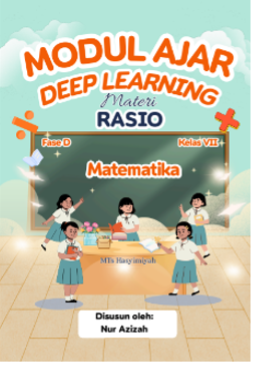
Development of a Teaching Module on the Deep Learning Approach to Ratios

https://doi.org/10.51574/kognitif.v6i3.4814
Keywords:
Deep Learning Approach, Junior High School , Ratio, Teaching ModuleAbstract
Teaching ratios at the junior high school level often poses a challenge for students who need a deep conceptual understanding to distinguish between direct and inverse proportions through real world contexts. Therefore, this study aims to produce a valid, practical, and effective Deep Learning based instructional module on ratios. The research method employed a Research and Development (R&D) approach using the 4D development model, which includes the Define, Design, Develop, and Disseminate stages, involving 25 students from MTs Hasyimiyah Bungah Gresik. The instruments used included an expert validation sheet, a teacher response questionnaire, a student response questionnaire, and a summative assessment. Based on the research results, the developed teaching module meets the criteria for validity, practicality, and effectiveness. The validation test results met the validity criteria, with an average score of 3.94 from two validators, falling into the highly valid category. Furthermore, the practicality test results met the practicality criteria, with an average score of 3,92 from the teacher response questionnaire and an average score of 3,90 from the student response questionnaire thus, the combined average score of 3,91 from both questionnaires falls into the highly practical category. Meanwhile, regarding the effectiveness test results, the module met the effectiveness criteria with an average score of 83,2 on the summative assessment test, placing it in the highly effective category. Therefore, the teaching module using the Deep Learning approach can be implemented and is recommended to teachers to stimulate conceptual understanding and enhance student engagement through more meaningful learning in the instructional process. The novelty of this study lies in the development of a ratio module that integrates Deep Learning (Mindful, Meaningful, and Joyful) in accordance with the Merdeka Curriculum, which transforms procedural learning into a deep mastery of concepts. Additionally, previous research has not extensively explored the Deep Learning approach to ratio material.
Downloads
References
Adawiyah, L., Pasani, C. F., & Kamaliya. (2024). Pengembangan Modul Ajar Matematika E-Komik Berbasis Pendidikan Karakter di Sekolah Menengah Pertama Pada Materi Rasio. Jurnal Mahasiswa Pendidikan Matematika. 4(2), 1-11. https://doi.org/10.20527/jurmadikta.v4i2.247
Agustin, M. (2026). Implementasi Pendekatan Deep Learning untuk Meningkatkan Kualitas Hasil Belajar Siswa SMA. Al-Irsyad Journal of Mathematics Education, 5(1), 375–386. https://doi.org/10.58917/ijme.v5i1.651
Akbar, M., Azmidar, A., Buhaerah, & Ahsan, M. (2026). Peningkatan Kemampuan Berfikir Kritis Siswa Menggunakan Metode Deep Learning pada Pembelajaran Matematika di SMP. https://doi.org/10.54371/jiip.v9i2.10576
Berliana, C. (2024). Pengembangan Lembar Kerja Peserta Didik (LKPD) Materi Perbandingan Dengan Kemampuan Pemecahan Masalah Matematika Kelas VII. Institut Agama Islam Negeri (IAIN) Metro.
BSKAP Kemendikbudristek. (2023). Panduan Pembelajaran dan Asesmen. Badan Standar, Kurikulum, dan Asesmen Pendidikan, Kemendikbudristek. Jakarta
Effendi, Effendi, R., Herpratiwi, H., & Sutiarso, S. (2021). Pengembangan LKPD Matematika Berbasis Problem Based Learning di Sekolah Dasar. Jurnal Basicedu, 5(2), 920–929. https://doi.org/10.31004/basicedu.v5i2.846
Fatria, E., Apriyanti, A., & Priadi, A. (2026). Deep Learning: Sebuah Strategi Pembelajaran Inovatif Dalam Kurikulum Nasional. Jurnal Pendidikan Sultan Agung. 6(1), 1-17. https://doi.org/10.30659/jp-sa.6.1.1-17
Ferdianto, F., & Setiyani. (2018). Pengembangan Bahan Ajar Media Pembelajaran Berbasis Kearifan Lokal Mahasiswa Pendidikan Matematika. JNPM (Jurnal Nasional Pendidikan Matematika), 2 (1), 37–47. https://doi.org/10.33603/jnpm.v2i1.781
Fitriani., Ramdhayani, E., & Lestari, I. D. (2019). Analisis Kesulitan Guru Dalam Implementasi Kurikulum 2013 Pada Sekolah Dasar di Kecamatan Sumbawa Tahun 2018. Jurnal Kependidikan, 4 (1), 57– 61. https://www.e-journallppmunsa.ac.id/index.php/kependidikan/index
Hanifah, N., Pendidikan, U., & Kampus, I. (2025). Pendekatan Deep Learning: Peluang dan Tantangan dalam Pembelajaran. 6.
Johnson, S., Lavergne, V., Skinner, A. M., Gonzales Luna, A. J., Garey, K. W., Kelly, C. P., & Wilcox, M. H. (2021). Clinical practice guideline by the Infectious Diseases Society of America (IDSA) and Society for Healthcare Epidemiology of America (SHEA): 2021 focused update guidelines on management of Clostridioides difficile infection in adults. Clinical Infectious Diseases. IDSA: Infectious Diseases Society of America. 73(5), 1029-1044. https://doi.org/10.1093/cid/ciab549
Kemendikdasmen. (2025). Naskah Akademik Pembelajaran Mendalam Menuju Pendidikan Bermutu Untuk Semua. Pusat Kurikulum dan Pembelajaran Badan Standar, Kurikulum, dan Asesmen Pendidikan Kementerian Pendidikan Dasar dan Menengah Republik Indonesia. Jakarta.
Marjohan, M., Aulia, D. D., Maulidi, R. P., & Nulhakim, L. (2022). Penerapan Kurikulum Di Sekolah Dasar. Jurnal Pendidikan Dan Konseling (JPDK), 4(6), 10776–10780. https://doi.org/10.31004/jpdk.v4i6.10132
Maydiantoro, A. (2021). Model-Model Penelitian Pengembangan (Research and Development). Jurnal Pengembangan Profesi Pendidik Indonesia (JPPPI).
http://repository.lppm.unila.ac.id/id/eprint/34333
Nasution, A. (2016). Pengembangan Modul Matematika Berbasis Masalah Untuk Meningkatkan Kemampuan Pemecahan Masalah Matematika Siswa. Jurnal Pendidikan dan Kependidikan. 1(1), 47-63. https://doi.org/10.31227/osf.io/ftyu6
Nasution, A. (2018). Pengembangan Modul Matematika Berbasis Masalah Untuk Meningkatkan Kemampuan Pemecahan Masalah Matematika Siswa INA-Rxiv, 164–175. https://doi.org/10.31227/osf.io/ftyu6
Nengsih, D., Febriana, W., Maifalinda., Junaidi., Darmansyah., & Demina. (2024). Pengembangan Modul Ajar Kurikulum Merdeka. Jurnal Manajemen Pendidikan dan Pelatihan. 8(1), 150-158. https://doi.org/10.32923/jmpp.v8i1.4116
Nisa', R., Nalurita, I. V., Jamaluddin, M., & Nuriyah, A. (2025). Pengembangan Bahan Ajar Mata Kuliah Teori Pembelajaran Matematika Untuk meningkatkan Kemandirian Belajar. AKSIOMA: Jurnal Program Studi Pendidikan Matematika, 14(4), 1529–1540. http://dx.doi.org/10.24127/ajpm.v14i4.14213
Nurhasanah, S. (2025). Analisis Problematika Guru dalam Penerapan Kurikulum Merdeka Belajar pada Pembelajaran Matematika SMP Negeri 1 Banjarharjo. Universitas Islam Negeri Profesor Kiai Haji Saifuddin Zuhri Purwokerto.
Permendikbudristek. (2022). Peraturan Menteri Pendidikan Kebudayaan Riset dan Teknologi Tentang Standar Proses Pada Pendidikan Usia Dini, Jenjang Pendidikan Dasar dan Jenjang Pendidikan Menengah. Peraturan Menteri Pendidikan Dan Kebudayaan Republik Indonesia Nomor 16 Tahun 2022 Tentang Standar Proses Pendidikan Dasar Dan Menengah, 1(69), 5–24.
Putra, L. V., & Rizqi, H. Y. (2024). Pendampingan Pembuatan Modul Ajar Berbasis Deep Learning Untuk Meningkatkan Kompetensi Pedagogik Guru Sekolah Dasar. 3, 55–64. http://e-abdimas.unw.ac.id/index.php/jfkp
Putri, R., Ardhiansyah, S. S., Kurniac, H., Sari, M.I., Putri, M.F.J.L. (2022). Penerapan Deep Learning dalam Pendidikan di Indonesia. Prosiding Seminar Nasional Pendidikan Pancasila Dan Kewarganegaraan Universitas Pamulung. 2, 97-102.. https://doi.org/10.32493/psn.v2i1.26189
Rahma, A., & Y Kurniawati. (2024). Pengaruh Model Pembelajaran Problem Based Learning (PBL) terhadap pemahaman konsep matematika siswa. PHI: Jurnal Pendidikan Matematika, 8 (2), 301-308. https://doi.org/10.37631/phi.v8i2.403
Saryanto, T. (2019). Problematika Siswa SMP Dalam Mempelajari Perbandingan Dua Besaran Dan Alternatif Penyelesaiannya. Journal of Mathematics and Mathematics Education. 9 (1), 2715-8276.
Solahuddin, W. (2024). Penerapan Deep Learning Dalam Pendidikan di Indonesia: Tantangan dan Peluang Implementasi Teknologi Pendidikan. Jurnal Ilmu Pendidikan. 1(1), 48-55. https://doi.org/10.65094/ypdnj013
Sugiyono, P. D. (2019). Metode Penelitian Kuantitatif (MP Setiyawwami, SH. ALFABETA, Cv).
Toha, M., Mirza, A., & Ahmad, D. (2018). Analisis Kesalahan Siswa dalam Menyelesaikan Soal Cerita Materi Perbandingan di Kelas VII SMP. Jurnal Pendidikan dan Pembelajaran Khatulistiwa. 7(1), 1–11. https://doi.org/10.26418/jppk.v7i1.23626
Wibowo, A. H. W. (2017). Pengembangan Media Menipulatif Graphmetri Model Pembelajaran Direct Instruction Untuk Meningkatkan Kemampuan Representasi Matematis Peserta Didik Pada Materi Grafik Fungsi Trigonometri. Universitas Negeri Malang.
Downloads
Published
How to Cite
Issue
Section
License
Copyright (c) 2026 This is an open-access under the CC-BY-SA license

This work is licensed under a Creative Commons Attribution-ShareAlike 4.0 International License.
Education and Talent Development Center of Indonesia (ETDC Indonesia)
e-mail: kognitif@gmail.com, website : https://etdc-indonesia.com

Kognitif: Jurnal Riset HOTS Pendidikan Matematika dengan Situs: https://etdci.org/journal/kognitif berlisensi Creative Commons Attribution-ShareAlike 4.0 International License






.png)


