Comparison of Teaching Content on Inequalities between China and Indonesia

https://doi.org/10.51574/kognitif.v5i4.4253
Keywords:
Teaching Content, Inequality Subject, Mathematics Textbook, People's Education Press, Kurikulum MerdekaAbstract
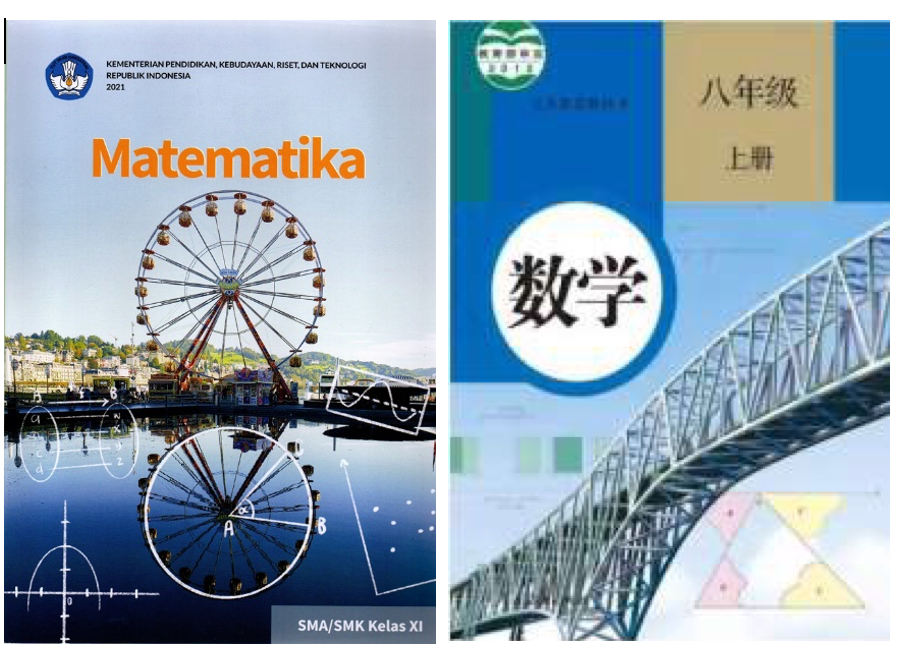
In this study, we select inequality content from a set of Indonesian instructional materials and compare it with the corresponding inequality content in the People’s Education Press (PEP) textbooks. The comparison is significant because the two education systems represent distinct pedagogical approaches that differ historically, culturally, and epistemologically. Moreover, they are grounded in contrasting educational philosophies. PEP follows a Chinese tradition emphasizing formal structure, systematic practice, and deductive reasoning that moves from worked examples to general rules. In contrast, the Indonesian Kurikulum Merdeka is rooted in Freudenthal’s Realistic Mathematics Education (RME), which encourages contextual modeling and meaning-making prior to the introduction of formal symbols. By comparing the topic of inequalities—an abstract concept with specific operational rules (such as reversing the inequality sign when multiplied by a negative number)—we can observe how these approaches lead to different learning experiences. Do students discover rules through structured exploration, or are they expected to apply rules within real-world contexts after the concepts are presumed to be understood? In Indonesia, inequalities are taught primarily in Grade 11 of senior high school, under the assumption that students already possess a mature level of abstract reasoning. In China, however, inequality-related content is distributed across multiple stages of elementary and secondary schooling. Both countries have undergone substantial curriculum reforms aimed at improving mathematical proficiency and educational equity, yet their textbooks continue to reflect distinct pedagogical philosophies and cultural priorities. By examining the differences across these dimensions, we hope to provide useful insights for the teaching of inequality-related content
Downloads
References
Ayu, L. K., & Wijaya, A. (2022, December). Comparison of Indonesia and Singapore middle school mathematics material mapping. In AIP Conference Proceedings (Vol. 2575, No. 1, p. 050019). AIP Publishing LLC. https://doi.org/10.1063/5.0110834
Bao. J. (2002) A comparison of the overall difficulty of the expected mathematics curriculum in junior high schools in China and the UK. Global Education Outlook, 2002(9): 48-52. https://doi.org/10.1007/978-981-97-8426-4_38
Cao, Y., & Wu, L. (2021). An International Comparative Study on Exercise Questions in Middle School Mathematics Textbooks. In School Mathematics Textbooks in China: Comparative Studies and Beyond (pp. 347–373). https://doi.org/10.1142/9753
Chang, C. C., & Silalahi, S. M. (2017). A review and content analysis of mathematics textbooks in educational research. Problems of Education in the 21st Century, 75(3), 235. https://doi.org/10.33225/pec/17.75.235
Ding, M. (2016). Opportunities to learn: Inverse relations in US and Chinese textbooks. Mathematical Thinking and Learning, 18(1), 45–68. https://doi.org/10.1080/10986065.2016.1107819
Greer, B., Mukhopadhyay, S., Powell, A. B., & Nelson-Barber, S. (Eds.). (2009). Culturally Responsive Mathematics Education: Studies in Mathematical Thinking and Learning. Routledge. https://doi.org/10.4324/9780203879948
Guo, X. (2024). A comparative philosophical analysis of primary mathematics curricula between the mainland of China and England in the United Kingdom. (Unpublished doctoral dissertation). University of Wolverhampton. http://hdl.handle.net/2436/625752
Huang, Y., Zhou, Y., Wijaya, T. T., Kuang, K., & Zhao, M. (2021, November). A comparative analysis on algebraic questions in Chinese and Indonesian textbook. In Journal of Physics: Conference Series (Vol. 2084, No. 1, p. 012024). IOP Publishing.
Jiang, Q., Xu, H., Wang, F., Zhang, C., Lyv, J., & Wu, W. (2025). Multidimensional poverty among middle-school children from rural China: The impact of teacher support. Children and Youth Services Review, 108622. https://doi.org/10.1016/j.childyouth.2025.108622
Lei, J. C., Chen, Z., & Ko, J. (2023). Differences in perceived instructional quality of the same classrooms with two different classroom observation instruments in China: Lessons learned from qualitative analysis of four lessons using TEACH and ICALT. In Effective teaching around the world: Theoretical, empirical, methodological and practical insights (pp. 137–163). Springer. https://doi.org/10.1007/978-3-031-31678-4_7
Li, J., & Wu, H. (2023). Urban–Rural Disparities Influence Educational Equity in China. In R. B. B. M. Hussain et al. (Eds.), ICHSSR 2023 (pp. 148–154). Atlantis Press. https://doi.org/10.2991/978-2-38476-092-3_22
Li, Z. (2009). Disparity between Rural and Urban Education in China. CORE.
Liang¹, S., Lyu, Y., & Zhi, Y. (2022, December). Comparison of the Content of Chinese. In Proceedings of the 2022 International Conference on Science Education and Art Appreciation (SEAA 2022) (Vol. 675, p. 147). Springer Nature. https://doi.org/10.2991/978-2-494069-05-3_19
Liu, Y., & Shen, W. (2020). Does Higher Education Have a Civic Bonus? Exploring the Role of Higher Education in the Formation of Social Attitudes in Contemporary China. ACADEMIA: the Higher Education Policy Network. , 2020(18), 145-166. https://doi.org/10.26220/aca.3215
Lutfiana, D. (2022). Penerapan Kurikulum Merdeka dalam Pembelajaran Matematika di SMK Diponegoro Banyuputih. VOCATIONAL: Jurnal Inovasi Pendidikan Kejuruan, 2(4), 313–330. https://doi.org/10.51878/vocational.v2i4.1752
Nurhayati, A., Raharja, S. P., & Pamungkas, D. (2025). Implementasi Kurikulum Merdeka Belajar ditinjau dari Pembelajaran Matematika di SMP Negeri 8 Kabupaten Sorong. JPPI. https://doi.org/10.30605/proximal.v5i2.2752
Peng, A., & Song, N. (2014). The Status Quo and Development of Mathematics Education for Ethnic Minorities in China. Studies in Ethnicity and Nationalism, 14(1), 171–187. https://doi.org/10.1111.sena.12083
Peng, W. J., McNess, E., Thomas, S., Wu, X. R., Zhang, C., Li, J. Z., & Tian, H. S. (2014). Emerging perceptions of teacher quality and teacher development in China. International Journal of Educational Development, 34, 77–89. https://doi.org/10.1016/j.ijedudev.2013.04.005
Purnomo, Y. W., Fatima, Y. M., Amiroh, A., Mawaddah, F., Prananto, I. W., & Firdaus, F. M. (2023). Comparative Study of Elementary School Mathematics Textbooks between Singapore and Indonesia: The Case of Fractions. Acta Scientiae, 25(4), 284–313. https://doi.org/10.17648/acta.scientiae.7446
Qin, L. (2019). A Comparative Study of the Difficulty of Statistical Exercises in High School Mathematics Textbooks in Mainland China, Japan and Taiwan. Journal of Mathematics Education, 28(1), 55–60. https://doi.org/10.9734/jamcs/2025/v40i21973
Rohmah, I. N., & Jupri, A. (2024). The effectiveness of mathematics learning through a realistic mathematics education approach in elementary schools. Jurnal Cakrawala Pendas, 10(3), 500–511. https://doi.org/10.2991/978-2-38476-414-3_16
Rohmatulloh, R. (2023). Pembelajaran Matematika pada Era Merdeka Belajar. Histogram: Jurnal Matematika dan Pendidikan Matematika, 1(1), 1–14.
https://doi.org/10.30605/proximal.v5i2.2752
Son, J. W., & Hu, Q. (2016). The initial treatment of the concept of function in the selected secondary school mathematics textbooks in the US and China. International Journal of Mathematical Education in Science and Technology, 47(4), 505–530. https://doi.org/10.1080/0020739X.2015.1088084
Sulistyaningrum, E., & Tjahjadi, A. M. (2022). Income Inequality in Indonesia: Which Aspects Cause the Most? https://doi.org/10.22146/jieb.v37i3.2015
Trung, N. T., Thao, T. P., & Trung, T. (2019, October). Realistic mathematics education (RME) and didactical situations in mathematics (DSM) in the context of education reform in Vietnam. In Journal of Physics: Conference Series (Vol. 1340, No. 1, p. 012032). IOP Publishing. https://doi.org/10.1088/1742-6596/1340/1/012032
Wang, J., & Cao, Y. (2015). Statistics in Junior High Schools Textbooks: A Comparative Study Between People’s Republic of China, the United States and Australia. Journal of Mathematics Education, 8(1), 30–36. https://doi.org/10.9734/ajess/2025/v51i21779
Wang, J., Lu, X. Selection of content in high school mathematics textbooks: an international comparison. ZDM Mathematics Education 50, 813–826 (2018). https://doi.org/10.1007/s11858-018-0977-6
Wang, L., Liu, Q., Du, X., & Liu, J. (2017). Chinese Mathematics Curriculum Reform in the 21st Century: A Review. Eurasia Journal of Mathematics, Science and Technology Education, 13(7), 5211–5226. https://doi.org/10.12973/eurasia.2017.01005a
Yang, D. C., & Sianturi, I. A. (2017). An analysis of Singaporean versus Indonesian textbooks based on trigonometry content. Eurasia Journal of Mathematics, Science and Technology Education, 13(7), 3829–3848. https://doi.org/10.12973/eurasia.2017.00760a
Yang, J., Huang, X., & Liu, X. (2014). An analysis of education inequality in China. International Journal of Educational Development, 37, 2–10. https://doi.org/10.1016/j.ijedudev.2014.03.002
Yurniwati, Y. (2018). Improving the Conceptual and Procedural Knowledge of Prospective Teachers through Multisensory Approach: Experience from Indonesia. JRAMathEdu (Journal of Research and Advances in Mathematics Education), 3(2), 106-117. https://doi.org/10.62872/7ygyx095
Zhu, Z. (2010). Higher education access and equality among ethnic minorities in China. Chinese Education & Society, 43(1), 12–23. https://doi.org/10.2753/CED1061-1932430101
Downloads
Published
How to Cite
Issue
Section
License
Copyright (c) 2025 Zhao Xuezhi , Damar Rais

This work is licensed under a Creative Commons Attribution-ShareAlike 4.0 International License.
Education and Talent Development Center of Indonesia (ETDC Indonesia)
e-mail: kognitif@gmail.com, website : https://etdc-indonesia.com

Kognitif: Jurnal Riset HOTS Pendidikan Matematika dengan Situs: https://etdci.org/journal/kognitif berlisensi Creative Commons Attribution-ShareAlike 4.0 International License







.png)