Correlation Between Self-Efficacy and Students’ Mathematical Communication Skills

https://doi.org/10.51574/kognitif.v6i2.4195
Keywords:
Correlation, Mathematical Communication Skills, Self-EfficacyAbstract
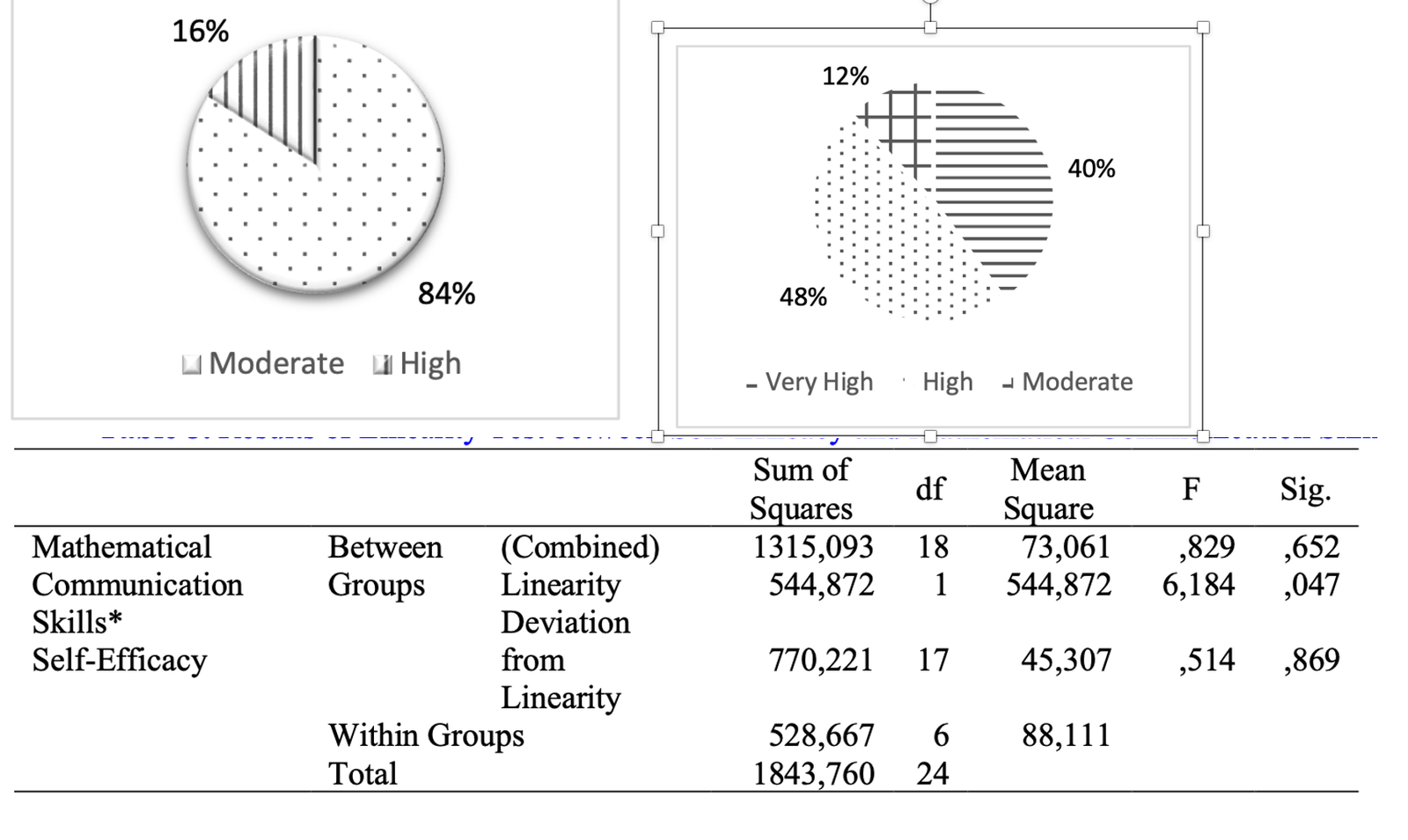
This study is motivated by the low level of students’ mathematical communication skills and the suboptimal level of self-efficacy, both of which require special attention in the learning process. Mathematical communication skills are essential as they enable students to express and interpret mathematical ideas clearly, both orally and in writing. Self-efficacy plays an important role in shaping students’ confidence to actively participate, complete tasks, and express their opinions. This study aims to determine the relationship between self-efficacy and students’ mathematical communication skills using a quantitative approach with a correlational method. The participants were 25 eighth-grade students of SMPN 5 Tarogong Kidul selected through purposive sampling. The research instruments consisted of a self-efficacy questionnaire and a mathematical communication skills test based on the indicators of each variable. The data were analyzed using Pearson correlation analysis. The results showed a correlation coefficient of 0.544 with a significance value of 0.005, indicating a positive and significant relationship between self-efficacy and students’ mathematical communication skills. These findings suggest that higher levels of self-efficacy are associated with better ability in communicating mathematical ideas. This study also contributes by providing a comprehensive analysis supported by prerequisite statistical tests, thereby strengthening empirical evidence regarding the relationship between the two variables at the junior high school level. Therefore, affective aspects, particularly self-efficacy, need to be considered in improving the effectiveness of mathematics learning through supportive and interactive learning strategies.
Downloads
References
A’yuni, Q., Faridah, S., Irawan, W. H., & Mukti, T. S. (2024). Influence of self-efficacy on the mathematical communication ability of students in material linear equation systems. Mathline: Jurnal Matematika dan Pendidikan Matematika, 9(2), 305–318. https://doi.org/10.31943/mathline.v9i2.512
Agustin Hanisyah, W., & Noriza Munahefi, D. (2024). Teori Belajar Konstruktivisme pada Kemampuan Komunikasi Matematis Siswa. Jurnal PRISMA, 7, 731–738. https://proceeding.unnes.ac.id/prisma
Elindra, R., Siregar, E. Y., & Sahrona, M. (2023). Pengaruh self-efficacy terhadap kemampuan komunikasi matematis siswa SMP Negeri 2 Padangsidimpuan. MathEdu: Mathematic Education Journal. https://doi.org/10.37081/mathedu.v6i2.5008
Firdaus, A. M. H., Darmiany, D., & Rosyidah, A. N. K. (2022). Hubungan Self Efficacy dengan Kemampuan Komunikasi Matematis Siswa Kelas V SDN Gugus IV Kuripan Tahun Ajaran 2020/2021. Jurnal Ilmiah Profesi Pendidikan, 6(4), 744–749. https://doi.org/10.29303/jipp.v6i4.330
Gunur, B., Ramda, A. H., Ningsi, G. P., Pantaleon, K. V., & Sugiarti, L. (2023). Dampak Self-regulation dan Self-efficacy Terhadap Kemampuan Komunikasi Matematis Siswa (Vol. 5, Number 1). https://doi.org/10.32938/jpm.v5i1.4763
Hakiki, S. N., & Sundayana, R. (2022). Kemampuan Komunikasi Matematis pada Materi Kubus dan Balok Berdasarkan Kemandirian Belajar Siswa. Plusminus: Jurnal Pendidikan Matematika, 2(1), 101–110. https://doi.org/10.31980/plusminus.v2i1.1088
Handayani, R., Siregar, N., Simanjuntak, E., & Molliq, Y. (2024). Mathematical communication ability of students given self-confidence and learning independence. Pythagoras: Jurnal Matematika dan Pendidikan Matematika, 19(1). https://doi.org/10.21831/pythagoras.v19i1.72580
Ismayanti, S., & Sofyan, D. (2021). Kemampuan Komunikasi Matematis Siswa SMP Kelas VIII di Kampung Cigulawing (Vol. 1, Number 1). https://doi.org/10.31980/plusminus.v1i1.889
Mardhiyah, R. H., Nurul, S., Aldriani, F., Chitta, F., & Zulfikar, M. R. (2021). Pentingnya Keterampilan Belajar di Abad 21 sebagai Tuntutan dalam Pengembangan Sumber Daya Manusia. Lectura : Jurnal Pendidikan, 12(1), 29–40. https://doi.org/10.31849/lectura.v12i1.5813
Muliastrini, N. K. E. (2020). New Literacy sebagai Upaya Peningkatan Mutu Pendidikan Sekolah Dasar di Abad 21. Jurnal Pendidikan Dasar Indonesia, 4(1), 115–125. https://doi.org/10.23887/jpdi.v4i1.3114
Novianti, N., & Wayudi, M. (2024). Improving students’ mathematical communication and self-efficacy through realistic mathematics learning assisted by Canva media. Daya Matematis: Jurnal Inovasi Pendidikan Matematika. https://doi.org/10.26858/jdm.v12i3.66382
Nurhanurawati, N., Widyastuti, W., & Ramadhan, R. (2021). Dampak Self-Efficacy Terhadap Kemampuan Komunikasi Matematis Siswa. Jurnal Magister Pendidikan Matematika (JUMADIKA), 3(2), 51–58. https://doi.org/10.30598/jumadikavol3iss2year2021page51-58
Prajono, R., & Gunarti, Y. (2022). Mosharafa: Jurnal Pendidikan Matematika Analisis Kemampuan Berpikir Kritis Matematis Peserta Didik SMP ditinjau dari Self Efficacy. 11(1). http://journal.institutpendidikan.ac.id/index.php/mosharafa
Purnamasari, A., & Afriansyah, E. A. (2021). Kemampuan Komunikasi Matematis Siswa SMP pada Topik Penyajian Data di Pondok Pesantren. https://scholar.archive.org/work/h43a7pvc3jgubc4g5o77nbw6pe/access/wayback/https://journal.institutpendidikan.ac.id/index.php/plusminus/article/download/pv1n2_02/848
Putri, A. F., & Setianingsih, R. (2024). Kemampuan komunikasi matematis siswa dalam menyelesaikan soal numerasi ditinjau dari self-efficacy. MATHEdunesa, 13(3), 836–845. https://doi.org/10.26740/mathedunesa.v13n3.p836-845
Rapsanjani, D. M., & Sritresna, T. (2021). Kemampuan Komunikasi Matematis Ditinjau dari Self-Efficacy Siswa. Plusminus: Jurnal Pendidikan Matematika, 1(3), 469–480. https://doi.org/10.31980/plusminus.v1i3.954
Saidah, & Mardiani, D. (2021). Kesulitan Siswa SMP Terhadap Soal Komunikasi Matematis pada Materi Penyajian Data. https://pdfs.semanticscholar.org/a3fa/08a8a7d564a88946190e6b1928b373016e90.pdf
Samsuddin, A. F., & Retnawati, H. (2022). Self-efficacy Siswa dalam Pembelajaran Matematika. Buana Matematika : Jurnal Ilmiah Matematika Dan Pendidikan Matematika, 12(1), 17–26. https://doi.org/10.36456/buanamatematika.v12i1.5521
Suhenda, L. L. A., & Munandar, D. R. (2023). Kemampuan Komunikasi Matematis Siswa dalam Pembelajaran Matematika. Jurnal Educatio FKIP UNMA, 9(2), 1100–1107. https://doi.org/10.31949/educatio.v9i2.5049
Sundanah, & Rahmadiansyah, R. (2022). Pengaruh Model Pembelajaran Make a Match Terhadap Kemampuan Komunikasi Matematis Siswa Kelas Vii Pada Materi Himpunan (Vol. 2). http://jurnal.desantapublisher.com/index.php/desanta/article/view/56/50
Syah, J. M., & Sofyan, D. (2021). Kemampuan Komunikasi Matematis Siswa SMP di Kampung Paledang Suci Kaler pada Materi Segiempat dan Segitiga. Plusminus: Jurnal Pendidikan Matematika, 1(2), 373–384. https://doi.org/10.31980/plusminus.v1i2.911
Wida, M., Dewi, K., & Nuraeni, R. (2022). Kemampuan Komunikasi Matematis Siswa SMP ditinjau dari Self-Efficacy pada Materi Perbandingan di Desa Karangpawitan.
Zulfa, A., Kartono, K., & Cahyono, A. N. (2021). Mathematical communication skills in terms of self-efficacy through guided discovery learning assisted immediate feedback. Unnes Journal of Mathematics Education Research, 10. https://journal.unnes.ac.id/sju/index.php/ujmer/article/view/34665
Downloads
Published
How to Cite
Issue
Section
License
Copyright (c) 2026 This is an open-access under the CC-BY-SA license

This work is licensed under a Creative Commons Attribution-ShareAlike 4.0 International License.
Education and Talent Development Center of Indonesia (ETDC Indonesia)
e-mail: kognitif@gmail.com, website : https://etdc-indonesia.com

Kognitif: Jurnal Riset HOTS Pendidikan Matematika dengan Situs: https://etdci.org/journal/kognitif berlisensi Creative Commons Attribution-ShareAlike 4.0 International License






.png)