Using Digital Pythagorean Tangram to Enhance Mathematical Justification Skills of Prospective Mathematics Teachers

https://doi.org/10.51574/kognitif.v5i4.4020
Keywords:
Digital Media , Pythagorean Theorem , Mathematical Justification , Tangram , Prospective TeacherAbstract
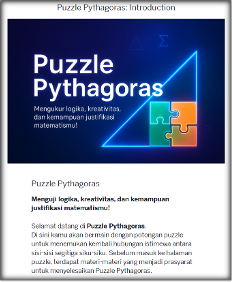
Mathematical justification is a crucial skill for mathematics teachers because it emphasizes proof and reasoning. This study examines how using the media “Digital Pythagorean Tangrams,” a manipulable, multimedia tool on Polypad, can improve prospective teachers' justification skills when proving the Pythagorean theorem. This research used a one-group pretest-posttest design where students were given a pre-test, then received an intervention using the media, and subsequently completed a post-test. The participants included 44 mathematics education students at a university in Bandung. Instruments comprised a mathematical justification test (pretest and posttest) and Digital Pythagorean Tangram media. Pretest and posttest data were analysed to obtain the N-gain score to estimate the effect size. The N-gain data were analysed using a one-sample t-test to check whether the improvement was statistically significant. The results revealed an average N-gain score of 0.42, which falls into the medium category, demonstrating a notable improvement in students' mathematical justification skills before and after using the digital tangram media. The One-Sample t-test also indicated a significance level below 0.05, confirming that the increase in students' mathematical justification ability is significant. Integrating digital manipulatives into proof-oriented instruction can meaningfully enhance prospective teachers’ justification skills and may serve as a practical pedagogical approach in mathematics teacher education.
Downloads
References
Anwar, L., Sa’dijah, C., Muzam Roudloh, Y. F., Yerizon, Y., & Maiyastri, M. (2025). Enhancing Students’ Reasoning Skills with GeoGebra-based Digital Worksheets. Salud, Ciencia y Tecnología, 5, 2137. https://doi.org/10.56294/saludcyt20252137
Cahyanita, E., Sunardi, S., Yudianto, E., Aini, N. R., & Wijaya, H. T. (2021). The development of tangram-based geometry test to measure the creative thinking ability of junior high school students in solving two-dimentional figure problems. Journal of Physics: Conference Series, 1836(1). https://doi.org/10.1088/1742-6596/1836/1/012051
Diaz Renavitasari, I. R., & Afif Supianto, A. (2018). Educational Game for Training Spatial Ability Using Tangram Puzzle. 3rd International Conference on Sustainable Information Engineering and Technology, SIET 2018 - Proceedings. https://doi.org/10.1109/SIET.2018.8693164
Dündar, S., & Gündüz, N. (2017). Justification for the subject of congruence and similarity in the context of daily life and conceptual knowledge. Journal on Mathematics Education, 8(1). https://doi.org/10.22342/jme.8.1.3256.35-54
Eloy, A., Cruz, D., Thennakoon, K., & Grant, W. (2020). Buildagram: A constructionist environment for spatial reasoning. Extended Abstracts - Proceedings of the 2020 ACM Interaction Design and Children Conference, IDC 2020. https://doi.org/10.1145/3397617.3402037
Flegas, K., & Charalampos, L. (2013). Exploring Logical Reasoning and Mathematical Proof in Grade 6 Elementary School Students. Canadian Journal of Science, Mathematics and Technology Education, 13(1), 70–89. https://doi.org/10.1080/14926156.2013.758326
Francisco, J. M. (2025). Teacher support of collective argumentation in mathematics classrooms: insights from an afterschool program. Journal of Mathematics Teacher Education, 28(1), 211–237. https://doi.org/10.1007/s10857-024-09651-5
Hakim, L. L., Alghadari, F., & Widodo, S. A. (2019). Virtual manipulatives media in mathematical abstraction. Journal of Physics …. https://doi.org/10.1088/1742-6596/1315/1/012017
Hamidah, D., Susiswo, Susanto, H., Hakim, Z. A., & Osman, S. (2025). Exploring the Mathematical Reasoning Skills Across Different Levels of Prospective Mathematics Teachers: A Mixed-Methods Investigation. Mathematics Education Journal, 19(2), 389–412. https://doi.org/10.22342/mej.v19i2.pp389-412
Hamidah, D., Susiswo, Susanto, H., & Osman, S. (2025). PROSPECTIVE MATHEMATICS TEACHERS’ MATHEMATIZATION COMPETENCIES IN SOLVING WORD PROBLEMS. Jurnal Ilmiah Ilmu Terapan Universitas Jambi, 9(3), 894–908. https://doi.org/10.22437/jiituj.v9i3.33211
Harel, G., & Sowder, L. (1998). Students’ proof schemes: Results from exploratory studies. https://doi.org/10.1090/cbmath/007/07
Isran, D., Susanta, A., Rahimah, D., & Syafri, F. S. (2025). Exploring Mathematical Proofs and Solutions in Higher Education: A Case Study on Real Analysis. Jurnal Pendidikan Matematika, 19(1), 163–180. https://doi.org/10.22342/jpm.v19i1.pp163-180
Lai, Y., Strayer, J. F., Ross, A., Adamoah, K., Anhalt, C. O., Bonnesen, C., Casey, S., Kohler, B., & Lischka, A. E. (2023). Enhancing prospective secondary teachers’ potential competence for enacting core teaching practices—through experiences in university mathematics and statistics courses. Zdm Mathematics Education, 55(4), 867–881. https://doi.org/10.1007/s11858-023-01485-4
Mata-Pereira, J., & da Ponte, J. P. (2018). Teacher’s actions to promote students’ justifications. Acta Scientiae, 20(3), 487–505. https://doi.org/10.17648/acta.scientiae.v20iss3id3910
Mega Faniya, V., Karuniawati, A., Nugroho, D., Nova Sutrianny, D., Sofia, & Ikashaum, F. (2023). STUDI LITERATUR : PENGGUNAAN TANGRAM SEBAGAI MEDIA PEMBELAJARAN MATEMATIKA. Asimtot : Jurnal Kependidikan Matematika, 4(2). https://doi.org/10.30822/asimtot.v4i2.2336
Mufti, N. N., Pranata, O. H., & M, M. R. W. (2020). Studi Literatur: Tangram Sebagai Media Pembelajaran Geometri. Jurnal Kajian Pendidikan Dasar, 5(2).
Mukuka, A., & Tatira, B. (2025). Analysis of pre-service mathematics teachers’ proof comprehension through Toulmin’s argumentation model. Journal on Mathematics Education, 16(1), 111–130. https://doi.org/10.22342/jme.v16i1.pp111-130
Mutmainah, F., & Nuha, M. ’Azmi. (2023). Implementation of Discovery Learning Assisted by Pythagorean Puzzle to Improve Mathematical Problem-Solving Ability. International Journal of Research in Mathematics Education, 1(2). https://doi.org/10.24090/ijrme.v1i2.8676
Ramadhani, N., Andriansah, M., Erfansyah, M., & Zuliana, E. (2024). PERAN PERMAINAN EDUKATIF TANGRAM DALAM PEMBELAJARAN MATEMATIKA REALISTIK INDONESIA (PMRI) UNTUK MENINGKATKAN PEMAHAMAN BANGUN DATAR SISWA. Al-Irsyad Journal of Mathematics Education, 3(1), 11–21. https://doi.org/10.58917/ijme.v3i1.100
Ridwan, I. R., Rizaldi, V. P., Susilawati, S., & Hanif, M. (2023). Pengaruh Media Tangram Berbasis Articulate Storyline 3 terhadap Kemampuan Berpikir Kreatif Materi Bangun Datar. PYTHAGORAS Jurnal Pendidikan Matematika, 18(1), 77–88. https://doi.org/10.21831/pythagoras.v18i1.57692
Sasmita, D., Utami, C., & Prihatiningtyas, N. C. (2019). Pemahaman Konsep Matematis Siswa dengan Model Pembelajaran Generatif Berbantuan Alat Peraga Puzzle Pythagoras. Variabel, 2(2). https://doi.org/10.26737/var.v2i2.1816
Staples, M. E., Bartlo, J., & Thanheiser, E. (2012). Justification as a teaching and learning practice: Its (potential) multifacted role in middle grades mathematics classrooms. The Journal of Mathematical Behavior, 31(4), 447–462. https://doi.org/10.1016/j.jmathb.2012.07.001
Utaminingsih, S., Amalia, I., & Sumaji, S. (2024). Management of Mathematics Learning Based on Interactive Digital Worksheets to Improve Students’ Critical Thinking Ability. Journal of Curriculum and Teaching, 13(1), 159. https://doi.org/10.5430/jct.v13n1p159
Wardani, A. K., & Putra, H. D. (2024). Penggunaan Media Tangram pada Materi Geometri Bidang Datar Terhadap Kemampuan Berpikir Kreatif Matematis Siswa SD. Indiktika : Jurnal Inovasi Pendidikan Matematika, 6(2), 245–254. https://doi.org/10.31851/indiktika.v6i2.15336
Weingarden, M., & Buchbinder, O. (2023). Teacher learning to teach mathematics via reasoning and proving: a discursive analysis of lesson plans modifications. Frontiers in Education, 8. https://doi.org/10.3389/feduc.2023.1154531
Zeybek Simsek, Z. (2025). Investigating prospective teachers’ skills of predicting and identifying significant student reasoning instances and deciding how to respond to those instances. Investigations in Mathematics Learning, 17(1), 83–101. https://doi.org/10.1080/19477503.2024.2391716
Downloads
Published
How to Cite
Issue
Section
License
Copyright (c) 2025 Yusuf Adhitya, Nurmala Setianing Putri, Bill Chairy Rizki Bustaren

This work is licensed under a Creative Commons Attribution-ShareAlike 4.0 International License.
Education and Talent Development Center of Indonesia (ETDC Indonesia)
e-mail: kognitif@gmail.com, website : https://etdc-indonesia.com

Kognitif: Jurnal Riset HOTS Pendidikan Matematika dengan Situs: https://etdci.org/journal/kognitif berlisensi Creative Commons Attribution-ShareAlike 4.0 International License






.png)