
Interactive Student Worksheet on Probability Using Problem-Based Learning to Support Computational Thinking

https://doi.org/10.51574/kognitif.v6i3.3677
Keywords:
ADDIE, Interactive Electronic Student Worksheet, Probability, Computational Thinking, Problem-Based LearningAbstract
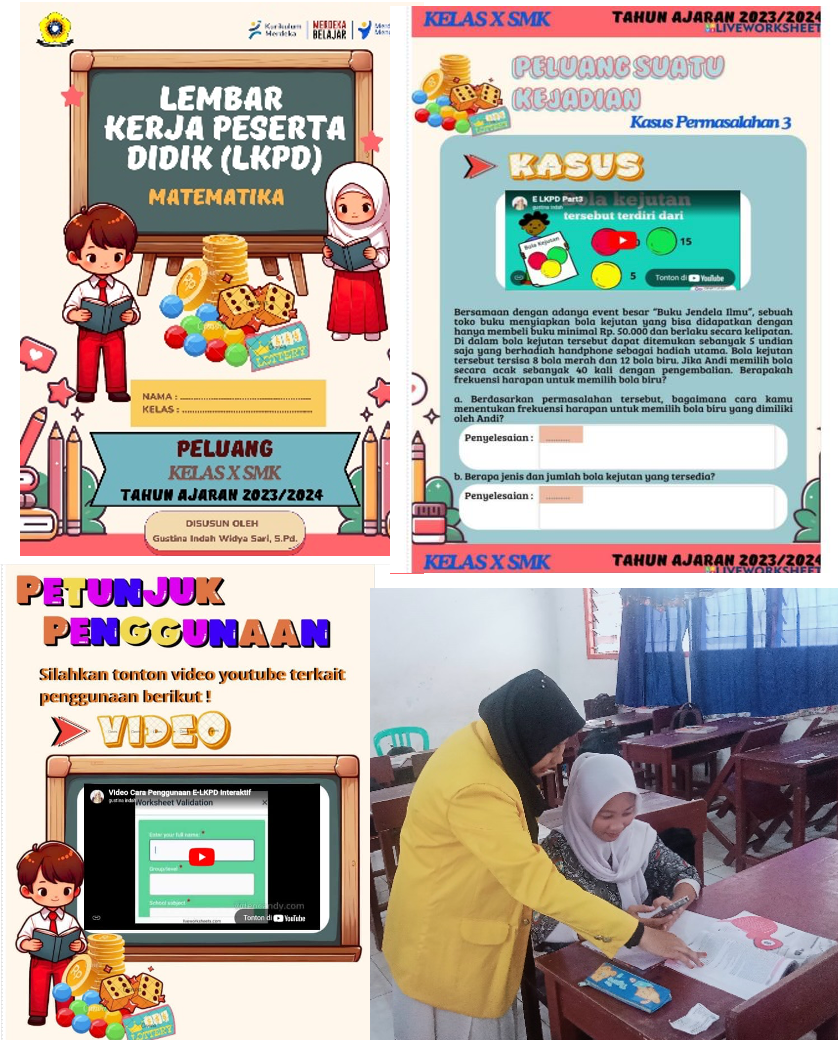
Twenty-first-century education requires students to develop computational thinking as a higher-order thinking skill needed to solve various problems systematically. However, this ability still needs to be strengthened through technology-enhanced and student-centred learning innovations. This study aimed to develop an interactive electronic student worksheet on probability based on Problem-Based Learning (PBL) that is valid and practical, and to examine its potential effects on supporting students’ computational thinking skills. The study employed a Research and Development (R&D) approach using the ADDIE model, which consists of the Analysis, Design, Development, Implementation, and Evaluation stages. The research was conducted at SMK Bakti Ibu 3 Palembang, involving Grade 10 students as the research participants. Data were collected through walkthroughs or expert validation, observations, questionnaires, learning achievement tests, and interviews. The results showed that the interactive electronic student worksheet obtained an average validity score of 4.18, which was classified as good based on the content, construct, and language aspects. The practicality test results were categorised as very good, with an average score of 4.63 based on responses from students and teachers. In addition, the test results indicated that 84.31% of the students achieved the Learning Objective Achievement Criteria. The analysis of students’ problem-solving processes and interview data also showed that the use of the interactive electronic student worksheet facilitated the development of computational thinking indicators, including decomposition, pattern recognition, abstraction, and algorithmic thinking. Therefore, the interactive electronic student worksheet on probability based on Problem-Based Learning was considered valid, practical, and potentially effective in supporting students’ computational thinking skills.
Downloads
References
Angeli, C., & Giannakos, M. (2020). Computational thinking education: Issues and challenges. In Computers in human behavior (Vol. 105, hal. 106185). Elsevier. https://doi.org/https://doi.org/10.1016/j.chb.2019.106185
Arends, R. I. (2012). Learning To Teach (Ninth Edit). McGraw-Hill Companies. https://hasanahummi.wordpress.com/wp-content/uploads/2017/04/connect-learn-succeed-richard-arends-learning-to-teach-mcgraw-hill-2012.pdf
Arsyad, A. (2019). Media Pembelajaran. PT RajaGrafindo Persada.
Barr, V., & Stephenson, C. (2011). Bringing computational thinking to K-12: What is involved and what is the role of the computer science education community? ACM inroads, 2(1), 48–54. https://doi.org/https://doi.org/10.1145/1929887.1929905
Bell, S. W. (2010). Project-based learning for the 21st century: Skills for the future. The clearing house: A journal of educational strategies, issues and ideas. https://doi.org/10.1080/00098650903505415
Bers, M. U. (2022). Beyond coding: How children learn human values through programming. MIT Press.
Bond, M., Bedenlier, S., Marín, V. I., & Händel, M. (2021). Emergency remote teaching in higher education?: mapping the first global online semester. International Journal of Educational Technology in Higher Education. https://doi. org/10.1186/s41239-021-00282-x. https://doi.org/https://doi.org/10.1186/s41239-021-00282-x
Branch, R. M., & Varank, İ. (2009). Instructional design: The ADDIE approach (Vol. 722). Springer.
Brennan, K., & Resnick, M. (2012). New frameworks for studying and assessing the development of computational thinking. Proceedings of the 2012 annual meeting of the American educational research association, Vancouver, Canada, 1, 25. https://scratched.gse.harvard.edu/ct/files/AERA2012.pdf
Clark, R. C., & Mayer, R. E. (2016). E-Learning and the Science of Instruction. Wiley. https://doi.org/https://doi.org/10.1002/9781119239086
Csizmadia, A., Curzon, P., Dorling, M., Humphreys, S., Ng, T., Selby, C., & Woollard, J. (2015). Computational thinking-A guide for teachers. https://eprints.soton.ac.uk/424545/1/150818_Computational_Thinking_1_.pdf
Dolmans, D. H. J. M., Loyens, S. M. M., Marcq, H., & Gijbels, D. (2016). Deep and surface learning in problem-based learning: a review of the literature. Advances in health sciences education, 21(5), 1087–1112. https://doi.org/https://doi.org/10.1007/s10459-015-9645-6?urlappend=%3Futm_source%3Dresearchgate.net%26utm_medium%3Darticle
Findell, B., Swafford, J., & Kilpatrick, J. (2001). Adding it up: Helping children learn mathematics. National Academies Press. http://www.daneshnamehicsa.ir/userfiles/file/Manabeh/Manabeh02/Adding It Up Helping Children Learn Mathematics (3).pdf
Fitrisyah, M. A., Hapizah, H., & Mulyono, B. (2025). Computational Thinking Ability of Students in Exponential Material Using Problem-Based Learning. Jurnal Riset Pendidikan Matematika, 12(2), 148–162. https://doi.org/https://doi.org/10.21831/jrpm.v12i2.75787
Grover, S., & Pea, R. (2013). Computational thinking in K–12: A review of the state of the field. Educational researcher, 42(1), 38–43. https://doi.org/https://doi.org/10.3102/0013189X12463051
Grover, S., & Pea, R. (2018). Computational thinking: A competency whose time has come. Computer science education: Perspectives on teaching and learning in school, 19(1), 19–38.
Hmelo-Silver, C. E. (2004). Problem-based learning: What and how do students learn? Educational psychology review, 16(3), 235–266. https://doi.org/https://doi.org/10.1023/B:EDPR.0000034022.16470.f3
Hsu, T.-C., Chang, S.-C., & Hung, Y.-T. (2018). How to learn and how to teach computational thinking: Suggestions based on a review of the literature. Computers & Education, 126, 296–310. https://doi.org/https://doi.org/10.1016/j.compedu.2018.07.004
Jonassen, D. H. (2011). Learning to solve problems: A handbook for designing problem-solving learning environments. Routledge.
Jones, G. A., Langrall, C. W., & Mooney, E. S. (2007). Research in probability. In F. K. Lester (Ed.), Second Handbook of Research on Mathematics Teaching and Learning. Macmillan.
Kemendikbudristek. (2022a). Keputusan Kepala Badan Standar, Kurikulum, dan Asesmen Pendidikan Kementerian Pendidikan, Kebudayaan, Riset, dan Teknologi Nomor 033/H/KR/2022 tentang Perubahan Atas Keputusan Kepala Badan Standar, Kurikulum, dan Asesmen Pendidikan Nomor 008/H/KR/2022 ten. Kemendikbudristek.
Kemendikbudristek. (2022b). Keputusan Kepala BSKAP Nomor 008/H/KR/2022 tentang Capaian Pembelajaran pada Kurikulum Merdeka.
Marwa, M., Saputra, W., & Herlinawati, H. (2024). International Society for Technology in Education (ISTE) Standards For EFL Students as 21st Century Skills. ELT-Lectura, 11(1), 1–12. https://doi.org/https://doi.org/10.31849/elt-lectura.v11i1.17244
Mayer, Ri. E. (2021). Multimedia Learning. Cambridge University Press.
Moore, M. G. (1989). Three types of interaction. Taylor & Francis.
Mulyatiningsih, E. (2016). Pengembangan model pembelajaran.
NCTM, N. C. (2000). Principles and standards for school mathematics. Reston, VA: NCT M.
Nieveen, N. (1999). Prototyping to reach product quality. In Design approaches and tools in education and training (hal. 125–135). Springer.
Nieveen, N., & Plomp, T. (2013). Educational Design Research Educational Design Research. Netherlands Institute for Curriculum Development: SLO, 1–206. http://www.eric.ed.gov/ERICWebPortal/recordDetail?accno=EJ815766
OECD. (2019). Learning compass 2030. 12. www.oecd.org/education/2030-project
P21. (2019). Framework for 21st century learning. A unified vision for learning to ensure student success in a world where change is constant and learning never stops. Partnership for 21st Century Learning, 1–2. http://static.battelleforkids.org/documents/p21/P21_framework_0816_2pgs.pdf%0Ahttp://www.p21.org/our-work/p21-framework
Papadakis, S. (2021). Advances in Mobile Learning Educational Research (A.M.L.E.R.): Mobile learning as an educational reform. Advances in Mobile Learning Educational Research, 1(1), 1–4. https://doi.org/10.25082/amler.2021.01.001
Polya, G. (1973). How To Solve It 2nd Ed. Princeton University Press.
Prihatini. (2023). Pengembangan media articulate storyline 360 berbasis kemampuan berpikir kreatif siswa universitas islam negeri raden fatah.
Redecker, C. (2022). European Framework for the Digital Competence of Educators: DigCompEdu. DigCompEdu. https://epale.ec.europa.eu/sites/default/files/pdf_digcomedu_a4_final.pdf%0A%0A
Ross, S. M. (2014). Introduction to probability models. Academic press. https://static1.squarespace.com/static/5530dddfe4b0679504639dc1/t/66ae0d1add2d2116bf7b7fdd/1722682655626/InstructorsManual+for+sheldon+ross+intro+to+probability+models+9th+edition.pdf
Savery, J. R. (2006). Overview of problem-based learning: Definitions and distinctions. Essential readings in problem-based learning: Exploring and extending the legacy of Howard S. Barrows, 9(2), 1–20. https://doi.org/https://doi.org/10.7771/1541-5015.1002
Shute, V. J., Sun, C., & Asbell-Clarke, J. (2017). Demystifying computational thinking. Educational research review, 22, 142–158. https://doi.org/https://doi.org/10.1016/j.edurev.2017.09.003
Sugiyono. (2016). Metode penelitian kuantitatif, kualitatif, dan R&D. Alfabeta, cv, 239–254.
Sung, Y.-T., Chang, K.-E., & Liu, T.-C. (2016). The effects of integrating mobile devices with teaching and learning on students’ learning performance: A meta-analysis and research synthesis. Computers & Education, 94, 252–275. https://doi.org/https://doi.org/10.1016/j.compedu.2015.11.008
Suryaningsih, S., & Nurlita, R. (2021). pentingnya lembar kerja peserta didik elektronik (E-LKPD) inovatif dalam proses pembelajaran abad 21. Jurnal Pendidikan Indonesia, 2(7), 1256–1268. https://doi.org/https://doi.org/10.36418/japendi.v2i7.233
Tikva, C., & Tambouris, E. (2021). A systematic mapping study on teaching and learning Computational Thinking through programming in higher education. Thinking Skills and Creativity, 41, 100849. https://doi.org/Tikva, C., & Tambouris, E. (2021). A systematic mapping study on teaching and learning computational thinking through programming in higher education. Thinking Skills and Creativity, 41, 100849.
UNESCO. (2021). Reimagining Our Futures Together: A New Social Contract for Education. UNESCO.
Van den Akker, J. (1999). Principles and methods of development research. In Design approaches and tools in education and training (hal. 1–14). Springer.
Van Merriënboer, J. J. G., & Kirschner, P. A. (2018). Ten Steps to Complex Learning (3rd ed.). Routledge.
Weintrop, D., Beheshti, E., Horn, M., Orton, K., Jona, K., Trouille, L., & Wilensky, U. (2016). Defining computational thinking for mathematics and science classrooms. Journal of science education and technology, 25(1), 127–147. https://doi.org/10.1007/s10956-015-9581-5
Wing, J. M. (2006). Computational thinking. Communications of the ACM, 49(3), 33–35. https://doi.org/https://doi.org/10.1145/1118178.1118215
Zawacki-Richter, O., Marín, V. I., Bond, M., & Gouverneur, F. (2019). Systematic review of research on artificial intelligence applications in higher education–where are the educators? International journal of educational technology in higher education, 16(1), 39. https://doi.org/https://doi.org/10.1186/s41239-019-0171-0
Published
How to Cite
Issue
Section
License
Copyright (c) 2026 This is an open-access under the CC-BY-SA license

This work is licensed under a Creative Commons Attribution-ShareAlike 4.0 International License.
Education and Talent Development Center of Indonesia (ETDC Indonesia)
e-mail: kognitif@gmail.com, website : https://etdc-indonesia.com

Kognitif: Jurnal Riset HOTS Pendidikan Matematika dengan Situs: https://etdci.org/journal/kognitif berlisensi Creative Commons Attribution-ShareAlike 4.0 International License







.png)


