Development of Quick Count Math Educational Game–Based Media for Learning Integers

https://doi.org/10.51574/kognitif.v5i4.2482
Keywords:
Development , Quick Count Math , Educational Game , Media Learning , IntegersAbstract
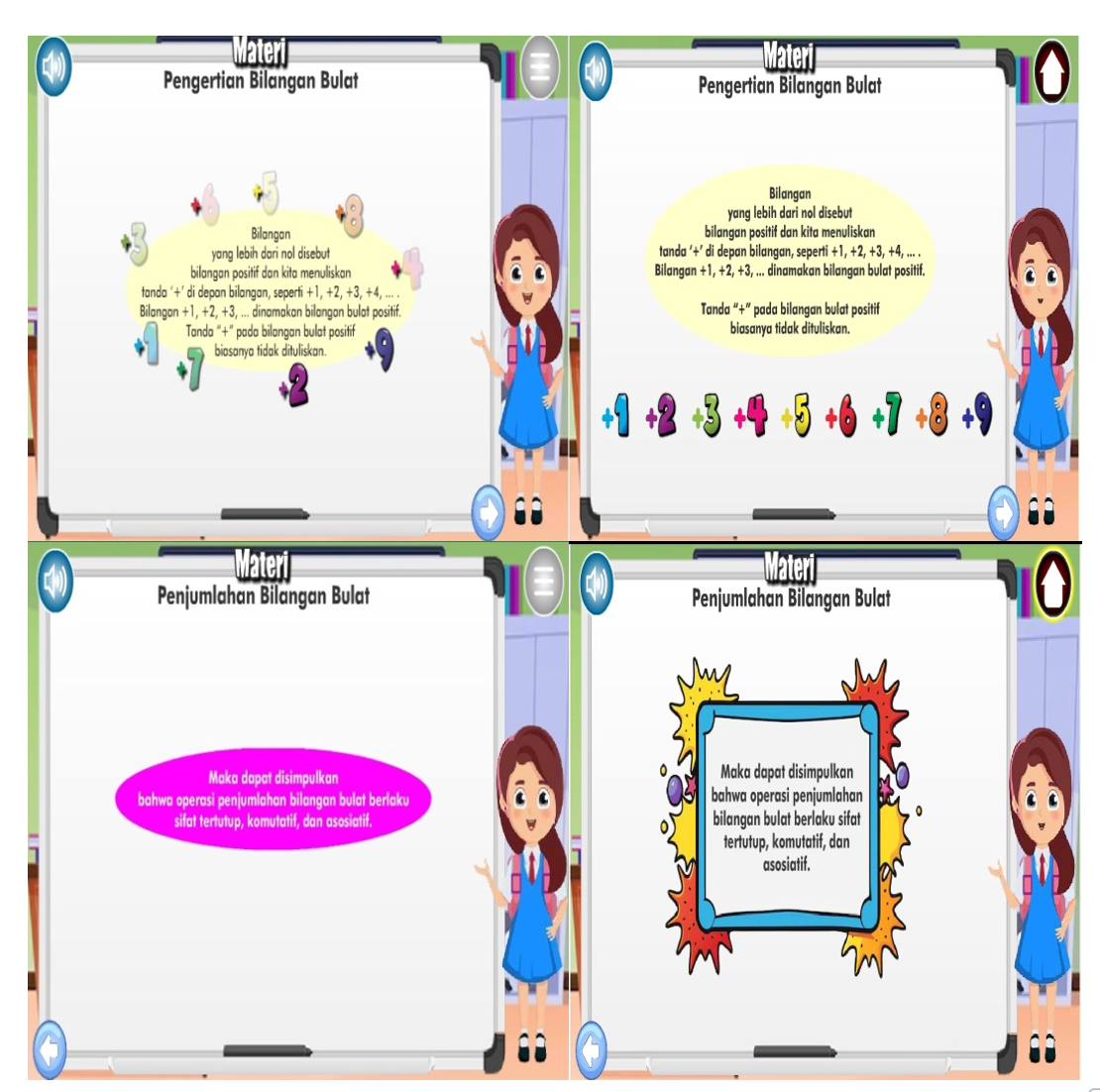
In response to students’ persistent difficulties in understanding integer operations and the limited use of engaging digital game-based media in mathematics classrooms, this study aims to develop “Quick Count Math,” an educational game-based instructional medium on the topic of integers for seventh-grade junior high school students. The study employed a Research and Development (R&D) design using the Four-D model, which consists of the define, design, develop, and disseminate stages. The game is designed to support learning of integer operations (addition, subtraction, multiplication, and division) through interactive challenges, gradually increasing levels of difficulty, immediate feedback, and appealing visuals. The results indicate that “Quick Count Math” meets the criteria of validity, practicality, and effectiveness. Expert review yielded validity scores of 85% for media aspects and 100% for content aspects, both categorized as very high. In addition, the game was reported to be easy to use by students and was effective in improving their understanding and learning outcomes on the integer topic, with an effectiveness score of 86%. These findings suggest that “Quick Count Math” can serve as an engaging and effective alternative digital medium for teaching mathematics in seventh-grade junior high school classes and contribute to the literature on game-based mathematics learning by offering a validated design that can be adapted to other topics and grade levels.
Downloads
References
Alqahtani, M. M., & Powell, A. B. (2017). Mediational activities in a dynamic geometry environment and teachers’ specialized content knowledge. Journal of Mathematical Behavior, 48(February), 77–94. https://doi.org/10.1016/j.jmathb.2017.08.004
Angeliki Kolovou, Marja van den Heuvel-Panhuizen, & Olaf Köller. (2013). An Intervention Including an Online Game to Improve Grade 6 Students’ Performance in Early Algebra. Journal for Research in Mathematics Education, 44(3), 510. https://doi.org/10.5951/jresematheduc.44.3.0510
Bishop, J. P., Lamb, L. L., Philipp, R. a, & Whitacre, I. (2014). Obstacles and Affordances for Integer Reasoning : An Analysis of Children ’ s Thinking and the History of Mathematics. Journal for Research in Mathematics Education, 45(1), 19–61. https://doi.org/10.5951/jresematheduc.45.1.0019
Bofferding, L. (2014). Negative Integer Understanding : Characterizing First Graders ’ Mental Models. Journal for Research in Mathematics Education, 45(2), 194–245. https://doi.org/10.5951/jresematheduc.45.2.0194
Borba, M. C. (2009). Potential scenarios for Internet use in the mathematics classroom. ZDM - International Journal on Mathematics Education, 41(4), 453–465. https://doi.org/10.1007/s11858-009-0188-2
Borji, V., Erfani, H., & Font, V. (2020). A combined application of APOS and OSA to explore undergraduate students’ understanding of polar coordinates. International Journal of Mathematical Education in Science and Technology, 51(3), 405–423. https://doi.org/10.1080/0020739X.2019.1578904
Engelbrecht, J., Llinares, S., & Borba, M. C. (2020). Transformation of the mathematics classroom with the internet. ZDM - Mathematics Education, 52(5), 825–841. https://doi.org/10.1007/s11858-020-01176-4
Freeman, B., Higgins, K. N., & Horney, M. (2020). How Students Communicate Mathematical Ideas: An Examination of Multimodal Writing Using Digital Technologies. Contemporary Educational Technology, 7(4), 281–313. https://doi.org/10.30935/cedtech/6178
Günster, S. M., & Weigand, H. G. (2020). Designing digital technology tasks for the development of functional thinking. ZDM - Mathematics Education, 52(7), 1259–1274. https://doi.org/10.1007/s11858-020-01179-1
Hsieh, F. J., Wang, T. Y., Hsieh, C. J., & Chu, C. T. (2025). The relationships of preservice teachers’ dispositions and noticing of technology-integrated mathematics teaching activities. ZDM - Mathematics Education. https://doi.org/10.1007/s11858-025-01727-7
Kärki, T., McMullen, J., & Lehtinen, E. (2022). Improving rational number knowledge using the NanoRoboMath digital game. Educational Studies in Mathematics, 110(1), 101–123. https://doi.org/10.1007/s10649-021-10120-6
Lee, Y., Capraro, R. M., & Bicer, A. (2019). Affective Mathematics Engagement: a Comparison of STEM PBL Versus Non-STEM PBL Instruction. Canadian Journal of Science, Mathematics and Technology Education, 19(3), 270–289. https://doi.org/10.1007/s42330-019-00050-0
Martínez, S., Guíñez, F., Zamora, R., Bustos, S., & Rodríguez, B. (2020). On the instructional model of a blended learning program for developing mathematical knowledge for teaching. ZDM - Mathematics Education, 52(5), 877–891. https://doi.org/10.1007/s11858-020-01152-y
Marufi, Ilyas, M., Winahyu, & Ikram, M. (2021). An Implementation of Ethno-STEM to Enhance Conceptual Understanding. Al-Jabar: Jurnal Pendidikan Matematika, 12(1).
Nisa, M. A., & Susanto, R. (2022). Pengaruh Penggunaan Game Edukasi Berbasis Wordwall Dalam Pembelajaran Matematika Terhadap Motivasi Belajar. JPGI (Jurnal Penelitian Guru Indonesia), 7(1). https://doi.org/10.29210/022035jpgi0005
Pepin, B. (2021). Connectivity in support of student co design of innovative mathematics curriculum trajectories. ZDM – Mathematics Education, 53(6), 1221–1232. https://doi.org/10.1007/s11858-021-01297-4
Ratnayake, I., Thomas, M., & Kensington-Miller, B. (2020). Professional development for digital technology task design by secondary mathematics teachers. ZDM - Mathematics Education, 52(7), 1423–1437. https://doi.org/10.1007/s11858-020-01180-8
Rocha, H. (2020). Graphical representation of functions using technology: A window to teacher knowledge. Teaching Mathematics and Its Applications, 39(2), 105–126. https://doi.org/10.1093/teamat/hrz011
S. Kumar, R., Subramaniam, K., & Naik, S. S. (2017). Teachers’ construction of meanings of signed quantities and integer operation. Journal of Mathematics Teacher Education, 20(6), 557–590. https://doi.org/10.1007/s10857-015-9340-9
Stohlmann, M. (2019). Three modes of STEM integration for middle school mathematics teachers. School Science and Mathematics, 119(5), 287–296. https://doi.org/10.1111/ssm.12339
Swidan, O. (2020). A learning trajectory for the fundamental theorem of calculus using digital tools. International Journal of Mathematical Education in Science and Technology, 51(4), 542–562. https://doi.org/10.1080/0020739X.2019.1593531
Taher, N. A. H., Nagaraju, G., & Eslavath, K. D. N. (2019). Motivating students in learning mathematics by using contextual teaching strategies. International Journal of Advanced Science and Technology, 28(13).
Whitacre, I., Azuz, B., Lamb, L. L. C., Bishop, J. P., Schappelle, B. P., & Philipp, R. A. (2017). Integer comparisons across the grades: Students’ justifications and ways of reasoning. Journal of Mathematical Behavior, 45, 47–62. https://doi.org/10.1016/j.jmathb.2016.11.001
Zambak, V. S., & Tyminski, A. M. (2020). Examining mathematical technological knowledge of pre-service middle grades teachers with Geometer’s Sketchpad in a geometry course. International Journal of Mathematical Education in Science and Technology, 51(2), 183–207. https://doi.org/10.1080/0020739X.2019.1650302
Downloads
Published
How to Cite
Issue
Section
License
Copyright (c) 2025 Freti Mangamis, Anetha L.F. Tilaar, Sylvia J.A. Sumarauw

This work is licensed under a Creative Commons Attribution-ShareAlike 4.0 International License.
Education and Talent Development Center of Indonesia (ETDC Indonesia)
e-mail: kognitif@gmail.com, website : https://etdc-indonesia.com

Kognitif: Jurnal Riset HOTS Pendidikan Matematika dengan Situs: https://etdci.org/journal/kognitif berlisensi Creative Commons Attribution-ShareAlike 4.0 International License






.png)