Design and Development of Construct 2-Based Learning Media for Teaching Three-Dimensional Geometry

https://doi.org/10.51574/kognitif.v5i4.2344
Keywords:
Construct 2 , Game-Based Learning , Three-Dimensional Geometry , Educational Media DevelopmentAbstract
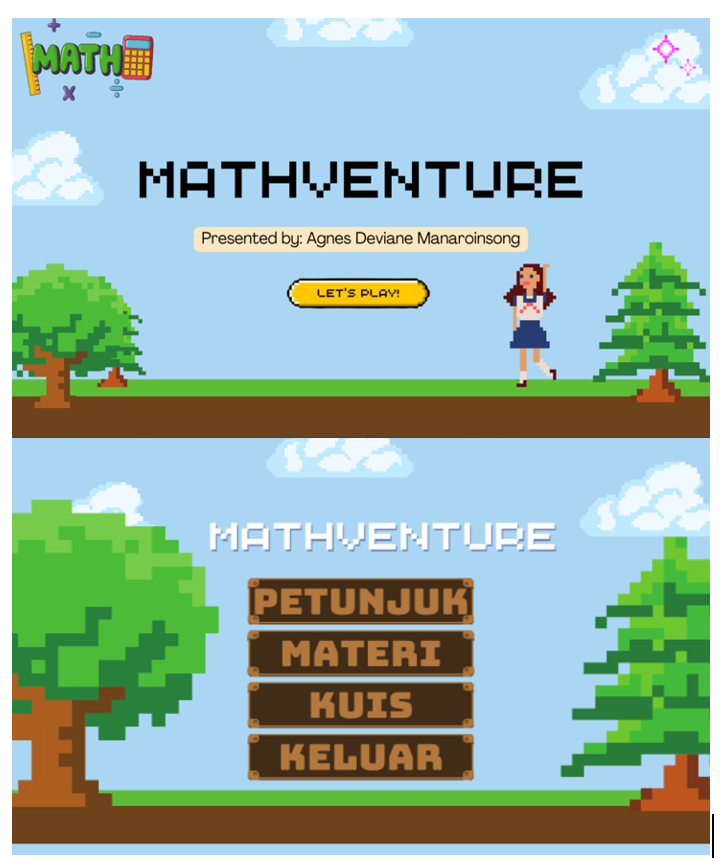
Game-based learning environments, in particular, offer enjoyable learning experiences while supporting the development of conceptual understanding. This study aims to develop and evaluate Construct 2–based learning media for teaching three-dimensional geometry in Grade 7. The research employed a Research and Development (R&D) design using the Akker model. Participants included media experts, material experts, and seventh-grade students from a public junior high school in Manado. The instruments used comprised expert validation sheets, student practicality questionnaires, and learning achievement tests. The development procedure involved identifying learning challenges related to students’ difficulties in visualizing geometric solids, designing the Construct 2 media, conducting expert validation, implementing one-to-one and small-group evaluations, and conducting a classroom field test. Data were analyzed descriptively to assess the validity, practicality, and effectiveness of the developed media. The findings indicate that the learning media achieved high validity based on evaluations from both media and material experts, high practicality based on students’ responses, and high effectiveness based on learning outcomes. The dynamic visualizations, interactive quizzes, and mobile accessibility offered by the media helped students overcome common difficulties in distinguishing and visualizing geometric solids and their nets. The novelty of this study lies in demonstrating the pedagogical value of Construct 2 not only as a feasible development tool but also as an effective instructional intervention. The study offers practical implications for educators seeking effective digital media for geometry instruction and provides a foundation for further innovation in game-based mathematics learning.
Downloads
References
Clark-Wilson, A., Robutti, O., & Thomas, M. (2020). Teaching with digital technology. ZDM - Mathematics Education, 52(7), 1223–1242. https://doi.org/10.1007/s11858-020-01196-0
Domu, I., & Mangelep, N. O. (2019). Developing of Mathematical Learning Devices Based on the Local Wisdom of the Bolaang Mongondow for Elementary School. Journal of Physics: Conference Series, 1387(1). https://doi.org/10.1088/1742-6596/1387/1/012135
Dreyfus, T. (2018). Learning Through Activity – Basic research on mathematical cognition. Journal of Mathematical Behavior, 52(November 2017), 216–223. https://doi.org/10.1016/j.jmathb.2018.04.001
Freeman, B., Higgins, K. N., & Horney, M. (2020). How Students Communicate Mathematical Ideas: An Examination of Multimodal Writing Using Digital Technologies. Contemporary Educational Technology, 7(4), 281–313. https://doi.org/10.30935/cedtech/6178
Hajeniati, N., & Kaharuddin, A. (2022). Innovation of the problem based learning model with contextual teaching learning in mathematics learning in the Industrial Revolution 4.0 era: A comparative case studies. International Journal of Trends in Mathematics Education Research, 5(2). https://doi.org/10.33122/ijtmer.v5i2.154
Hamami, Y., & Morris, R. L. (2020). Philosophy of mathematical practice: a primer for mathematics educators. ZDM - Mathematics Education, 52(6), 1113–1126. https://doi.org/10.1007/s11858-020-01159-5
Harris, D., Logan, T., & Lowrie, T. (2023). Spatial visualization and measurement of area: A case study in spatialized mathematics instruction. Journal of Mathematical Behavior, 70(May 2022), 101038. https://doi.org/10.1016/j.jmathb.2023.101038
Hong, Y. C., & Choi, I. (2011). Three dimensions of reflective thinking in solving design problems: A conceptual model. Educational Technology Research and Development, 59(5), 687–710. https://doi.org/10.1007/s11423-011-9202-9
Hsieh, F. J., Wang, T. Y., Hsieh, C. J., & Chu, C. T. (2025). The relationships of preservice teachers’ dispositions and noticing of technology-integrated mathematics teaching activities. ZDM - Mathematics Education. https://doi.org/10.1007/s11858-025-01727-7
Jankvist, U. T., Clark, K. M., & Mosvold, R. (2020). Developing mathematical knowledge for teaching teachers: potentials of history of mathematics in teacher educator training. Journal of Mathematics Teacher Education, 23(3), 311–332. https://doi.org/10.1007/s10857-018-09424-x
Kärki, T., McMullen, J., & Lehtinen, E. (2022). Improving rational number knowledge using the NanoRoboMath digital game. Educational Studies in Mathematics, 110(1), 101–123. https://doi.org/10.1007/s10649-021-10120-6
Kurniasih, S., Darwan, D., & Muchyidin, A. (2020). Menumbuhkan Kemandirian Belajar Matematika Siswa Melalui Mobile Learning Berbasis Android. Jurnal Edukasi Matematika Dan Sains, 8(2). https://doi.org/10.25273/jems.v8i2.7041
Lichti, M., & Roth, J. (2019). Functional Thinking—A Three-Dimensional Construct? Journal Fur Mathematik-Didaktik, 40(2), 169–195. https://doi.org/10.1007/s13138-019-00141-3
Nisa, M. A., & Susanto, R. (2022). Pengaruh Penggunaan Game Edukasi Berbasis Wordwall Dalam Pembelajaran Matematika Terhadap Motivasi Belajar. JPGI (Jurnal Penelitian Guru Indonesia), 7(1). https://doi.org/10.29210/022035jpgi0005
Psycharis, G., & Kalogeria, E. (2018). Studying the process of becoming a teacher educator in technology-enhanced mathematics. Journal of Mathematics Teacher Education, 21(6), 631–660. https://doi.org/10.1007/s10857-017-9371-5
Ratnayake, I., Thomas, M., & Kensington-Miller, B. (2020). Professional development for digital technology task design by secondary mathematics teachers. ZDM - Mathematics Education, 52(7), 1423–1437. https://doi.org/10.1007/s11858-020-01180-8
Remillard, J. T., Van Steenbrugge, H., Machalow, R., Koljonen, T., Krzywacki, H., Condon, L., & Hemmi, K. (2021). Elementary teachers’ reflections on their use of digital instructional resources in four educational contexts: Belgium, Finland, Sweden, and U.S. ZDM - Mathematics Education, 53(6), 1331–1345. https://doi.org/10.1007/s11858-021-01295-6
Rocha, H. (2020). Graphical representation of functions using technology: A window to teacher knowledge. Teaching Mathematics and Its Applications, 39(2), 105–126. https://doi.org/10.1093/teamat/hrz011
Swidan, O., Sabena, C., & Arzarello, F. (2020). Disclosure of mathematical relationships with a digital tool: a three layer-model of meaning. Educational Studies in Mathematics, 103(1), 83–101. https://doi.org/10.1007/s10649-019-09926-2
Utami, T. N., Jatmiko, A., & Suherman, S. (2018). Pengembangan Modul Matematika dengan Pendekatan Science, Technology, Engineering, And Mathematics (STEM) pada Materi Segiempat. Desimal: Jurnal Matematika, 1(2), 165. https://doi.org/10.24042/djm.v1i2.2388
Utari, T., & Hartono, H. (2019). Muatan penalaran dan pembuktian matematis pada buku teks matematika SMA kelas X Kurikulum 2013. Jurnal Riset Pendidikan Matematika, 6(1), 1–13. https://doi.org/10.21831/jrpm.v6i1.17002
Velani, F. Y., & Retnawati, H. (2020). Application of contextual teaching and learning approaches in improving mathematics interest and learning achievement of elementary school students. Journal of Physics: Conference Series, 1511(1). https://doi.org/10.1088/1742-6596/1511/1/012032
Yilmaz, R. (2020). Prospective Mathematics Teachers ’ Cognitive Competencies on Realistic Mathematics Education. Journal on Mathematics Education, 11(1), 17–44.
Zambak, V. S., & Tyminski, A. M. (2020). Examining mathematical technological knowledge of pre-service middle grades teachers with Geometer’s Sketchpad in a geometry course. International Journal of Mathematical Education in Science and Technology, 51(2), 183–207. https://doi.org/10.1080/0020739X.2019.1650302
Downloads
Published
How to Cite
Issue
Section
License
Copyright (c) 2025 Agnes Deviane Manaroinsong, Ichdar Domu, Christina M. Laamena

This work is licensed under a Creative Commons Attribution-ShareAlike 4.0 International License.
Education and Talent Development Center of Indonesia (ETDC Indonesia)
e-mail: kognitif@gmail.com, website : https://etdc-indonesia.com

Kognitif: Jurnal Riset HOTS Pendidikan Matematika dengan Situs: https://etdci.org/journal/kognitif berlisensi Creative Commons Attribution-ShareAlike 4.0 International License






.png)