Effectiveness of the Make a Match Model Based on Flashcard Media to Improve Students' Learning Outcomes on Fractions

https://doi.org/10.51574/kognitif.v6i2.5259
Keywords:
Flashcard, Fractions, Learning Outcomes , Make a MatchAbstract
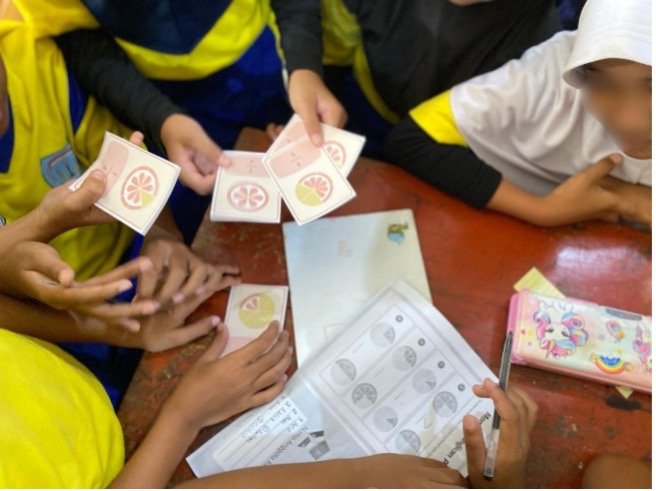
The low results Study mathematics material fractions in elementary school are caused by the abstract nature of the material and patterns, teaching isolated, teacher-centered. This study aims to test effectiveness application of the make-a-match model assisted by flashcard media to improve results Study mathematics material fractions compared with the Problem Based Learning (PBL) model. This type of research is a quantitative experiment with a quasi-experimental design with a non-equivalent control group design. Instrument data collection in the form of test results Study mathematics objective, 26 items, question choice double, which was tested as a pretest and posttest (Cronbach's alpha of 0.703). The data analysis technique uses statistical tests, descriptive and inferential, which include prerequisite tests and hypothesis testing using an independent-samples t-test and paired-samples t-test. The pretest results showed that the initial abilities of the two groups were relatively balanced with an average of 58.16 for the experimental class and 53.80 for the control class. After the intervention, the results showed a significant difference in learning outcomes between the two groups based on the independent samples t-test with a t value of 4.124, df = 58, and a p value < 0.001. The experimental class obtained a posttest average of 83.43, significantly higher than the control class (PBL), which obtained an average of 75.57. In addition, the Normalized Gain (N-Gain) test proved that the experimental class increased by 57.18% (moderate and more effective category), outperforming the control class, which only achieved 45.38% (moderate and quite effective category). Based on these results, it can be concluded that the application of the make-a-match model assisted by flashcard media is more effective in improving the mathematics learning outcomes in fractions compared to the use of the problem-based learning (PBL) model.
Downloads
References
Afiyah, KN, & Sutriyani, W. (2024). The effectiveness of game-based learning methods assisted by fraction flashcard media on students' mathematics learning outcomes. LINEAR: Journal of Mathematics Education , 5 (2), 171–180. https://doi.org/10.32332/xmy86j91
Amalia, A. (2025). The Use of Flashcard Media to Overcome Obstacles to Students' Basic Mathematics Understanding at MI Tarbiyatul Ikhwan Pamekasan. RESTECH: Journal of Research In Education, Science & Technology , 1 (1), 1–6.
Amerinda, NR (2026). THE EFFECT OF MAKE A MATCH LEARNING MODEL ASSISTED BY FLASHCARD MEDIA ON MATHEMATICS LEARNING OUTCOMES OF GRADE III STUDENTS AT MIN 2 BANDAR LAMPUNG THESIS. Diploma Thesis, UIN RADEN INTAN LAMPUNG. https://repository.radenintan.ac.id/id/eprint/42968
Andani, N.A., Nizaruddin, N., & Prayito, M. (2021). The Effectiveness of the Make-A-Match and Problem Posing Learning Models in Terms of Student Learning Creativity on the Learning Achievement of Grade VII Junior High School Students. Imajiner: Journal of Mathematics and Mathematics Education , 3 (3), 258–264. https://doi.org/10.26877/imajiner.v3i3.7609
Anwar, C., & Setiawan, A. (2022). Analysis of Elementary School Students' Learning Obstacles (Cognitive Obstacles) in Learning Fractions. Cognitive. HOTS Research Journal of Mathematics Education , 2 (2), 105–118. https://doi.org/https://www.google.com/search?q=https://doi.org/10.51574/kognitif.v2i2.420
Asadulloh. (2023). The use of concrete objects and hands-on activities is in line with the cognitive development of children who are still at the concrete operational stage. Central Sulawesi Provincial Health Office . https://dinkes.sultengprov.go.id/4-tahapan-perkembangan-kognitif-si-kecil-dalam-teori-piaget/
Braithwaite, D. W., & Sprague, L. N. (2021). Cultivating fraction understanding: Why visual representations work, and when they don't. Educational Psychology Review , 3 (33), 1203–1227. https://doi.org/https://www.google.com/search?q=https://doi.org/10.1007/s10648-020-09587-5
Darrosa, F., Yusuf, N., & Ibrahimi, R. (2026). DEVELOPMENT OF DIGITAL-BASED FLASHCARD LEARNING MEDIA TO IMPROVE STUDENTS' UNDERSTANDING OF MATHEMATICAL CONCEPTS IN GRADE V SDN 2 LAMCOT. Journal of Elementary Education , 11 (01). https://doi.org/https://doi.org/10.23969/jp.v11i01.42392
Fauzi, MR, & Rahmawati, L. (2024). The Effectiveness of Visual Card Media on Reducing Whole Number Bias in Fraction Learning for Grade III Students. Journal of Innovation in Basic Mathematics Learning , 2 (5), 142–155.
Fegi Nopriani, Rohana, & Aldora Pratama. (2025). The Effect of Gamification-Assisted Cooperative Learning Model on Students' Mathematical Problem-Solving Ability in Elementary Schools. BADA'A: Scientific Journal of Elementary Education , 7 (1), 1–10. https://doi.org/10.37216/badaa.v7i1.1582
Fuchs, L.S., Wang, AY, & Malone, A.S. (2021). The role of executive function and whole-number bias in fraction development among struggling learners. Exceptional Children , 4 (87), 412–432. https://doi.org/https://www.google.com/search?q=https://doi.org/10.1177/0014402921994155
Geller, L. K., & Alibali, M. W. (2023). Bridging the concrete and abstract: How external representations and teacher gestures support fractional learning. Journal of Numerical Cognition , 1 (9), 89–106. https://doi.org/doi.org/10.5964/jnc.8324
Hake, R.R. (1998). Interactive-engagement versus traditional methods: A six-thousand-student survey of mechanics test data for introductory physics courses. In American Journal of Physics (Vol. 66, Issue 1, pp. 64–74). https://doi.org/10.1119/1.18809
Nurjannah, S., Hoiriyah, R., & Komarullah, H. (2025). CONVENTIONAL TEACHING AND LEARNING. Journal of Mathematics Education, Mathematics Science and Applications .
OECD. (2023). PISA 2022 Results. In Factsheets: Vol. I . https://www.oecd-ilibrary.org/educstion/pisa-2022-results-volume-i_53f23881-en
Pratama, R. (2023). The Effect of Conventional Expository Learning on Elementary School Numeracy Problem-Solving Skills. Cognitive: HOTS Research Journal of Mathematics Education , 1 (3), 45–57. https://doi.org/https://www.google.com/search?q=https://doi.org/10.51574/kognitif.v3i1.610
Putri, SFR, Fatih, M., & Alfi, C. (2024). Augmented Reality-Based Flashcards on Fractions Through Team Games Tournaments Improve Elementary School Students' Self-Regulated Learning. Jurnal Educatio , 10 (4), 1222–1232. https://doi.org/10.31949/educatio.v10i4.9500
Samsudin, M., Hairun, Y., & Afandi, A. (2023). Analysis of Students' Difficulties in Solving Questions on Fractional Number Material. Journal of Mathematics Teacher Education , 3 (2). https://doi.org/10.33387/jpgm.v3i2.6129
Sari, UP (2025). The Effectiveness of Flashcard-Assisted Games-Based Learning Model on Learning Outcomes in Mathematics for Grade I at MIN 2 Madiun City. Electronic Theses . https://etheses.iainponorogo.ac.id/id/eprint/32469
Siegler, R. S. (2024). Fractions: The gateway to algebra and higher mathematics. Journal of Educational Psychology , 2 (116), 145-161. https://doi.org/10.1037/edu0000812
Slavin. (2025). Educational Psychology: Theory and Practice. Plant Sciences: Ecology, Physiology, And Biotechnology . https://doi.org/10.59646/539
Suciati, I. (2021). The "Snakes and Ladders of Mathematics" Game on Fractional Number Material. Cognitive: HOTS Research Journal of Mathematics Education , 1 (1), 10–21. https://doi.org/10.51574/kognitif.v1i1.5
Sugiyono. (2021). biblio-detail-43 . https://digilib.unigres.ac.id/?p=show_detail&id=43
Sulistio, A., & Haryanti, N. (2022). Cooperative Learning Model. Visipena Journal , 2 (1), 21–27.
Suprianto. (2024). Improving Student Learning Outcomes Using the Make A Match Learning Model. Journal of Islamic Education and Teacher Training (JITK) , 2 (2). https://doi.org/10.56393/kognisi.v1i2.881
Suyoto, DS (2015). Basic Research Methodology of Quantitative and Qualitative Research Journal, Journal of Research Methods, Vol. 1(No. 2) (pp. 60–89).
Wahyuni, SS, & Damayani, AT (2025). EFFORTS TO IMPROVE LEARNING OUTCOMES OF GRADE III STUDENTS BY APPLYING THE MAKE A MATCH TYPE COOPERATIVE LEARNING MODEL ON SIMPLE FRACTIONS. Jurnal Prasasti Ilmu , 5 (3), 91–97.
Widiastuti, N., & Utami, S. (2024). Analysis of Elementary School Students' Misconceptions on Fractions from the Perspective of Cognitive Style. HOTS Research Journal of Mathematics Education , 4 (1), 15–28. https://doi.org/https://doi.org/10.51574/kognitif.v4i1
Wulandari, SY, & Ismiyanti, Y. (2022). THE EFFECT OF THE MAKE A MATCH MODEL USING MAP UPON FLASH CARD MEDIA ON THE HOTS OF SCIENCES OF GRADE V ELEMENTARY SCHOOL STUDENTS. SEJ (School Education Journal) , 12 (1), 57–63. https://jurnal.unimed.ac.id/2012/index.php/
Downloads
Published
How to Cite
Issue
Section
License
Copyright (c) 2026 This is an open-access under the CC-BY-SA license

This work is licensed under a Creative Commons Attribution-ShareAlike 4.0 International License.
Education and Talent Development Center of Indonesia (ETDC Indonesia)
e-mail: kognitif@gmail.com, website : https://etdc-indonesia.com

Kognitif: Jurnal Riset HOTS Pendidikan Matematika dengan Situs: https://etdci.org/journal/kognitif berlisensi Creative Commons Attribution-ShareAlike 4.0 International License






.png)