Effect of Wordwall-Assisted Numbered Heads Together on Junior High School Students’ Mathematical Conceptual Understanding

https://doi.org/10.51574/kognitif.v6i2.4753
Keywords:
Conceptual Understanding , Exponents, Mathematics Learning, Numbered Heads Together, WordwallAbstract
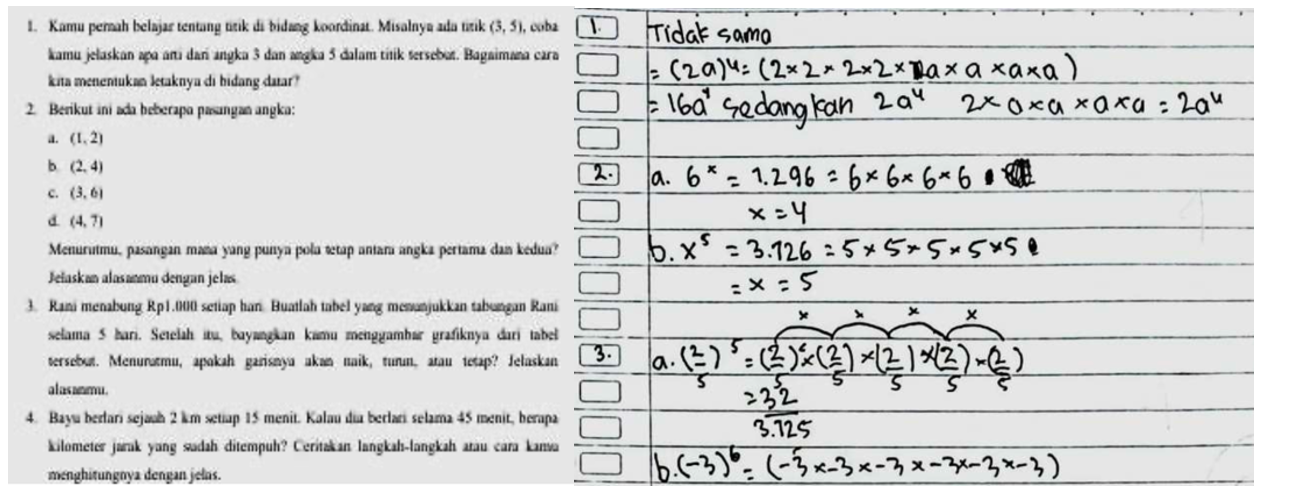
Students’ mathematical conceptual understanding remains an important concern in junior high school mathematics learning. Inadequate conceptual understanding may lead to students’ difficulties in connecting mathematical concepts and solving mathematical problems. Learning that involves collaboration and the use of interactive media is considered capable of promoting students’ active engagement. This study aims to examine the effect of the Wordwall-assisted Numbered Heads Together (NHT) learning model on students’ mathematical conceptual understanding of exponents. This study employed a quantitative approach with a quasi-experimental design using a nonequivalent control group design. The research subjects were Grade VIII junior high school students consisting of an experimental class and a control class. The research instrument was a mathematical conceptual understanding test developed based on four indicators: restating concepts, classifying objects, representing concepts in various forms, and applying concepts in problem solving. The data were analyzed using an independent samples t-test. The results showed a significant difference between the mathematical conceptual understanding of students taught using the Wordwall-assisted NHT model and those taught using conventional instruction. The Wordwall-assisted NHT model had a positive effect on improving students’ mathematical conceptual understanding, as indicated by the higher posttest mean score of the experimental class (62.08) compared with the control class (51.68), with a Sig. (2-tailed) value of 0.017 < 0.05. These findings indicate that cooperative learning supported by interactive media can serve as a strategic alternative for improving the quality of junior high school mathematics learning.
Downloads
References
Alqahtani, M. M., & Powell, A. B. (2017). Mediational activities in a dynamic geometry environment and teachers’ specialized content knowledge. Journal of Mathematical Behavior, 48(February), 77–94. https://doi.org/10.1016/j.jmathb.2017.08.004
Ayu, N. M., Hamdani, H., Sahputra, R., Rif’at, M., & Suratman, D. (2023). Komunikasi matematis lisan, pemahaman konseptual dan motivasi belajar dalam pembelajaran matematika menggunakan media quizizz. AKSIOMA: Jurnal Program Studi Pendidikan Matematika, 12(3). https://doi.org/10.24127/ajpm.v12i3.7207
Byerley, C. (2019). Calculus students’ fraction and measure schemes and implications for teaching rate of change functions conceptually. Journal of Mathematical Behavior, 55(March), 0–1. https://doi.org/10.1016/j.jmathb.2019.03.001
Chorney, S., Evans, K. R., & Staples, M. (2024). Conceptualizing reasoning practices in the context of sociomathematical issues. Journal of Mathematical Behavior, 73. https://doi.org/10.1016/j.jmathb.2024.101124
Díaz-Berrios, T., & Martínez-Planell, R. (2022). High school student understanding of exponential and logarithmic functions. Journal of Mathematical Behavior, 66(April). https://doi.org/10.1016/j.jmathb.2022.100953
Ferrari-Escolá, M., Martínez-Sierra, G., & Méndez-Guevara, M. E. M. (2016). “Multiply by adding”: Development of logarithmic-exponential covariational reasoning in high school students. Journal of Mathematical Behavior, 42, 92–108. https://doi.org/10.1016/j.jmathb.2016.03.003
Habibi, H., & Suparman, S. (2020). Literasi Matematika dalam Menyambut PISA 2021 Berdasarkan Kecakapan Abad 21. JKPM (Jurnal Kajian Pendidikan Matematika), 6(1), 57. https://doi.org/10.30998/jkpm.v6i1.8177
Husnah, A. (2020). Efektivitas Penerapan Model Kooperatif Tipe Numbered Heds Together (NHT) Dalam Pembelajaran Matematika Siswa. ELIPS: Jurnal Pendidikan Matematika, 1(1). https://doi.org/10.47650/elips.v1i1.123
Kafetzopoulos, G. I., & Psycharis, G. (2022). Conceptualization of function as a covariational relationship between two quantities through modeling tasks. Journal of Mathematical Behavior, 67(July), 100993. https://doi.org/10.1016/j.jmathb.2022.100993
Karsidik, K. (2021). Peningkatan hasil belajar matematika tentang pecahan melalui model pembelajaran nht (numbered head together) pada siswa kelas V SD Negeri Bulang II tahun pelajaran 2018/2019. Pedagogy : Jurnal Ilmiah Ilmu Pendidikan, 8(1). https://doi.org/10.51747/jp.v8i1.699
Kurniah, N., Basir, F., & Ikram, M. (2018). Pola Interaksi Dalam Belajar Matematika Berdasarkan Kemampuan Awal Melalui Pembelajaran Kooperatif. Proximal: Penelitian Matematika Dan Pendidikan Matematika, 1(1), 65–74. https://www.e-journal.my.id/proximal/article/view/188,
Liljekvist, Y., Mellroth, E., Olsson, J., & Boesen, J. (2017). Conceptualizing a Local Instruction Theory in Design Research: Report from a Symposium. Swedish Society for Research in Mathematics Education, 119–128. http://ncm.gu.se/media/smdf/Published/No11_Madif10/119128_madif_SY003_liljekvist.pdf
Nisa, M. A., & Susanto, R. (2022). Pengaruh Penggunaan Game Edukasi Berbasis Wordwall Dalam Pembelajaran Matematika Terhadap Motivasi Belajar. JPGI (Jurnal Penelitian Guru Indonesia), 7(1). https://doi.org/10.29210/022035jpgi0005
Nurhafsari, A. (2019). Kemandirian Belajar Matematika Siswa dalam Pembelajaran Kooperatif dengan Aktivitas Quick on The Draw. GAUSS: Jurnal Pendidikan Matematika, 1(2). https://doi.org/10.30656/gauss.v1i2.1051
Qadry, I. K., Dessa, A., & Aynul, N. (2022). Analisis Kemampuan Literasi Matematika Siswa Dalam Menyelesaikan Soal Pisa Konten Space and Shape Pada Kelas IX SMP Negeri 13 Makassar. Jurnal Matematika Dan Aplikasinya, 2(2). https://doi.org/10.30605/27458326-99
Rachmawati. (2023). Peningkatan Hasil Belajar Matematika tentang Pecahan Melalui Model Pembelajaran NHT (Numbered Head Together) pada Siswa Kelas V SD Negeri Tegalsiwalan 1. PEDAGOGY, 10(1). https://doi.org/10.46229/elia.v3i2.670
Sengupta-irving, T., & Agarwal, P. (2017). Conceptualizing Perseverance in Problem Solving as Collective Enterprise Conceptualizing Perseverance in Problem Solving as Collective. Mathematical Thinking and Learning, 19(2), 115–138. https://doi.org/10.1080/10986065.2017.1295417
Siregar, R. F., & Wandini, R. R. (2023). Penerpan Model Pembelajaran Kooperatife Tipe Nht (Numbered Heads Together) Dalam Pembelajaran Matematika di SD Subsidi Swakarya. Jurnal Pendidikan Tambusai, 7. https://doi.org/10.31004/jptam.v7i3.11948
Stewart, S., Troup, J., & Plaxco, D. (2019). Reflection on teaching linear algebra: examining one instructor’s movements between the three worlds of mathematical thinking. ZDM - Mathematics Education, 51(7), 1253–1266. https://doi.org/10.1007/s11858-019-01086-0
Downloads
Published
How to Cite
Issue
Section
License
Copyright (c) 2026 This is an open-access under the CC-BY-SA license

This work is licensed under a Creative Commons Attribution-ShareAlike 4.0 International License.
Education and Talent Development Center of Indonesia (ETDC Indonesia)
e-mail: kognitif@gmail.com, website : https://etdc-indonesia.com

Kognitif: Jurnal Riset HOTS Pendidikan Matematika dengan Situs: https://etdci.org/journal/kognitif berlisensi Creative Commons Attribution-ShareAlike 4.0 International License






.png)