AI-Integrated Classroom Action Research for Enhancing Students' Critical Thinking Skills: A Systematic Review

https://doi.org/10.51574/ijrer.v5i4.5010
Keywords:
Artificial Intelligence, Classroom Action Research, Critical Thinking Skills, Systematic Literature ReviewAbstract
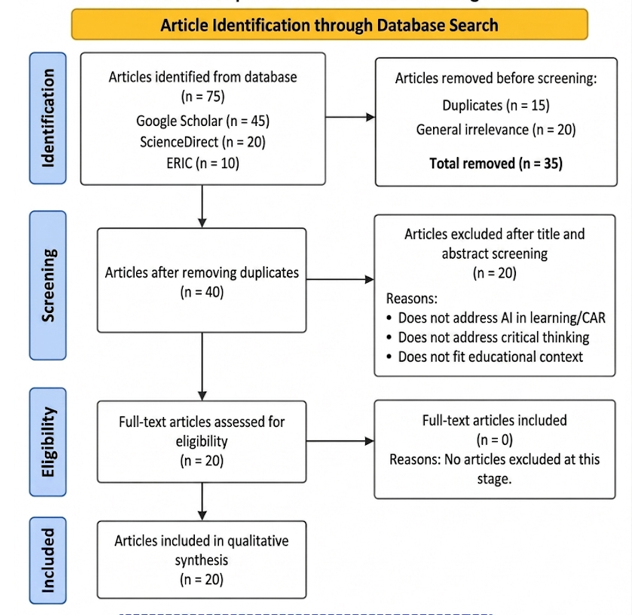
The rapid development of Artificial Intelligence (AI) in education has opened new opportunities for pedagogical innovation, including in the practice of Classroom Action Research (CAR). This study aims to analyze and synthesize how AI is integrated across the CAR cycle and to examine its contribution to the development of students' critical thinking skills. A systematic literature review was conducted following the PRISMA (Preferred Reporting Items for Systematic Reviews and Meta-Analyses) protocol. Twenty peer-reviewed articles published between 2023 and 2026, retrieved from Google Scholar, ScienceDirect, and ERIC, were analyzed through thematic categorization and narrative synthesis. AI is no longer positioned merely as an instructional tool; it is increasingly embedded across all stages of the CAR cycle, with the most prominent role emerging in the observation and reflection phases, where it supports learning data analysis and delivers rapid, adaptive feedback. AI integration is associated with improved student engagement and learning outcomes, as well as stronger analytical, evaluative, and argumentation skills. However, the benefits are not automatic: unstructured or excessive use of AI risks fostering dependency and reducing the depth of students' independent thinking. This review offers one of the first comprehensive syntheses of AI integration across the entire CAR cycle—planning, acting, observing, and reflecting—linking it explicitly to critical-thinking development within a reflective, teacher-led inquiry framework, an intersection that remains underexplored in the extant literature.
References
Abubakar, S., Jeilani, A., & Yusuf, M. (2025). The role of over-reliance on AI in the negative consequences of student learning: The moderating effects of ethical concerns and institutional policies. Cogent Education, 12(1), 2591503. https://doi.org/10.1080/2331186X.2025.2591503
Aini, A. N., & Putranta, H. (2025). The Effect Of Using Artificial Intelligence (AI) On Students’ Critical Thinking Skills In Magnetic Electricity Courses. JPPIPA: Jurnal Penelitian Pendidikan IPA, 10(2), 2025. https://doi.org/10.26740/jppipa.v10n2.p94-104
Ali, Z. A. (2025). Artificial Intelligence in Education: Applications, Challenges, and Future Directions–a Critical Review. International Journal of Ethical AI Application, 1(3), 49–55. https://doi.org/10.64229/88956K15
Alkhawaja, L., Idris, M., Al-Sayyed, S., & Al Jaber, A. M. (2025). Exploring the impact of Artificial Intelligence on students’ skills for sustainable development in education. Frontiers in Education, 10, 1–12. https://doi.org/10.3389/feduc.2025.1691148
Alqahtani, T., Badreldin, H. A., Alrashed, M., Alshaya, A. I., Alghamdi, S. S., Bin Saleh, K., ... & Albekairy, A. M. (2023). The emergent role of artificial intelligence, natural learning processing, and large language models in higher education and research. Research in social and administrative pharmacy, 19(8), 1236-1242. https://doi.org/10.1016/j.sapharm.2023.05.016
Annastiar, S., Suparni, Arfinanti, N., & Wedyastuti, R. (2026). Implementasi PTK Berbasis Lesson Study melalui Penerapan Media Interaktif Canva AI terhadap Hasil Belajar Peserta Didik. JURNAL. MathEdu (Mathematic Education Journl), 9(1). https://doi.org/10.37081/mathedu.v9i1.7849
Antoci, D., & Borozan, M. (2024). The Theoretical Model of Pedagogical Action Research in the configuration of the current significance assigned to action research. Analele Universității din Craiova, 47(2), 19-35. https://www.ceeol.com/search/article-detail?id=1321229
Aprianto, I., Rahmawati, S., & Sufyadi, S. (2025). Artificial intelligence and its effects on critical thinking and problem-solving abilities in higher education. Indonesian Journal of Educational Development (IJED), 6(3), 704-719. https://doi.org/10.59672/ijed.v6i3.5030
Arifin, M. Z., Zulkarnain, I., & Ansori, H. (2025). The influence of artificial intelligence on critical thinking ability in mathematics: A systematic literature review. Indonesian Journal of Science and Mathematics Education, 8(1), 82–92. https://doi.org/10.24042/ijsme.v8i1.24352
Aripuspita, L. M., Dewi, K. S., & Pratiwi, N. P. A. (2026). The Use of Artificial Intelligence as a Personalized Correction Tool to Improve Students’ Writing Skill. Journal of English Language and Education, 11(2), 2026. https://doi.org/10.31004/jele.v11i2.2192
Bauer, E., Greiff, S., Graesser, A. C., Scheiter, K., & Sailer, M. (2025). Looking beyond the hype: Understanding the effects of AI on learning. Educational Psychology Review, 37(2), 45. https://doi.org/10.1007/s10648-025-10020-8
Garzón, J., Patiño, E., & Marulanda, C. (2025). Systematic Review of Artificial Intelligence in Education: Trends, Benefits, and Challenges. Multimodal Technologies and Interaction, 9(8), 1–19. https://doi.org/10.3390/mti9080084
González-Pérez, L. I., & Ramírez-Montoya, M. S. (2022). Components of Education 4.0 in 21st century skills frameworks: systematic review. Sustainability, 14(3), 1493. https://doi.org/10.3390/su14031493
Hariyanto, Kristianingsih, F. X. D., & Maharani, R. (2025). Artificial intelligence in adaptive education: a systematic review of techniques for personalized learning. Discover Education, 4(1), 458. https://doi.org/10.1007/S44217-025-00908-6
Hong, H., Vate-U-Lan, P., & Viriyavejakul, C. (2025). Generative AI–mediated scaffolds for enhanced critical thinking in EFL writing. Edelweiss Applied Science and Technology, 9(6), 43–54. https://doi.org/10.55214/25768484.v9i6.7751
Ingram, J., Stiff, J., Cadwallader, S., Lee, G., & Kayton, H. (2023). PISA 2022: National Report for England. Research Report. UK Department for Education.
Isnur, S. J., & Alrasi, F. (2026). Penelitian Tindakan Kelas (PTK) Inovatif melalui Integrasi Teknologi dan Media dalam Pembelajaran Abad ke-21. TSAQOFAH, 6(2), 2384–2394. https://doi.org/10.58578/tsaqofah.v6i2.8991
Lawasi, M. C., Rohman, V. A., & Shoreamanis, M. (2024). The Use of AI in Improving Student’s Critical Thinking Skills. Proceedings Series on Social Sciences & Humanities, 18, 366–370. https://doi.org/10.30595/pssh.v18i.1279
Melisa, R., Ashadi, A., Triastuti, A., Hidayati, S., Salido, A., Ero, P. E. L., Marlini, C., Zefrin, Z., & Al Fuad, Z. (2025). Critical Thinking in the Age of AI: A Systematic Review of AI’s Effects on Higher Education. Educational Process International Journal, 14(1). https://doi.org/10.22521/edupij.2025.14.31
Nag, S. K., & Dwivedi, S. K. (2024). Effect of Critical Thinking on Decision Making Efficacy of Students at Senior Secondary Level. International Journal of Indian Psychȯlogy, 12(3). https://doi.org/10.25215/1203.003
Nopasari, D., & Muarif, J. A. (2025). Classroom Action Research as a tool for teacher reflection and innovation in critical analysis of scientific literature. Proceeding International Collaborative Conference on Multidisciplinary Science (Vol. 2, No. 2, pp. 162-168). https://doi.org/10.70062/iccms.v2i2.151
OECD. (2023). PISA 2022 Results (Volume I): The State of Learning and Equity in Education. OECD Publishing. https://doi.org/10.1787/53f23881-en
Pratiwi, S., & Zahra, R. R. (2026). Penggunaan Artificial Intelligence Animated Drawings Dalam Kegiatan Menggambar Sebagai Upaya Meningkatkan Kreativitas Anak Usia Dini. Jurnal Pendidikan Islam Anak Usia Dini ( Anaking ), 4(2), 115–123. https://doi.org/10.37968/anaking.v4i2.1340
Primandiri, P. R., Rohmania, Q. N., Afifah, I. N., & Santoso, A. M. (2025). Penerapan Strategi Pembelajaran ASICC untuk Meningkatkan Keterampilan Berpikir Kritis Siswa SMAN 1 Kediri. PTK: Jurnal Tindakan Kelas, 5(2), 301-308. https://doi.org/10.53624/ptk.v5i2.575
Putri, N. N., Ningsih, K., & Supartini, S. (2023). Efforts to Improve 4C Skills (Critical Thinking, Collaborative, Communicative, and Creative) Through Project-Based Learning. BIOTIK: Jurnal Ilmiah Biologi Teknologi Dan Kependidikan, 11(2), 159–169. https://doi.org/10.22373/biotik.v11i2.18326
Qadariah, N., Nengsih, R., Mairisiska, T., Rimin, R., Kurniati, R., & Qalbina, P. (2026). Feasibility Analysis of Essay Test Instruments to Assess Students’ Critical Thinking Skills in Contextual Learning. JURNAL BIOSHELL, 15(1), 33-47. https://doi.org/10.56013/bio.v15i1.4842
Riyanto, A. J., Hanif, M., & Nugraha, N. (2025). Penggunaan Teknologi Artificial Intelligence (AI) untuk Meningkatkan Hasil Belajar IPS Siswa SMP. Jurnal Ilmu Sosial Dan Pendidikan, 6(1), 155–170. https://jurnal.iainponorogo.ac.id/index.php/asanka/article/view/11099
Sajja, R., Sermet, Y., Cikmaz, M., Cwiertny, D., & Demir, I. (2024). Artificial intelligence-enabled intelligent assistant for personalized and adaptive learning in higher education. Information, 15(10), 596. https://doi.org/10.3390/info15100596
Salido, A., Syarif, I., Sitepu, M. S., Suparjan, Wana, P. R., Taufika, R., & Melisa, R. (2025). Integrating critical thinking and artificial intelligence in higher education: A bibliometric and systematic review of skills and strategies. Social Sciences & Humanities Open, 12, 1–13. https://doi.org/10.1016/j.ssaho.2025.101924
Sari, N., & Zuraya, H. (2025). Enhancing the Capacity for Classroom Action Research Utilizing Artificial Intelligence Among Teachers at MAN Bengkayang. At-Turats, 18(2), 152–174. https://doi.org/10.24260/at-turats.v18i2.3390
Shukor, N. A. F., & Osman, K. (2025). The Role of Artificial Intelligence in Developing Critical Thinking among Science Students: A Systematic Literature Review. International Journal of Academic Research in Progressive Education and Development, 14(3), 164–176. https://doi.org/10.6007/IJARPED/v14-i3/25576
Siregar, I., Salmah, T., Hartati, T., & Nola, I. S. (2024). Refleksi Dan Evaluasi Dalam Penelitian Tindakan Kelas. QOUBA: Jurnal Pendidikan, 1(1), 41-47. https://doi.org/10.61104/QOUBA.V1I1.159
Sopacua, F., Tomi, A. S., Muhammad, C. A., Dewanto, Safira, I., & Wijoyo, H. (2026). The Impact Of Artificial Intelligence Integration On Students’ Critical Thinking And Problem-Solving Skills In Higher Education. JKIP : Jurnal Kajian Ilmu Pendidikan, 7(1), 384–392. https://doi.org/10.55583/jkip.v7i1.1898
Syahputra, F., Sabrina, E., Simbolon, A. B., Nasution, A. R., Hutagalung, N. R., Amanda, N., Siboro, S. A., & Sirait, S. (2024). Impact of Using Artificial Intelligence in Learning on Students’ Critical Thinking Skills: A Literature and Public Sentiment Analysis Study. Journal Corner of Education, Linguistics, and Literature, 4(001), 568–577. https://doi.org/10.54012/jcell.v4i001.441
Tarwanto, R. A., Sujana, Y., & Prakisya, N. P. T. The Role of Artificial Intelligence in Enhancing Critical Thinking in Education: A Systematic Literature Review. IJIE (Indonesian Journal of Informatics Education), 9(2), 116-124. https://doi.org/10.20961/ijie.v9i1.103868
Vildósola, M., Salcedo-Lagos, P., Kotz, G., & Sanhueza-Campos, C. (2025). Contributions of AI Tools to Critical Thinking Development in EFL Learning: A Systematic Review and Meta-Analysis. Computer-Assisted Language Learning Electronic Journal: Special Issue AIIDLE, 26(7), 2025. https://orcid.org/0000-0002-7924-5910
Walter, Y. (2024). Embracing the future of Artificial Intelligence in the classroom: the relevance of AI literacy, prompt engineering, and critical thinking in modern education. International journal of educational technology in higher education, 21(1), 15. https://doi.org/10.1186/s41239-024-00448-3
Wang, D., & Huang, X. (2025). Transforming education through artificial intelligence and immersive technologies: enhancing learning experiences. Interactive Learning Environments, 33(7), 4546-4565. https://doi.org/10.1080/10494820.2025.2465451
Wang, D., & Jia, Q. (2023). Twenty years of research development on teachers’ critical thinking: Current status and future implications——A bibliometric analysis of research articles collected in WOS. Thinking Skills and Creativity, 48, 101252. https://doi.org/10.1016/j.tsc.2023.101252
Wibowo, A. S., Patonah, S., & Novita, M. (2026). Analysis Of High School Students’critical And Computational Thinking Skills In Thermochemistry. Jurnal Pendidikan Matematika dan IPA, 17(1), 1-13. https://doi.org/10.26418/jpmipa.v17i1.104115
Williamson, B., & Eynon, R. (2020). Historical threads, missing links, and future directions in AI in education. Learning, Media and Technology, 45(3), 223-235. https://doi.org/10.1080/17439884.2020.1798995
Yani, I. P., Ahzari, S., & Novitra, F. (2026). Technology Integration in the Project Based Learning Model: Bibliometric Analysis 2015-2024. arXiv preprint arXiv:2601.09149. https://doi.org/10.48550/arXiv.2601.09149
Yavich, R. (2025). Will the use of AI undermine students independent thinking?. Education Sciences, 15(6), 669. https://doi.org/10.3390/educsci15060669
Zhai, C., Wibowo, S., & Li, L. D. (2024). The effects of over-reliance on AI dialogue systems on students' cognitive abilities: a systematic review. Smart learning environments, 11(1), 28. https://doi.org/10.1186/s40561-024-00316-7
Downloads
Published
How to Cite
Issue
Section
License
Copyright (c) 2026 Yusriani Yusriani, Andi Yuyung

This work is licensed under a Creative Commons Attribution-ShareAlike 4.0 International License.