The Effectiveness of a Differentiated Learning Approach: Creativity and Elementary School Students' IPAS Learning Outcomes

https://doi.org/10.51574/ijrer.v5i3.4949
Keywords:
Creativity, Differentiated Learning, Elementary School, IPAS, Learning OutcomesAbstract
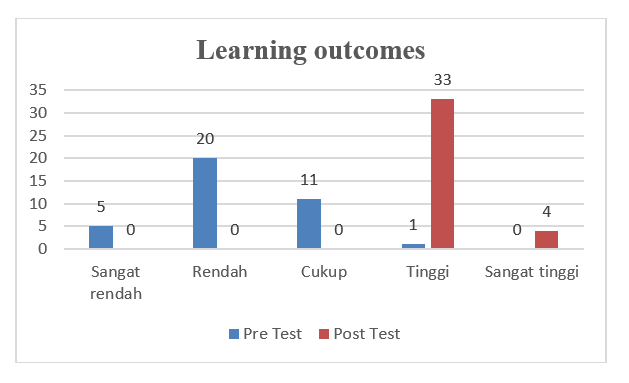
This research is motivated by the low level of creativity and student learning outcomes in Natural and Social Sciences (IPAS) subjects in grade V at Elementary School Lantebung, Makassar City, which is caused by conventional learning processes that have not accommodated the diversity of student characteristics. The purpose of this study is to test the effectiveness of the implementation of a differentiated learning approach in improving students' creativity and learning outcomes in IPAS. The research method used is a quasi-experimental design with the one-group pretest-posttest design on 37 grade V students. Data collection techniques were carried out through learning outcome tests, observations of teacher and student activities, and creativity assessments. Data was analyzed using descriptive statistics and paired sample t-tests. The results showed a significant transformation in the classroom ecosystem, marked by a progressive increase in teacher pedagogical competence (64% to 93%) and student learning activities (60% to 89%). Academically, the average value of learning outcomes increased sharply from 47.43 to 76.89 (t = 18.073; p < 0.000), with a drastic decrease in standard deviation from 11.99 to 6.38, proving a reduced understanding gap among students. Furthermore, this strategy significantly stimulated all aspects of divergent thinking (t = 26.760; p < 0.000), with optimal development in flexibility and elaboration. In conclusion, differentiated learning is an empirically valid, effective, and inclusive model that is highly adaptive to students' characteristics, interests, and learning readiness in maximizing both cognitive potential and creativity in elementary schools.
References
Aisah, D. N., Munandar, K., Wadiono, G., & Jannah, S. R. (2023). Increasing Students' Creative Thinking Through Differentiated Learning with an CRT-Integrated PjBL Model. Bioeduca: Journal of Biology Education, 5(2), 125-132. https://doi.org/10.21580/bioeduca.v5i2.17299
Akhiruddin, A., Bashori, I., & Pasiamping, Y. (2024). The Influence of Differentiated Learning Strategies on Motivation and Geography Learning Outcomes. AL-ISHLAH: Jurnal Pendidikan, 16(3), 3732-3741. https://doi.org/10.35445/alishlah.v16i3.5073
Alamer, A., Robat, E. S., Shirvan, M. E., & Ryan, R. (2025). Self-determination theory and language learning: A multilevel meta-analysis. Educational Psychology Review, 37(2), 59. https://doi.org/10.1007/s10648-025-10038-y
Aminah, S. A., & Setyowati, N. A. D. (2024). The influence of the Project Based Learning model using video on the creativity thinking ability and IPAS learning outcomes for elementary school students. JP (Jurnal Pendidikan): Teori dan Praktik, 9(1), 67-75. https://doi.org/10.26740/jp.v9n1.p67-75
Angreni, S., Sari, R. T., Hamda, F., & Zainul, R. (2026). Differentiated Learning in Elementary Schools: A Systematic Literature Review from an Inclusive Education Perspective. Journal of ICSAR, 148-163. https://doi.org/10.17977/um005v10i12026p148-163
Barbot, B., Naczenski, L. M., Baas, M., & Stevenson, C. E. (2026). Varieties of divergent thinking: A network analysis of Guilford, Merriefield and Cox (1961). Intelligence, 114, 101975. https://doi.org/10.1016/j.intell.2025.101975
Bernard, R. M., Borokhovski, E., Schmid, R. F., Waddington, D. I., & Pickup, D. I. (2019). Twenty‐first century adaptive teaching and individualized learning operationalized as specific blends of student‐centered instructional events: A systematic review and meta‐analysis. Campbell Systematic Reviews, 15(1-2), e1017. https://doi.org/10.1002/cl2.1017
Bondie, R. S., Dahnke, C., & Zusho, A. (2019). How does changing “one-size-fits-all” to differentiated instruction affect teaching?. Review of Research in Education, 43(1), 336-362. https://doi.org/10.3102/0091732X18821130
Brenner, C. A. (2022). Self-regulated learning, self-determination theory and teacher candidates’ development of competency-based teaching practices. Smart Learning Environments, 9(1), 3. https://doi.org/10.1186/s40561-021-00184-5
Dack, H. (2018). Structuring teacher candidate learning about differentiated instruction through coursework. Teaching and Teacher Education, 69, 62-74. https://doi.org/10.1016/j.tate.2017.09.017
Eksangkul, N., Li, Z., & Liu, N. (2024). Integrating Teacher-Centred and Student-Centred Approaches for Effective Online Teaching. Asia Social Issues, 17(2), e255453-e255453. https://doi.org/10.48048/asi.2023.255453
Glăveanu, V. P., & Kaufman, J. C. (2020). The creativity matrix: Spotlights and blind spots in our understanding of the phenomenon. The Journal of Creative Behavior, 54(4), 884-896. https://doi.org/10.1002/jocb.417
Goyibova, N., Muslimov, N., Sabirova, G., Kadirova, N., & Samatova, B. (2025). Differentiation approach in education: Tailoring instruction for diverse learner needs. MethodsX, 14, 103163. https://doi.org/10.1016/j.mex.2025.103163
Haq, M. R. I., & Arifin, M. B. U. B. (2024). Implementation of the Project-Based Differentiated Learning Model in Science and Social Sciences (Ipas). Jurnal Pendidikan Glasser, 8(1), 98-113. https://lonsuit.unismuhluwuk.ac.id/glasser/article/view/3177
Hardiansyah, F., AR, M. M., & Hidayatillah, Y. (2022). Ipas learning assessment to measure science process skill in elementary school. International Journal of Elementary Education, 6(4), 612-623. https://doi.org/10.23887/ijee.v6i4.54217
Jaelani, K. (2025). The Effectiveness of the Differentiation Approach in Accommodating Students' Learning Styles in Inclusive Classrooms. Indonesian Journal of Educational Research and Evaluation Global, 1(1), 9-17. https://e-journal.nusantaraglobal.ac.id/index.php/ijereg/article/view/3
Joanan, S., & Rahmadani, N. (2025). Differentiated Learning: Strategies for Accommodating Elementary School Students' Learning Styles. JOBE: Journal of Basic Education, 1(1), 43-58. https://journal.zmsadra.or.id/index.php/fej/article/view/79
Komariah, M., As’ary, M. Y., Hanum, C. B., & Maftuh, B. (2023). IPAS Implementation in Elementary Schools: How Teachers Build Student Understanding. Edunesia: Jurnal Ilmiah Pendidikan, 4(3), 1399-1412. https://doi.org/10.51276/edu.v4i3.533
Lestari, M. I., Anshory, I., & Wijayaningputri, A. R. (2024). Analysis of Student Learning Style in IPAS Learning with a Differentiated Learning Approach as an Optimization of the MerdekaCurriculum at Elementary School. JIP Jurnal Ilmiah PGMI, 10(2), 11-22. https://jurnal.radenfatah.ac.id/index.php/jip/article/view/25436
Mishra, N. R. (2023). Constructivist approach to learning: An analysis of pedagogical models of social constructivist learning theory. Journal of research and development, 6(01), 22-29. https://nepjol.info/index.php/jrdn/article/view/55227
Mullen, C. A. (2020). Creativity framed: definitional descriptions, theories, and the 4-Cs. In Revealing creativity: Exploration in transnational education cultures (pp. 19-45). Cham: Springer International Publishing. https://doi.org/10.1007/978-3-030-48165-0_3
Musfita, M., Rasmitadila, R., & Puspitasari, K. A. (2025). Development of IPAS Learning Modules Based on Differentiated Instruction. Journal of Educational Sciences, 9(5), 4232-4247. https://doi.org/10.31258/jes.9.5.p.4232-4247
Muyassaroh, I., Saputri, A. E., Saefudin, A., Djumhana, N., Rengganis, I., & Darmayanti, M. (2023). Teachers’ Perception and Readiness Toward IPAS Learning Implementation of the Merdeka Curriculum. DWIJA CENDEKIA: Jurnal Riset Pedagogik, 7(3). https://doi.org/10.20961/jdc.v7i3.80728
Ness, I. J. (2023). Zone of proximal development. In The Palgrave encyclopedia of the Possible (pp. 1781-1786). Cham: Springer International Publishing. https://doi.org/10.1007/978-3-030-90913-0_60
Nisa, F., Fiteriani, I., & Ningrum, A. R. (2025). The Concept of IPAS with the LSQ Learning Method: Question Card Media for Primary School Students. ETDC: Indonesian Journal of Research and Educational Review, 4(4), 1269-1279. https://doi.org/10.51574/ijrer.v4i4.3822
Nurmala, N., Paik, I. N., & Fitriani, Y. (2025). Implementing Differentiated Learning to Foster Learning Interest and Creative Thinking among Diverse Elementary School Students. Journal of Innovation and Research in Primary Education, 4(3), 1721-1735. https://ejournal.papanda.org/index.php/jirpe/article/view/1822
Padmore, E. A., & Ali, C. A. (2024). Exploring effective differentiated instruction in the teaching and learning of mathematics. ASEAN Journal for Science Education, 3(1), 41-54. https://ejournal.bumipublikasinusantara.id/index.php/ajsed/article/view/320
Raslan, G. (2024). The impact of the zone of proximal development concept (scaffolding) on the students problem solving skills and learning outcomes. In BUiD Doctoral Research Conference 2023: Multidisciplinary Studies (pp. 59-66). Cham: Springer Nature Switzerland. https://doi.org/10.1007/978-3-031-56121-4_6
Ratnawati, E., Sobri, A. Y., & Arifin, I. (2025). Differentiated Learning Management in Improving Children's Cognitive Development and Creativity in Kindergarten. ETDC: Indonesian Journal of Research and Educational Review, 5(1), 717-730. https://doi.org/10.51574/ijrer.v5i1.4458
Sibley, L., Fabian, A., Plicht, C., Pagano, L., Ehrhardt, N., Wellert, L., ... & Lachner, A. (2025). Adaptive teaching with technology enhances lasting learning. Learning and instruction, 99, 102141. https://doi.org/10.1016/j.learninstruc.2025.102141
Tang, K. H. D. (2023). Student-centered approach in teaching and learning: What does it really mean?. Acta Pedagogia Asiana, 2(2), 72-83. https://doi.org/10.53623/apga.v2i2.218
Wang, S., Sun, Z., & Chen, Y. (2023). Effects of higher education institutes’ artificial intelligence capability on students' self-efficacy, creativity and learning performance. Education and Information Technologies, 28(5), 4919-4939. https://doi.org/10.1007/s10639-022-11338-4
Yumiarty, Y., Sakina, U. P., Irsal, I. L., & Gunawan, G. (2025). The Impact of Scaffolding Strategies Within the Zone of Proximal Development on Fourth-Grade Students’ Conceptual Understanding in Mathematics. AL-ISHLAH: Jurnal Pendidikan, 17(3), 4406-4414. https://doi.org/10.35445/alishlah.v17i3.7523
Ziernwald, L., Hillmayr, D., & Holzberger, D. (2022). Promoting high-achieving students through differentiated instruction in mixed-ability classrooms—A systematic review. Journal of Advanced Academics, 33(4), 540-573. https://doi.org/10.1177/1932202X221112931
Downloads
Published
How to Cite
Issue
Section
License
Copyright (c) 2026 Asmaul Husna Kasim, Supriadi Supriadi, Erwin Nurdiansyah

This work is licensed under a Creative Commons Attribution-ShareAlike 4.0 International License.