Educational and Cultural Value of the Pakarena Anida Dance: A Medium for Passing on Local Wisdom in High Schools

https://doi.org/10.51574/ijrer.v5i1.4377
Keywords:
Bhakti Seni Studio, Cultural Heritage, Educational Values, Local Wisdom, Pakarena Anida DanceAbstract
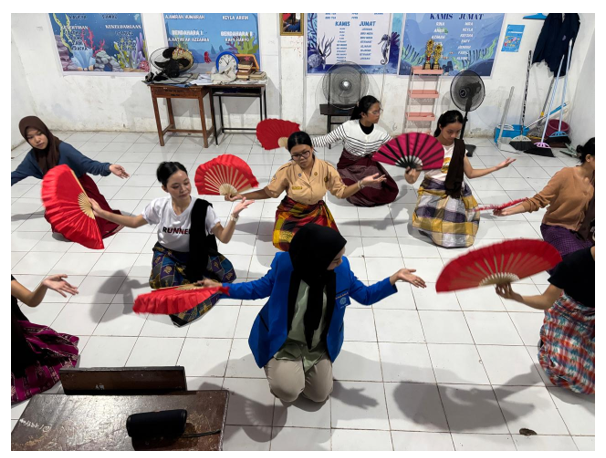
This paper addresses modernization's propensity to undermine local wisdom. This research asks how the Pakarena Anida Dance can teach young people educational and cultural values in a sustainable way. This study seeks to (1) identify and define the educational values in each Pakarena Anida Dance movement, property, and accompaniment. (2) the Sanggar Bhakti Seni 05 Makassar's role in preserving this dance is to carry on indigenous wisdom. This research uses a qualitative descriptive method. We chose this approach to provide a rich, in-depth, and holistic picture of the phenomenon under study. The main subjects of the research are Sanggar Bhakti Seni 05 (High School 5 Makassar), with a focus on the studio managers, trainers, and students who are actively involved in learning the Pakarena Anida Dance. Participatory observation, in-depth interviews with key informants, and document analysis of studio curriculum and training methods collected data. Research shows that the Pakarena Anida Dance is a rich source of local wisdom. Education emphasizes discipline, ethics/courtesy (particularly amongst men and women), patience, and respect for ancestors. An integrated approach to technical dance instruction and cultural philosophy at Sanggar Bhakti Seni 05 Makassar helps students internalize these principles. This study contributes theoretically to performing arts studies as a source of socio-cultural knowledge and practically to educational institutions and local governments in developing cultural preservation policies based on non-formal education and arts communities.
References
Abtahi, Y. (2018). Pupils, tools and the Zone of Proximal Development. Research in Mathematics Education, 20(1), 1-13. https://doi.org/10.1080/14794802.2017.1390691
Aldyan, A., Putri, K. A., Aldyan, R. A., & Alasttal, A. (2024). Local Wisdom-Based Environmental Management Policy in Indonesia: Challenges and Implementation. Journal of Law, Environmental and Justice, 2(3), 332-354. https://doi.org/10.62264/jlej.v2i3.100
Allott, N. (2013). Relevance theory. In Perspectives on linguistic pragmatics (pp. 57-98). Cham: Springer International Publishing. https://doi.org/10.1007/978-3-319-01014-4_3
Amin, M., & Ritonga, A. D. (2024). Diversity, local wisdom, and unique characteristics of millennials as capital for innovative learning models: Evidence from North Sumatra, Indonesia. Societies, 14(12), 260. https://doi.org/10.3390/soc14120260
Arifin, I., Muhaemin, M., & Satriadi, S. (2025). Design Education As A Media Transmission Of Social Values Based On Local Wisdom. Prima Magistra: Jurnal Ilmiah Kependidikan, 6(2), 81-91. https://doi.org/10.37478/jpm.v6i2.5561
Arsal, T., Setyowati, D. L., & Hardati, P. (2023). The inheritance of local wisdom for maintaining peace in multicultural society. Journal of Aggression, Conflict and Peace Research, 15(2), 137-151. https://doi.org/10.1108/JACPR-01-2022-0673
Ascenzi, A., Brunelli, M., & Meda, J. (2021). School museums as dynamic areas for widening the heuristic potential and the socio-cultural impact of the history of education. A case study from Italy. Paedagogica Historica, 57(4), 419-439. https://doi.org/10.1080/00309230.2019.1660387
Chaer, M. T., & Rochmah, E. Y. (2021). Education based on local wisdom. Journal of Islamic Education, 6(2), 145-157. http://ejournal.stitmuhbangil.ac.id/index.php/jie/article/view/32
Daeng, K., & Rahim, I. (2025). Kajian Makna Kelong dalam Pertunjukan Tari Pakarena Samborikna di Kabupaten Gowa: Study Of The Meaning Of Kelong In The Pakarena Samborikna Dance Performance In Gowa District. Journal Studies in Indonesian Language and Literature, 1(3), 144-151.
da Silva, C., Pereira, F., & Amorim, J. P. (2024). The integration of indigenous knowledge in school: a systematic review. Compare: A Journal of Comparative and International Education, 54(7), 1210-1228. https://doi.org/10.1080/03057925.2023.2184200
Edensor, T. (2020). National identity, popular culture and everyday life. Routledge. https://doi.org/10.4324/9781003086178
Eko, B. S., & Putranto, H. (2019). The role of intercultural competence and local wisdom in building intercultural and inter-religious tolerance. Journal of Intercultural Communication Research, 48(4), 341-369. https://doi.org/10.1080/17475759.2019.1639535
Fauzan, A. (2025). The Transformation of Traditional Culture in Responding to the Challenges of Globalization in Local Indonesian Communities. The Journal of Academic Science, 2(3), 1021-1030. https://doi.org/10.59613/42jzr037
Ibrahim, A., & Rachmat, R. (2021). 'Pakarena'dance image classification using convolutional neural network algorithm. ILKOM Jurnal Ilmiah, 13(2), 134-139. https://doi.org/10.33096/ilkom.v13i2.816.134-139
Jensen, L. A., & Arnett, J. J. (2012). Going global: New pathways for adolescents and emerging adults in a changing world. Journal of Social Issues, 68(3), 473-492. https://doi.org/10.1111/j.1540-4560.2012.01759.x
Karim, S. (2021). Acculturation in a globalised world: Implications for theory and educational policy and practice. International journal of comparative education and development, 23(1), 44-58. https://doi.org/10.1108/IJCED-11-2020-0078
Karimi-Aghdam, S. (2017). Zone of proximal development (ZPD) as an emergent system: A dynamic systems theory perspective. Integrative Psychological and Behavioral Science, 51(1), 76-93. https://doi.org/10.1007/s12124-016-9359-1
Khalik, S., & Mustika, M. (2022). The Siri’Culture Of Makassar Women In Pakarena Anida Dance. La Ogi: English Language Journal, 8(1), 55-59.
Lestari, N., & Suyanto, S. (2024). A systematic literature review about local wisdom and sustainability: Contribution and recommendation to science education. Eurasia Journal of Mathematics, Science and Technology Education, 20(2), em2394. https://doi.org/10.29333/ejmste/14152
Lieber, R. J., & Weisberg, R. E. (2002). Globalization, culture, and identities in crisis. International Journal of Politics, Culture, and Society, 16(2), 273-296. https://doi.org/10.1023/A:1020581114701
Lim, M., Permana, L., Hongo, V. B., Kiandra, K., Nabasa, K., & Hasudungan, A. (2021). The roles and capabilities of formal, non-formal, and informal institutions in shaping education access in Cigugur Sub-district, West Java, Indonesia. Budapest International Research and Critics Institute (BIRCI-Journal): Humanities and Social Sciences, 4(1), 696-708.
Malik, A. (2025). Pakarena Dance as a Medium for Character Education: A Phenomenological Study in South Sulawesi Elementary Schools. Journal of Local Wisdom in Education, 1(1), 18-32. https://doi.org/10.26618/7dvtkb48
Mursidi, A. (2025). Transformation of History Education Based on Local Wisdom to Foster Historical Awareness in Generation Z. Jurnal Iqra': Kajian Ilmu Pendidikan, 10(3), 1-20. https://doi.org/10.25217/ji.v10i3.6525
Musthafa, N. Q., & Darmawan, W. (2024). Generation Z As Agent Of Change In Preserving Local Culture In The Era Globalization. International Conference of Humanities and Social Science (ICHSS) (pp. 983-990). https://programdoktorpbiuns.org/index.php/proceedings/article/view/460
Newman, S., & Latifi, A. (2021). Vygotsky, education, and teacher education. Journal of Education for Teaching, 47(1), 4-17. https://doi.org/10.1080/02607476.2020.1831375
Padalia, A., & Sahnir, N. (2023). Mengungkap Makna di Balik Tarian Tradisional Pepe-pepe ri Makkah Pada Masyarakat Makassar. Seminar Nasional Dies Natalis 62 (Vol. 1, pp. 563-574). https://doi.org/10.59562/semnasdies.v1i1.1092
Perbawasari, S., Subekti, P., & Setyanto, Y. (2024). Strategies for herbal knowledge inheritance through non-formal education in traditional villages. Jurnal Komunikasi, 16(1), 205-225. https://doi.org/10.24912/jk.v16i1.29048
Pornpimon, C., Wallapha, A., & Prayuth, C. (2014). Strategy challenges the local wisdom applications sustainability in schools. Procedia-Social and Behavioral Sciences, 112, 626-634. https://doi.org/10.1016/j.sbspro.2014.01.1210
Pramana, A. D. R., Astuti, T. M. P., Malarsih, M., & Sinaga, S. S. (2025). Embodied pedagogy and ecological ethics: Internalising environmental values through the Pakarena Anida dance in South Sulawesi. Journal of Environment and Sustainability Education, 3(3), 369-376. https://doi.org/10.62672/joease.v3i3.122
Pramana, A. D. R., & Nugrahaeni, T. (2019). Pakarena anida dance as guidance values of Buginese women in Indonesia. International Conference on Arts and Design Education (ICADE 2018) (pp. 262-266). Atlantis Press.
Salama, A. M., & Patil, M. P. (2025). The socius in architectural pedagogy: Transformative design studio teaching models. Architecture, 5(3), 61. https://doi.org/10.3390/architecture5030061
Samsul Hady, M., Roibin, Teguh Prastyo, A., Bakar, A., Faslah, R., Malik Fajar Alam, A., ... & Abdul Ghani, M. Z. (2025). Cultural transformation: religious moderation from manuscripts heritage to living tradition in Indonesia and Malaysia. Cogent Education, 12(1), 2556891. https://doi.org/10.1080/2331186X.2025.2556891
Santos, M. H. D. S. R., & Rios, J. A. V. P. (2021). Education and cultural differences: boundary educational practices in basic education. Revista Tempos e Espaços em Educação, 14(33).
Sari, Y., & Syahrir, N. (2024). Analisis koreografi tari Pakarena Ma’lino produksi Lembaga Kesenian Batara Gowa di Makassar. Variable Research Journal, 1(02), 343-357. https://variablejournal.my.id/index.php/VRJ/article/view/52
Syahrir, N., & Alimuddin, A. (2024). Integrating computing techniques in preserving Makassar’s Pakarena dance heritage. Indonesian Journal of Electrical Engineering and Computer Science, 36(3), 1674-1682.
Taber, K. S. (2025). Mediated learning leading development—The social development theory of Lev Vygotsky. In Science education in theory and practice: An introductory guide to learning theory (pp. 275-292). Cham: Springer Nature Switzerland. https://doi.org/10.1007/978-3-031-81351-1_16
Wijaya, E. P. (2024). Manajemen Pelestarian Sinrilik Keso-Keso sebagai Warisan Budaya Takbenda Sulawesi Selatan. Jurnal Tata Kelola Seni, 10(1), 1-14. https://doi.org/10.24821/jtks.v10i1.12053
Xi, J., & Lantolf, J. P. (2021). Scaffolding and the zone of proximal development: A problematic relationship. Journal for the Theory of Social Behaviour, 51(1), 25-48. https://doi.org/10.1111/jtsb.12260
Yoon, E., Cabirou, L., Galvin, S., Hill, L., Daskalova, P., Bhang, C., ... & Baltazar, B. (2020). A meta-analysis of acculturation and enculturation: Bilinear, multidimensional, and context-dependent processes. The Counseling Psychologist, 48(3), 342-376. https://doi.org/10.1177/0011000019898583
Downloads
Published
How to Cite
Issue
Section
License
Copyright (c) 2025 Nur Indah Swara Rahman, Johar Linda, Asia Ramli

This work is licensed under a Creative Commons Attribution-ShareAlike 4.0 International License.