The Secret of Brotherhood-Based Education: A Holistic Ice-Breaking Strategy for Islamic Schools

https://doi.org/10.51574/ijrer.v5i1.4216
Keywords:
Character, Ice Breaking, Islamic Education, Islamic Schools, Ukhuwah IslamiahAbstract
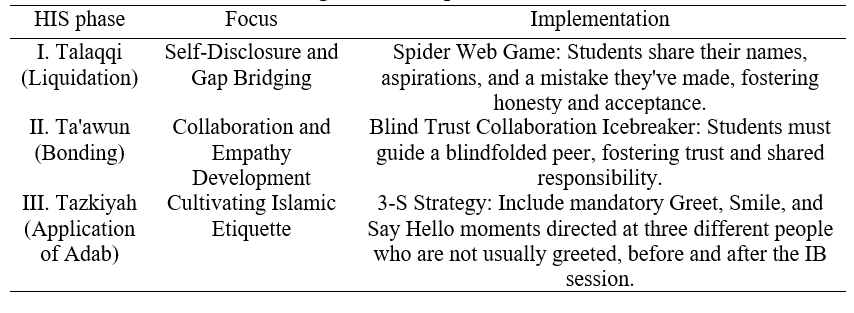
Islamic education often faces challenges in realizing solid Islamic brotherhood, where students tend to be rigid, less interactive, and compartmentalized, hindering character formation and collaboration. This study intends to analyze and formulate a holistic and sharia-relevant icebreaking optimization model as a primary strategy for strengthening brotherhood in Islamic schools. The method used is descriptive qualitative, with a case study approach in the Islamic School in Wajo Regency, involving participatory observation and in-depth interviews with teachers and students. The results indicate that the implementation of the 3-S Strategy (Salam, Senyum, Sapa) through structured icebreaking, integrated with the values of adab and muamalah, is proven effective in increasing self-disclosure and empathy among students. The main contribution of this finding is the hidden curriculum model that positions icebreaking not just as a break, but as an essential component of character education. This model provides practical contributions for Islamic educators and institutions to create a warm, inclusive, and strong learning ecosystem based on brotherhood.
References
Aisyah, A. (2024). Penerapan Metode Ice Breaking Dalam Meningkatkan Hasil Belajar Siswa Mata Pelajaran Pendidikan Agama Islam. Indonesian Journal of Multidisciplinary on Social and Technology, 2(2), 22-27. https://doi.org/10.31004/ijmst.v2i2.300
Azhari, M. R. (2025). The Role of Islamic Education in Enhancing Social Integration of the Ummah: A Theoretical Review. Indonesian Journal of Education and Science, 1(2), 57-63. https://www.journal.formadenglishfoundation.org/index.php/IJES/article/view/84
Bastomi, B., & Sirozi, M. (2024). Pola Komunikasi dalam Kepemimpinan Pendidikan Islam: Perbandingan antara Pesantren dan Madrasah. Journal of Education Research, 5(4), 6472-6480. https://doi.org/10.37985/jer.v5i4.1955
Gusrianto, G., Ouarniki, O., Zakarya, Z., Mahfuzh, T. W., Ali, A., & Simbolon, B. R. (2025). Innovation of madrasa teacher teaching: Transformation of teacher teaching creativity through performance and motivation engagement in teaching and learning. Journal of Instruction and Islamic Religious Education, 1(2), 71-86. https://doi.org/10.63826/jiire.v1i2.8
Fitria, T. N. (2023). Breaking the ice in the classroom: Using ice breaking in the teaching and learning process. Borneo Journal of English Language Education, 5(1). http://jurnal.borneo.ac.id/index.php/jele/article/view/4210
Haryati, F. D., & Puspitaningrum, D. (2023). Implementasi ice breaking sebagai pematik motivasi belajar siswa dalam pembelajaran. Jurnal Al-Ilmi Jurnal Riset Pendidikan Islam, 4(1), 99-106. https://doi.org/10.47435/al-ilmi.v4i1.2133
Iqbal, M., Panjaitan, A. Y., Helvirianti, E., Nurhayati, N., & Ritonga, Q. S. P. (2024). Relevansi pendidikan karakter dalam konteks pendidikan Islam: Membangun generasi berkarakter islami. Indonesian Research Journal on Education, 4(3), 13-22. https://doi.org/10.31004/irje.v4i3.568
Izzah, E. A. U. (2025). Holistic Competencies of Islamic Religious Teachers and Their Impact on Student Understanding in Secondary Schools. Scaffolding: Jurnal Pendidikan Islam Dan Multikulturalisme, 7(1), 99-118. https://doi.org/10.37680/scaffolding.v7i1.6886
Kulsum, U., Munirom, A., Sayuti, A., & Waluyo, B. (2024). Manajemen Kurikulum Dalam Pendidikan Islam: Integrasi Ilmu Dunia Dan Akhirat. Unisan Jurnal, 3(9), 22-33. http://journal.an-nur.ac.id/index.php/unisanjournal/article/view/3391
Maidugu, U. A., & Isah, A. T. (2024). Islamic Education and its Value: A Vital Means for the Formation National Character. Bulletin of Islamic Research, 2(4), 725-744. https://yayasanpendidikantafsirhadis.com/index.php/bir/article/view/165
Minabari, K. H., Adam, A., Bambang, S., & Jaohar, Y. (2024). Integrasi manajemen pendidikan dalam pengembangan kurikulum pendidikan agama islam di sekolah: Integration of educational management in the development of islamic religious education curriculum in schools. Edu Cendikia: Jurnal Ilmiah Kependidikan, 4(02), 631-644. https://doi.org/10.47709/educendikia.v4i02.4499
Muchtar, N. E. P., & Inayah, K. (2025). The role of Islamic education teachers in instilling ukhuwah Islamiyah through tafsir learning. ATTARBIYAH: Journal of Islamic Culture and Education, 10(1), 103-124. https://doi.org/10.18326/attarbiyah.v10i1.103-124
Mustain, M., & Bakar, M. Y. A. (2025). The Role of Islamic Boarding School Education in Shaping Students' Religious Character Amid the Challenges of Globalization. Hikmah, 22(1), 83-100. https://doi.org/10.53802/hikmah.v22i1.455
Nafsaka, Z., Kambali, K., Sayudin, S., & Astuti, A. W. (2023). Dinamika pendidikan karakter dalam perspektif Ibnu Khaldun: Menjawab tantangan pendidikan Islam modern. Jurnal Impresi Indonesia, 2(9), 903-914. https://doi.org/10.58344/jii.v2i9.3211
Nurhidayah, A., Nawawi, M. L., & Muamalah, H. (2025). The Effect of Ice Breaking on Student Learning Outcomes in Islamic Religious Education Subjects in Elementary Schools. GENIUS: Journal of Elementary Pedagogy and Innovation Studies, 1(1), 18-39. https://doi.org/10.62448/genius.v1i1.72
Rahman, A. S., & Sadewa, M. A. (2020). Makna Ukhuwah dalam Al-Qur’ an Perspektif M. Quraish Shihab (Analisis Tafsir Tematik). Jurnal Ilmu Al-Qur'an Dan Tafsir Nurul Islam Sumenep, 5(1), 1-78. https://ejournal.kopertais4.or.id/madura/index.php/alqorni/article/view/4502
Rahmawita, R., Junaidi, J., & Anas, A. (2024). Penerapan Ice Breaking dalam Pembelajaran Pendidikan Agama Islam di SMP Negeri 1 Panti Kabupaten Pasaman. Jurnal Budi Pekerti Agama Islam, 2(4), 162-177. https://doi.org/10.61132/jbpai.v2i4.451
Rojali, R. (2025). Pembelajaran Pendidikan Agama Islam untuk Mengurangi bullying di Sekolah. Komprehensif, 3(1), 100-109. https://ejournal.edutechjaya.com/index.php/komprehensif/article/view/1393
Romdoniyah, F., Dedih, U., & Aliyah, A. (2024). Pendekatan holistik dalam perencanaan pendidikan Islam sebagai pendorong pengembangan spiritual. Epistemic: Jurnal Ilmiah Pendidikan, 3(1), 79-96. https://doi.org/10.70287/epistemic.v3i1.213
Safitriana, G., Hakim, P. A., & Syafitri, S. (2025). Menyelidiki Manfaat Ice Breaking Terhadap Fokus Belajar Siswa. Jurnal Pendidikan Guru Madrasah Ibtidaiyah Al-Amin, 4(1), 16-23. https://doi.org/10.54723/ejpgmi.v4i1.280
Sahin, A. (2018). Critical issues in Islamic education studies: Rethinking Islamic and Western liberal secular values of education. Religions, 9(11), 335. https://doi.org/10.3390/rel9110335
Sihono, S., & Hamami, T. (2025). Integrasi Asas Psikologi dalam Pengembangan Kurikulum Pendidikan Agama Islam. Al-Hikmah: Jurnal Agama Dan Ilmu Pengetahuan, 22(1), 163-175. https://doi.org/10.25299/ajaip.2025.vol22(1).21245
Silvani, S. D., & Fahyuni, E. F. (2024). Fostering Engagement Through Ice Breaking in Islamic Education. Indonesian Journal of Islamic Studies, 12(4), 10-21070. https://doi.org/10.21070/ijis.v12i4.1752
Sinaga, J. S., & Syaflita, D. (2023). Implementasi dan Manfaat ICE-Breaking pada Proses Pembelajaran di SMP Negeri 11 Pekanbaru. Jurnal Armada Pendidikan, 1(1), 1-5. https://kilaupublishing.com/index.php/jap/article/view/6
Siregar, P., Simangunsong, N., & Siregar, P. (2024). Efektivitas Penerapan Ice Breaking Dalam Pembelajaran Benda Disekitarku Pada Siswa Kelas III MIS Al-Hasanah Kota Padangsidimpuan. Nizhamiyah, 14(1), 99-109. http://dx.doi.org/10.30821/niz.v14i1.3838
Sugito, S. (2021). Pengenalan Ice Breaking Dalam Meningkatkan Semangat Belajar Siswa. Jurnal Bahasa Indonesia Prima (BIP), 3(2), 145-150. https://jurnal.unprimdn.ac.id/index.php/BIP/article/view/1717
Syahid, N. (2024). Konsep pendidikan holistik dalam filsafat pendidikan Islam: Studi atas pengembangan konsep pendidikan yang berbasis pada akal, hati, dan fisik. MODELING: Jurnal Program Studi PGMI, 11(1), 1186-1196. https://doi.org/10.69896/modeling.v11i1.2535
Utomo, E., & Rizqa, M. (2024). Merdeka belajar dan pendekatan holistik: Pendidikan Islam yang terintegrasi. Instructional Development Journal, 7(1), 225-234. http://dx.doi.org/10.24014/idj.v7i1.31704
Warlim, W., Rozak, A., & Revalina, A. (2025). Implementasi Pendidikan Karakter melalui Kurikulum Sekolah: Sebuah Kajian Literatur. Jurnal Ilmiah Edukatif, 11(1), 184-194. https://doi.org/10.37567/jie.v11i1.3668
Winward, M. (2021). Intelligence capacity and mass violence: Evidence from Indonesia. Comparative Political Studies, 54(3-4), 553-584. https://doi.org/10.1177/0010414020938072
Yus, S., Usman, J., Zulfatmi, Z., Mulia, M., & Zubaidah, Z. (2025). Integrating Hiem Aceh Ice Breakers in Islamic Religious Education: Impact on Student Engagement and Challenges. AL-ISHLAH: Jurnal Pendidikan, 17(3), 5467-5479. https://doi.org/10.35445/alishlah.v17i3.7122
Yuwono, C., Syafruddin, S., Novriadi, D., Sujud, F. A., Asmul, A., Muhirdan, M., & Kuswianto, D. (2025). Pedagogi Islam: Konsep, Nilai, dan Implementasi dalam Pendidikan. Yayasan Tri Edukasi Ilmiah.
Downloads
Published
How to Cite
Issue
Section
License
Copyright (c) 2025 Nurdalia Nurdalia

This work is licensed under a Creative Commons Attribution-ShareAlike 4.0 International License.