Producing Digital Natives with Morals: A Bridge Between Parental Perceptions and Student Needs

https://doi.org/10.51574/ijrer.v5i1.4215
Keywords:
Digital Morality, Digital Native, Islamic Education, Parental Perceptions, Student NeedsAbstract
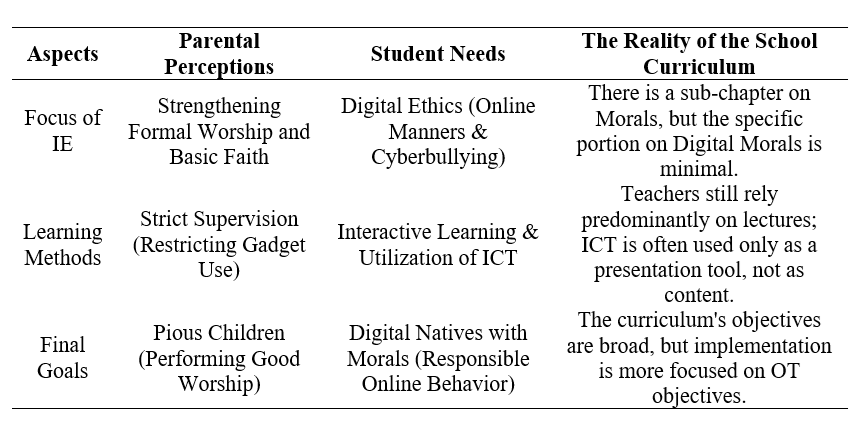
Digital natives, who have unrestricted access to information, suffer moral and ethical issues like cyberbullying, disinformation (hoaxes), and identity crises. This has created a gap between parents' idealized view of Islamic education as a moral bulwark and students' needs for a more adaptable and digitally relevant curriculum. Islamic education may be less effective at shaping noble digital character due to this divide. This study aims to identify and analyze in depth (1) how parental perceptions influence the emphasis of Islamic Education materials and methods, and (2) how the relevance of these materials meets students' spiritual and digital literacy needs. This study used a qualitative-descriptive approach with a case study method in an Islamic high school. Data was collected through in-depth interviews (with 15 parents and 10 students), classroom observations, and analysis of curriculum documents at As'adiyah Madrasah No. 21 Kampiri. It was found that most parents have a strong perception that Islamic education should focus on strengthening traditional faith and worship. However, this perception has not yet fully encouraged the integration of Islamic-perspective digital literacy materials (such as social media jurisprudence or online ethics). Thus, pupils believed religious material was insufficient for virtual world problems. This research proposes an Islamic education curriculum model to bridge parents' ideal perceptions and students' current needs, creating morally sound and technologically savvy digital natives.
References
Alauddin, M. B., Fitri, D., & Wenando, F. A. (2025). Tradition to Technology: The Transformation of Indonesian Culture in the Social Media Era. Asian Journal of Media and Culture, 1(1), 1-21. https://doi.org/10.63919/ajmc.v1i1.16
Alenezi, M., Wardat, S., & Akour, M. (2023). The need of integrating digital education in higher education: Challenges and opportunities. Sustainability, 15(6), 4782. https://doi.org/10.3390/su15064782
Ali, N., Afwadzi, B., Abdullah, I., & Mukmin, M. I. (2021). Interreligious literacy learning as a counter-radicalization method: A new trend among institutions of Islamic higher education in Indonesia. Islam and Christian–Muslim Relations, 32(4), 383-405. https://doi.org/10.1080/09596410.2021.1996978
Alptekin, Z., & Taneri, A. (2025). Technology ıntegration in pedagogical processes: digital competence and teaching practices of primary school teachers in Turkey. Discover Education, 4(1), 351. https://doi.org/10.1007/s44217-025-00646-9
Banić, L., & Orehovački, T. (2024). A comparison of parenting strategies in a digital environment: A systematic literature review. Multimodal technologies and interaction, 8(4), 32. https://doi.org/10.3390/mti8040032
Chhanchhuahi, V., & Deka, J. (2023). Digital Enhancement: A Drawbridge or a Detachment of the Digital Divide. Journal of Creative Communications, 09732586231204205.
David, H. (2022). Digital immigrants, digital natives and digital learners: Where are we now?. Journal for the Education of Gifted Young Scientists, 10(2), 159-172. https://doi.org/10.1177/09732586231204205
Dewi, G. D. P., & Lusikooy, A. E. (2023). E-commerce transformation in Indonesia: Innovation and creative destruction. Nation State: Journal of International Studies, 6(2), 117-138. https://doi.org/10.24076/nsjis.v6i2.1304
ElSayary, A. (2024). An investigation of teachers' perceptions of using ChatGPT as a supporting tool for teaching and learning in the digital era. Journal of computer assisted learning, 40(3), 931-945. https://doi.org/10.1111/jcal.12926
Faizin, M. A. (2024). Islamic Boarding Education Management Reform: Transformation Strategies to Improve Competitiveness and Relevance. Al-Ishlah: Jurnal Pendidikan, 16(2), 2497-2506. https://doi.org/10.35445/alishlah.v16i2.4462
Guishard, D. K. (2024). The impact of 21st-century technology teaching on socio-economically challenged students in public high schools: A phenomenological study.
Hasmiza, H. (2025). Model kurikulum pendidikan Islam di era digital: Mengoptimalkan teknologi untuk pembelajaran yang inovatif. Research and Development Journal of Education, 11(1), 164-177. http://dx.doi.org/10.30998/rdje.v11i1.28068
Iksal, I., Hayani, R. A., & Aslan, A. (2024). Strengthening character education as a response to the challenges of the times. Indonesian Journal of Education (INJOE), 4(1), 761-774. http://felifa.net/index.php/INJOE/article/view/233
Ilten-Gee, R., & Mirra, N. (2024). Employing Digital Media for Moral and Character Education in the Classroom. In Handbook of Moral and Character Education (pp. 183-201). Routledge.
Isbah, F. (2024). Digital Islam: Challenges and Opportunity of Islamic Education in Digital Era. In Proceeding International Conference on Islam and Education (ICONIE) (Vol. 3, No. 1, pp. 939-949).
Kalolo, J. F. (2019). Digital revolution and its impact on education systems in developing countries. Education and Information Technologies, 24(1), 345-358. https://doi.org/10.1007/s10639-018-9778-3
Maemonah, M., Zuhri, H., Masturin, M., Syafii, A., & Aziz, H. (2023). Contestation of Islamic educational institutions in Indonesia: Content analysis on social media. Cogent Education, 10(1), 2164019. https://doi.org/10.1080/2331186X.2022.2164019
MacLeod, A., Burm, S., & Mann, K. (2022). Constructivism: learning theories and approaches to research. Researching medical education, 25-40. https://doi.org/10.1002/9781119839446.ch3
Margaryan, A., Littlejohn, A., & Vojt, G. (2011). Are digital natives a myth or reality? University students’ use of digital technologies. Computers & education, 56(2), 429-440. https://doi.org/10.1016/j.compedu.2010.09.004
Montasari, R. (2024). The impact of technology on radicalisation to violent extremism and terrorism in the contemporary security landscape. In Cyberspace, cyberterrorism and the international security in the fourth industrial revolution: Threats, assessment and responses (pp. 109-133). Cham: Springer International Publishing. https://doi.org/10.1007/978-3-031-50454-9_7
Munawarsyah, M. (2023). Islamic education in the modern era: Analysis of student character and their role in facing the challenges of Industry 4.0. HEUTAGOGIA: Journal of Islamic Education, 3(2), 141-154.
Natadireja, U., & Nurachadijat, K. (2023). Evaluasi Pendidikan Menuju Insan Kamil dalam Perspektif Filsafat Ilmu. Al-Idaroh: Jurnal Studi Manajemen Pendidikan Islam, 7(2), 253-267. https://doi.org/10.54437/alidaroh.v7i2.929
Newton, P. M., Da Silva, A., & Berry, S. (2020). The case for pragmatic evidence-based higher education: a useful way forward?. In Frontiers in Education (Vol. 5, p. 583157). Frontiers Media SA.
Nirwana, A., & Muthoifin, M. (2024). Parenting problems in the digital age and their solution development in the frame of value education. Multidisciplinary Reviews, 7(8), 2024163-2024163. https://10.0.124.149/multirev.2024163
Nurhabibi, N., Arifannisa, A., Ismail, D., Kuswandi, D., Anggraeni, A. F. D. G., & Aji, Y. A. (2025). Strategi lembaga pendidikan Islam dalam membentuk karakter siswa di era digital. Jurnal Pendidikan Indonesia: Teori, Penelitian, dan Inovasi, 5(2). https://doi.org/10.59818/jpi.v5i2.1527
Phippen, A., Bond, E., & Buck, E. (2021). Effective strategies for information literacy education: Combatting ‘fake news’ and empowering critical thinking. In Future Directions in Digital Information (pp. 39-53). Chandos Publishing.
Putra, R. G., Yusri, N., & Sinaga, S. F. (2024). The Role of Social Media in Islamic Religious Education: Challenges and Opportunities in the Digital Era. Jurnal Pendidikan Islam, 1(3), 191-199. https://doi.org/10.70938/judikis.v1i3.70
Putra, D. H. A. (2025). Optimizing Digital Technology in Progressive Islamic Education to Enhance Public Literacy and Combat Hoaxes. Multicultural Islamic Education Review, 3(1), 63-74. https://journals2.ums.ac.id/index.php/mier/article/view/9915
Qowim, A. N., Afif, N., Mukhtarom, A., & Fauziah, E. (2024). Pendidikan karakter dalam era digital: Pengintegrasian nilai-nilai moral dalam kurikulum berbasis teknologi. Tadarus Tarbawy: Jurnal Kajian Islam Dan Pendidikan, 6(1).
Rafsanjani, T. A., Abdurrozaq, M., & Inayati, F. (2024). Islamic Religious Learning in the Digital Age: An Interactive Method for Generation Z. Solo International Collaboration and Publication of Social Sciences and Humanities, 2(03), 304-315. https://doi.org/10.61455/sicopus.v2i03.222
Reid, L., Button, D., & Brommeyer, M. (2023). Challenging the myth of the digital native: A narrative review. Nursing Reports, 13(2), 573-600. https://doi.org/10.3390/nursrep13020052
Romlah, L. S., Wahid, L., & Purnama, R. (2024). Manajemen Strategis Kurikulum di Era Digital: Systematic Literature Review. Didaktika: Jurnal Kependidikan, 13(001 Des), 1057-1072.
Samala, A. D., Rawas, S., Criollo-C, S., Fortuna, A., Feng, X., Prasetya, F., ... & Hidayat, R. (2024). Social media in education: trends, roles, challenges, and opportunities for digital-native generations-a systematic literature review. Asian Journal of University Education (AJUE), 20(3), 524-539. https://doi.org/10.24191/ajue.v20i3.27869
Samaranayake, P. N. (2024). Navigating The Moral Prospect: Ethical Consideration in The Digital Age. Journal of Ethics and Emerging Technologies, 34(1), 1-13. https://doi.org/10.55613/jeet.v34i1.144
Sanusi, M. (2024). Transforming Islamic Education in the Digital Age: Challenges and Opportunities for the Young Generation. Attractive: Innovative Education Journal, 6(3), 206-215.
Sharma, S., & Lee, C. Y. (2024). Parental mediation and preferences for regulation regarding children's digital media use: role of protection motivation and theory of planned behaviour. Behaviour & Information Technology, 43(8), 1499-1517. https://doi.org/10.1080/0144929X.2023.2217275
Suša Vugec, D., & Stjepić, A. M. (2022). Digital literacy of digital natives. In Technological challenges: the human side of the digital age (pp. 61-91). Cham: Springer International Publishing. https://doi.org/10.1007/978-3-030-98040-5_3
Thompson, P. (2013). The digital natives as learners: Technology use patterns and approaches to learning. Computers & Education, 65, 12-33. https://doi.org/10.1016/j.compedu.2012.12.022
Voronkova, V., Vasyl’chuk, G., Nikitenko, V., Kaganov, Y., & Metelenko, N. (2023). Transformation of digital education in the era of the fourth industrial revolution and globalization. https://dspace.znu.edu.ua/jspui/handle/12345/19241
Yadav, N. (2024). The impact of digital learning on education. International Journal of Multidisciplinary Research in Arts, Science and Technology, 2(1), 24-34.
Yasin, N. A. (2025). Transformasi Pembelajaran di Era Digital: Pemanfaatan Internet sebagai Sumber Belajar yang Inovatif. Jurnal Kajian dan Inovasi Ilmu (JKII), 1(1), 18-26. https://doi.org/10.64123/jkii.v1.i1.4
Zahraini, Z., Akib, A., Rosidin, R., & Sulaeman, O. (2025). Islamic education reform in the digital age: Challenges and opportunities for a modern curriculum. Journal of Noesantara Islamic Studies, 2(1), 1-11. https://doi.org/10.70177/jnis.v2i1.1841
Downloads
Published
How to Cite
Issue
Section
License
Copyright (c) 2025 Nurdalia Nurdalia

This work is licensed under a Creative Commons Attribution-ShareAlike 4.0 International License.