Artificial Intelligence and Problem-Based Learning: Structural Equation Modeling Evaluation of Undergraduate Critical Thinking and Academic Performance
Keywords:
Problem-Based Learning (PBL), Artificial Intelligence in Education, Structural Equation Modeling (SEM), Critical Thinking, Higher Education EvaluationAbstract
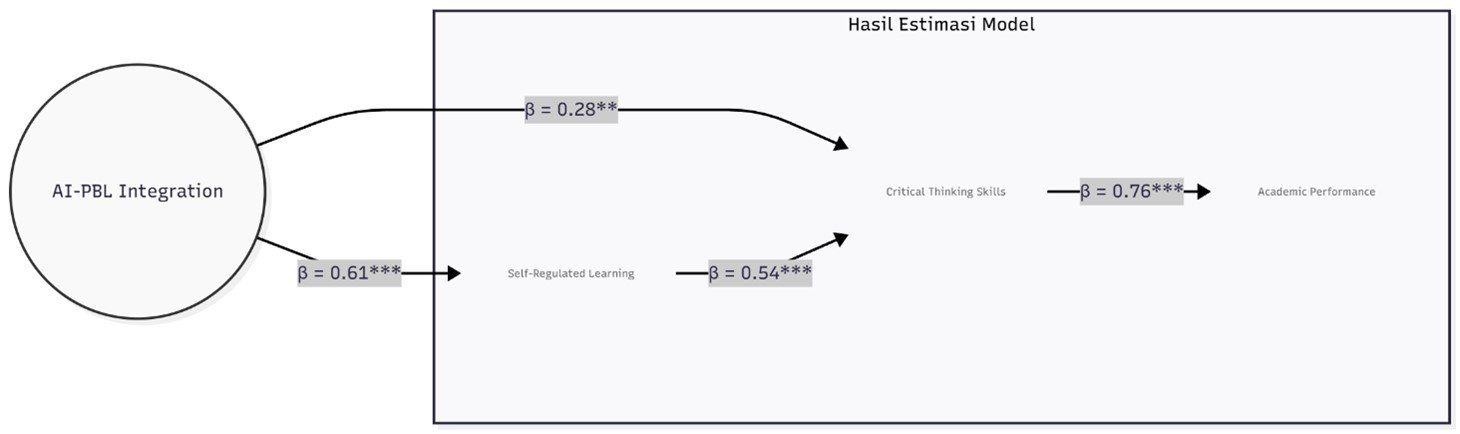
The integration of Artificial Intelligence (AI) into pedagogical frameworks represents a paradigm shift in higher education. This study evaluates the effectiveness of an AI-integrated Problem-Based Learning (AI-PBL) model among undergraduate students. Specifically, it aims to determine how AI tools, acting as scaffolding agents, influence students' critical thinking, self-regulated learning, and overall academic performance. A quantitative research design utilizing Structural Equation Modeling (SEM) was employed. Data were collected from 450 undergraduate students across three major universities who participated in a semester-long AI-PBL course. The instrument consisted of a validated questionnaire measuring AI literacy, PBL engagement, critical thinking disposition, and learning outcomes. The measurement model demonstrated high validity and reliability. The structural model revealed that AI integration significantly mediates the relationship between PBL engagement and critical thinking skills ($\beta = 0.42, p < .001$). Furthermore, the model showed that AI-PBL positively impacts academic performance directly and indirectly through self-regulated learning mechanisms. The study confirms that AI does not diminish cognitive effort but, when integrated into PBL, enhances critical analysis and learning efficiency. These findings offer a robust framework for curriculum designers to embed AI explicitly as a collaborative intelligence tool in problem-solving tasks.
References
Bearman, M., & Ajjawi, R. (2023). Learning to work with the black box: Pedagogy for a world with artificial intelligence. British Journal of Educational Technology, 54(5), 1160-1173. https://doi.org/10.1111/bjet.13337
Chan, C. K. Y., & Hu, W. (2023). Students’ voices on generative AI: Perceptions, benefits, and challenges in higher education. International Journal of Educational Technology in Higher Education, 20(1), 43. https://doi.org/10.1186/s41239-023-00411-8
Chen, L., Chen, P., & Lin, Z. (2020). Artificial intelligence in education: A review. IEEE Access, 8, 75264-75278. https://doi.org/10.1109/ACCESS.2020.2988510
Cotton, D. R., Cotton, P. A., & Shipway, J. R. (2023). Chatting and cheating: Ensuring academic integrity in the era of ChatGPT. Innovations in Education and Teaching International, 61(2), 228-239. https://doi.org/10.1080/14703297.2023.2190148
Dochy, F., segers, M., van den Bossche, P., & Gijbels, D. (2017). Effects of problem-based learning: A meta-analysis. Learning and Instruction, 13(5), 533-568.
Dwyer, C. P., Hogan, M. J., & Stewart, I. (2015). An integrated critical thinking framework for the 21st century. Thinking Skills and Creativity, 12, 43-52. https://doi.org/10.1016/j.tsc.2013.12.004
Firat, M. (2023). How chat GPT can transform autodidactic experiences and open education? Department of Distance Education, Open Education Faculty, 1(1), 1-12.
Fitria, T. N. (2023). Artificial intelligence (AI) technology in OpenAI ChatGPT application: A review of ChatGPT in writing English essay. ELT Forum: Journal of English Language Teaching, 12(1), 44-58.
Hair, J. F., Risher, J. J., Sarstedt, M., & Ringle, C. M. (2019). When to use and how to report the results of PLS-SEM. European Business Review, 31(1), 2-24. https://doi.org/10.1108/EBR-11-2018-0203
Hong, J. C., Tai, K. H., Hwang, M. Y., Kuo, Y. C., & Chen, J. S. (2017). Internet cognitive failure relevant to self-efficacy, learning interest, and satisfaction with social media learning. Computers in Human Behavior, 55, 214-222.
Hwang, G. J., & Chang, C. Y. (2021). A review of opportunities and challenges of chatbots in education. Interactive Learning Environments, 31(7), 4099-4112. https://doi.org/10.1080/10494820.2021.1914560
Hwang, G. J., Xie, H., Wah, B. W., & Gašević, D. (2020). Vision, challenges, roles and research issues of Artificial Intelligence in Education. Computers and Education: Artificial Intelligence, 1, 100001. https://doi.org/10.1016/j.caeai.2020.100001
Kaharuddin, A., Arsyad, N., & Asdar, M. P. (2023). Media Hologram 3D dalam Pembelajaran Geometri untuk meningkatkan keterampilan proses sains. Pustaka Learning.
Kaharuddin, A., García, J. G., Magfirah, I., & Yulismayanti, Y. (2025). Validating a TPCK-S Instrument for Hologram-Based Mathematics Teaching. Indonesian Journal on Learning and Advanced Education (IJOLAE).
Kasneci, E., Sessler, K., Küchemann, S., Bannert, M., Dementieva, D., Fischer, F., ... & Kasneci, G. (2023). ChatGPT for good? On opportunities and challenges of large language models for education. Learning and Individual Differences, 103, 102274. https://doi.org/10.1016/j.lindif.2023.102274
Kirschner, P. A., Sweller, J., & Clark, R. E. (2018). Why minimal guidance during instruction does not work: An analysis of the failure of constructivist, discovery, problem-based, experiential, and inquiry-based teaching. Educational Psychologist, 41(2), 75-86.
Kline, R. B. (2016). Principles and practice of structural equation modeling (4th ed.). Guilford Publications.
Lodge, J. M., Howard, S. K., Bearman, M., & Dawson, P. (2023). Assessment reform for the age of artificial intelligence. Tertiary Education and Management, 29(3), 223-228.
Luckin, R., & Cukurova, M. (2019). Designing educational technologies in the age of AI: A learning sciences-driven approach. British Journal of Educational Technology, 50(6), 2824-2838.
Molenaar, I. (2022). Personalized learning: The role of AI in the classroom. Frontiers in Artificial Intelligence, 5, 965874.
Panadero, E. (2017). A review of self-regulated learning: Six models and four directions for research. Frontiers in Psychology, 8, 422. https://doi.org/10.3389/fpsyg.2017.00422
Pratiwi, D., & Kaharuddin, A. (2025). Analysis of Students’ Learning Interest in Mathematics on Integer Numbers Material Using the Quizizz Application. EduTransform: Multidisciplinary International Journal, 1(1), 1-12.
Qadir, J. (2023). Engineering education in the era of ChatGPT: Promise and pitfalls of generative AI for education. IEEE Global Engineering Education Conference (EDUCON), 1-9.
Rahman, A., & Naber, J. (2023). AI-assisted problem-based learning in undergraduate engineering: A comparative study. Journal of Engineering Education, 112(3), 567-589.
Rudolph, J., Tan, S., & Tan, S. (2023). ChatGPT: Bullshit spewer or the end of traditional assessments in higher education? Journal of Applied Learning & Teaching, 6(1), 342-363.
Savery, J. R. (2015). Overview of problem-based learning: Definitions and distinctions. Interdisciplinary Journal of Problem-Based Learning, 1(1), 9-20.
Selwyn, N. (2022). The future of AI in education: Critical perspectives. Computers & Education, 182, 104473.
Sutrisno, A. B., Kaharuddin, A., & Gupta, V. (2025). Analysis Of Student Difficulties in Solving Problems on Statistics Material. EduTransform: Multidisciplinary International Journal, 1(1), 27-39.
Susilo, A., & Sofyar, Y. (2024). Structural Equation Modeling of student engagement in AI-mediated classrooms. International Journal of Emerging Technologies in Learning, 19(2), 45-60.
Trust, T., Whalen, J., & Mouza, C. (2023). Editorial: ChatGPT in education: Is it a game changer? Journal of Technology and Teacher Education, 31(2), 147-155.
UNESCO. (2023). Guidance for generative AI in education and research. UNESCO Publishing.
World Economic Forum. (2023). The Future of Jobs Report 2023. World Economic Forum.
Yew, E. H. J., & Goh, K. (2016). Problem-Based Learning: An overview of its process and impact on learning. Health Professions Education, 2(2), 75-79. https://doi.org/10.1016/j.hpe.2016.01.004