Artificial Intelligence-Assisted Learning Videos for Biotechnology Instruction: Effects on Senior High School Students' Learning Outcomes

https://doi.org/10.51574/ijrer.v5i4.5254
Keywords:
Artificial Intelligence, Biotechnology, Learning Video, Learning Outcomes, Quasi-Experimental DesignAbstract
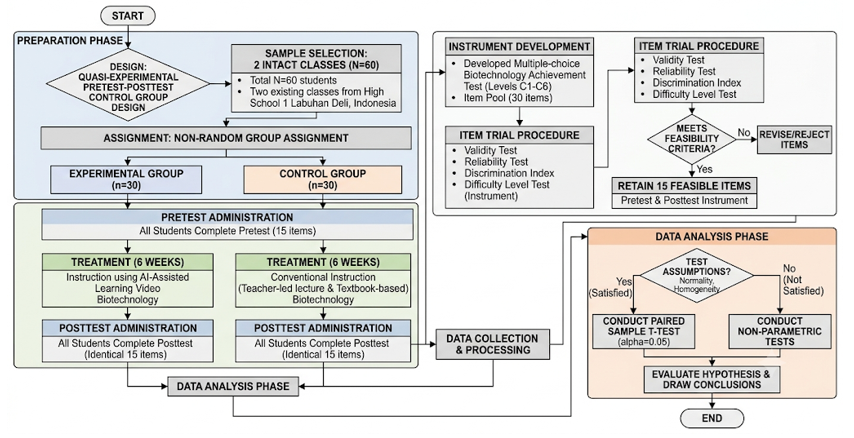
This study examined the effect of Artificial Intelligence (AI)-assisted learning video on the biotechnology learning outcomes of senior high school students. A quantitative approach was employed using a quasi-experimental, pretest-posttest control group design, involving an experimental class and a control class at High School 1 Labuhan Deli, Indonesia, each consisting of 30 students (N = 60). Learning outcomes were measured using 15 multiple-choice items selected from an initial pool of 30 items covering cognitive levels C1 to C6 of Bloom's Taxonomy, following item-trial procedures encompassing validity, reliability, discrimination index, and difficulty level. Data was analyzed using tests of normality and homogeneity, followed by a paired-sample t-test. The pretest results indicated comparable baseline ability between the control (M = 47.11) and experimental (M = 45.78) groups. After treatment, the experimental group's posttest mean (M = 89.55) was considerably higher than that of the control group (M = 72.00), corresponding to mean gains of 43.77 and 24.89 points, respectively. Hypothesis testing confirmed a statistically significant difference between groups (t = 7.03 > t-table = 2.00; p = 0.000 < 0.05). The largest gains in the experimental group occurred on indicators related to the utilization of microorganisms, tissue culture, and cloning and genetic engineering, suggesting that AI-assisted video is particularly effective for visualizing abstract, microscopic biological processes. These findings indicate that AI-assisted learning video is a more effective instructional medium than conventional lecture-and-textbook teaching for biotechnology content, and broader adoption of such media is recommended for similarly abstract topics in biology education.
References
Ayenku, J. E., Oduah, A. A., & Canaan, H. O. (2025). Integrating Artificial Intelligence and Biotechnology in Biology Education: Preparing Learners for the 5th Industrial Revolution. Journal of Education in Developing Areas, 33(2), 371-392. https://journals.journalsplace.org/index.php/JEDA/article/view/751
Bentahar, S., Abada, R., & Ykhlef, N. (2023). Biotechnology: Definitions, types and main applications. Ymer, 22(4), 563-575.
Bizami, N. A., Tasir, Z., & Kew, S. N. (2023). Innovative pedagogical principles and technological tools capabilities for immersive blended learning: a systematic literature review. Education and information technologies, 28(2), 1373-1425. https://doi.org/10.1007/s10639-022-11243-w
Chander, B., Pal, S., De, D., & Buyya, R. (2022). Artificial intelligence-based internet of things for industry 5.0. Artificial intelligence-based internet of things systems (pp. 3-45). Cham: Springer International Publishing. https://doi.org/10.1007/978-3-030-87059-1_1
Cope, B., & Kalantzis, M. (2022). The cybernetics of learning. Educational Philosophy and Theory, 54(14), 2352-2388. https://doi.org/10.1080/00131857.2022.2033213
Cruz, J. C., & Reyes, L. H. (2025). Synergizing Minds and Machines: Harnessing Generative AI for Transformative Biotechnology Education. NATO Advanced Research Workshop (pp. 297-327). Cham: Springer Nature Switzerland. https://doi.org/10.1007/978-3-032-05246-9_12
Das, S., Ray, M. K., Panday, D., & Mishra, P. K. (2023). Role of biotechnology in creating sustainable agriculture. PLOS Sustainability and Transformation, 2(7), e0000069. https://doi.org/10.1371/journal.pstr.0000069
Dunne, G. (2025). Rethinking ‘thinking skills’ in 21st-century education: Combining conceptual clarity with a novel 4E cognitive framework. Studies in Philosophy and Education, 44(5), 493-511. https://doi.org/10.1007/s11217-025-09997-0
Eun, B. (2019). The zone of proximal development as an overarching concept: A framework for synthesizing Vygotsky’s theories. Educational philosophy and theory, 51(1), 18-30. https://doi.org/10.1080/00131857.2017.1421941
Haryaka, U., Razak, N. K., Rachman, F., Tung, K. Y., & Judijanto, L. (2025). Integrating digital literacy, critical thinking, and collaborative learning: Addressing contemporary challenges in 21st century education. Journal of Hunan University Natural Sciences, 52(3). https://doi.org/10.55463/issn.1674-2974.52.3.9
Karakhanova, L., Makhmudova, D., Shernazarov, I., & Khujanov, E. (2024). Biotechnology Breakthroughs: Shaping the Future of Health, Agriculture, and Industry. In BIO Web of Conferences (Vol. 141, p. 04003). EDP Sciences.
Karanfiloğlu, M., & Bulut, M. A. (2025). Techno-pedagogical communication, ed-tech and media professionals: crossroads for enhancing instructional quality. Interactive Learning Environments, 33(7), 4193-4217. https://doi.org/10.1080/10494820.2025.2459180
Khan, T., Mishra, P., Hashmi, K., Raza, S., Singh, M., Joshi, S., & Khan, A. R. (2024). Artificial intelligence assisted teaching and learning and research of environmental sciences. Artificial Intelligence: A Multidisciplinary Approach towards Teaching and Learning (pp. 80-114). Bentham Science Publishers. https://doi.org/10.2174/97898153051801240101
Kim, J. M. (2025). Integrating mammalian cell culture into undergraduate biology education: benefits, challenges, and innovative strategies. Journal of Hazard Literacy, 1(1). https://doi.org/10.63737/jhl.25.0016
Lubis, J. A., Saputra, R., Tuah, S., Adrian, M., & Padhilah, S. (2024). Canva-assisted biotechnology module based on Marsialap Ari’s local wisdom: The endeavor to improve students' creativity skills. Jurnal Biolokus: Jurnal Penelitian Pendidikan Biologi dan Biologi, 6(2), 168-177. http://dx.doi.org/10.30821/biolokus.v6i2.3114
Macwan, A., Desai, D., Vandra, N., Mishra, K. K., & Jha, Y. (2025). Biotechnology for Global Sustainability: Innovations, Applications, and Challenges. Int. Res. J. Adv. Eng. Manag, 3. https://doi.org/10.47392/IRJAEM.2025.0013
Majewska, M., Mazur-Wierzbicka, E., & Duarte, N. (2025). Education Quality and Technological Progress in the Business Sector at Different Stages of Economic Development. Krakow Review of Economics and Management/Zeszyty Naukowe Uniwersytetu Ekonomicznego w Krakowie, (2 (1008)), 49-67. https://www.ceeol.com/search/article-detail?id=1347401
Malakul, S. (2025). Exploring Factors Influencing Teachers' Acceptance of AI Tools for Creating Animated Educational Videos With Pedagogical Agents. Journal of Computer Assisted Learning, 41(4), e70083. https://doi.org/10.1111/jcal.70083
Mejía-Manzano, L. A., Vázquez-Villegas, P., Díaz-Arenas, I. E., Escalante-Vázquez, E. J., & Membrillo-Hernández, J. (2023). Disciplinary competencies overview of the first cohorts of undergraduate students in the Biotechnology Engineering Program under the Tec 21 Model. Education Sciences, 14(1), 30. https://doi.org/10.3390/educsci14010030
Ness, I. J. (2023). Zone of proximal development. In The Palgrave encyclopedia of the Possible (pp. 1781-1786). Cham: Springer International Publishing. https://doi.org/10.1007/978-3-030-90913-0_60
Papaneophytou, C., & Nicolaou, S. A. (2025). Promoting critical thinking in biological sciences in the era of artificial intelligence: The role of higher education. Trends in Higher Education, 4(2), 24. https://doi.org/10.3390/higheredu4020024
Pellas, N. (2025). The impact of AI-generated instructional videos on problem-based learning in science teacher education. Education Sciences, 15(1), 102. https://doi.org/10.3390/educsci15010102
Rahma, S. A., & Sulistiyawati, S. (2024). Development of Canva-Based E-Module on Biotechnology Subject for 10th Grade High School Students. Proceeding International Conference on Religion, Science and Education (Vol. 3, pp. 447-454). http://sunankalijaga.org/prosiding/index.php/icrse/article/view/1088
Rahmawati, S., & Fikri, A. A. (2023). Pengembangan Media Pembelajaran Materi Bioteknologi melalui Video Tik Tok. NCOINS: National Conference Of Islamic Natural Science (Vol. 2, No. 1, pp. 151-160). https://proceeding.uinsuku.ac.id/index.php/NCOINS/article/view/344
Sayed, W. S., Noeman, A. M., Abdellatif, A., Abdelrazek, M., Badawy, M. G., Hamed, A., & El-Tantawy, S. (2023). AI-based adaptive personalized content presentation and exercises navigation for an effective and engaging E-learning platform. Multimedia Tools and Applications, 82(3), 3303-3333. https://doi.org/10.1007/s11042-022-13076-8
Şimşek, A. C., Anders, G., Göth, J., Specht, L., & Huff, M. (2025). Is ChatGPT a good study companion? The role of AI-generated summaries and reflective prompts in learning from educational videos. Computers and Education: Artificial Intelligence, 100512. https://doi.org/10.1016/j.caeai.2025.100512
Suryawanshi, V. K. (2022). The Impact and Effectiveness of Dale’s Cone of Experience on Management Students. of the Book: A Flourishing Digital Era: Innovations in Industry, Education, 1, 312.
Syah, I., Sukmana, O., & Yumitro, G. (2026). Analysis of Vygotsky's Social Constructivism Theory in Collaborative Learning Based on Digital Technology. International Journal of Economics Management and Social Science, 9(1), 365-376. https://journal.salewangang.net/ijemss/article/view/53
Tilak, S., Glassman, M., Kuznetcova, I., & Pelfrey, G. L. (2022). Applications of cybernetics to psychological theory: Historical and conceptual explorations. Theory & Psychology, 32(2), 298-325. https://doi.org/10.1177/09593543211053804
Waqas, M., & Naseem, A. (2025). Artificial intelligence in sustainable industrial transformation: A comparative study of industry 4.0 and industry 5.0. FinTech and Sustainable Innovation, 1, A2-A2. https://doi.org/10.47852/bonviewFSI52025321
Xu, P. (2025). Digital media design and production method based on multimedia human–computer interaction technology. Discover Artificial Intelligence, 5(1), 13. https://doi.org/10.1007/s44163-025-00232-w
Yarden, H., & Yarden, A. (2010). Learning using dynamic and static visualizations: students’ comprehension, prior knowledge and conceptual status of a biotechnological method. Research in Science Education, 40(3), 375-402. https://doi.org/10.1007/s11165-009-9126-0
Zheng, J., & Huang, S. (2025). Popularization Education and National Progress: Real Challenges and Future Outlook. International Theory and Practice in Humanities and Social Sciences, 2(1), 125-141. https://elibrary.ru/item.asp?id=80814492
Zhu, J., Yang, Z., Yin, Y., & Fang, W. (2025). The development of supplemental multimedia learning modules and their impact on student learning in food biotechnology courses. Biochemistry and Molecular Biology Education, 53(1), 70-79. https://doi.org/10.1002/bmb.21867
Downloads
Published
How to Cite
Issue
Section
License
Copyright (c) 2026 Rieke Octaviani Aritonang , Eko Prasetya

This work is licensed under a Creative Commons Attribution-ShareAlike 4.0 International License.