Challenges of Inclusive-Responsive Leadership in Public High Schools: Mapping the Socio-Cultural and Policy Contexts

https://doi.org/10.51574/ijrer.v5i3.5001
Keywords:
Educational Policy, Inclusive Education, Public High Schools, Socio-Cultural Context, South SulawesiAbstract
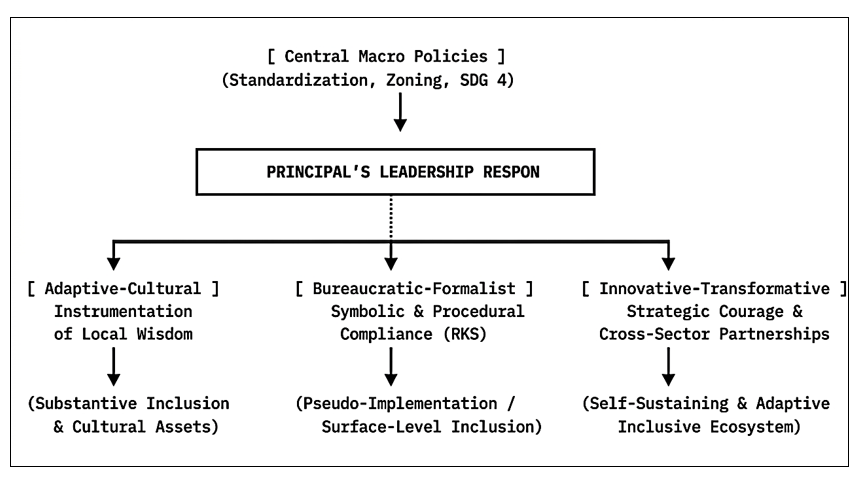
Despite national mandates for inclusive education, implementing inclusive-responsive leadership in Indonesian public high schools faces complex hurdles. This study maps the challenges of inclusive-responsive leadership by examining the socio-cultural and policy contexts within public high schools in South Sulawesi, exploring how school leaders navigate the gap between formal inclusion regulations and local cultural expectations. Employing a qualitative approach, a multi-site case study design was utilized across several schools. Data were collected through semi-structured interviews with principals and policy stakeholders, alongside regional policy document analysis, and interpreted using thematic analysis focusing on leadership adaptability. The results reveal three primary challenges: (1) policy-practice decoupling, where inclusive regulations lack technical guidelines for local execution; (2) socio-cultural barriers, including traditional paradigms viewing inclusion as a peripheral value; and (3) resource scarcity, specifically a lack of specialized pedagogical training for leaders. The study finds that while leaders show high commitment, their actions are restricted by a compliance-based rather than a value-based approach. This research contributes to educational leadership discourse by providing a localized mapping of inclusion challenges in a non-Western context. It offers insights for policymakers to harmonize national standards with socio-cultural specificities, advocating for a leadership model that is both policy-compliant and culturally responsive.
References
Ainscow, M. (2020). Promoting inclusion and equity in education: Lessons from international experiences. Nordic Journal of Studies in Educational Policy, 6(1), 7-16. https://doi.org/10.1080/20020317.2020.1729587
Banwo, B., McKoena, K., Carter Jr, C., & Khalifa, M. (2024). The role of equity audits in culturally responsive school leadership. Culturally responsive instructional supervision: Leadership for equitable and emancipatory outcomes, 124.
Biktagirova, G. F. (2020). Formalism in the implementation of inclusive education: Problems and solutions. Journal of Social Studies Education Research, 11(3), 188-201.
Bush, T., & Glover, D. (2014). School leadership models: What do we know?. School Leadership & Management, 34(5), 553-571. https://doi.org/10.1080/13632434.2014.972102
Carrington, S., Saggers, B., Adie, L., & Shaddock, A. (2021). Leadership for inclusive education: International perspectives and ways forward. International Journal of Inclusive Education, 25(8), 891-906. https://doi.org/10.1080/13603116.2019.1602363
Carter, S., & Abawi, L. A. (2018). Leadership, inclusion, and quality education for all. Australasian Journal of Special and Inclusive Education, 42(1), 49-64. https://doi.org/10.1017/jsi.2018.5
Handayani, T., & Rahadian, A. S. (2019). Peraturan kebijakan pendidikan inklusif di Indonesia: Antara regulasi dan implementasi. Jurnal Pendidikan Kebutuhan Khusus, 3(2), 55-62. https://doi.org/10.24036/jpkk.v3i2.535
Kurniawan, A., & Fitri, S. (2021). Kompetensi manajerial kepala sekolah dalam pengelolaan sekolah inklusif. Jurnal Akuntabilitas Manajemen Pendidikan, 9(1), 45-56. https://doi.org/10.21831/jamp.v9i1.33614
Liasidou, A. (2012). Inclusive education and the politics of difference: School leaders as social justice advocates. International Studies in Sociology of Education, 22(3), 185-204. https://doi.org/10.1080/09620214.2012.714246
Magnússon, G., Göransson, K., & Lindqvist, G. (2019). Contextualizing inclusive education: Historical development and administrative challenges in upper secondary schools. European Journal of Special Needs Education, 34(3), 367-380. https://doi.org/10.1080/08856257.2018.1533611
Makarim, N. A. (2020). Strategi Merdeka Belajar dan Profil Pelajar Pancasila. Kementerian Pendidikan dan Kebudayaan Republik Indonesia.
Mattulada. (2015). Latoa: Satu Analisis Antropologi Politik Orang Bugis. Ombak.
Murniati, M., Yusrizal, Y., & Usman, N. (2023). Implementation of inclusive education policies in secondary education: Challenges in eastern Indonesia. Journal of Education and Learning (EduLearn), 17(2), 241-249. https://doi.org/10.11591/edulearn.v17i2.20658
Nirmala, R. (2023). Budaya kompetisi dan eksklusi terselubung di sekolah menengah unggulan Sulawesi Selatan. Jurnal Sosiologi Pendidikan, 15(2), 112-125.
Opertti, R., Walker, Z., & Zhang, Y. (2014). Inclusive education: From targeting groups and schools to achieving quality education as a right for all. The SAGE Handbook of Special Education, 2, 45-62. https://doi.org/10.4135/9781446282236.n4
Poernomo, B. (2019). Kesiapan infrastruktur dan ketersediaan Guru Pembimbing Khusus (GPK) dalam pendidikan inklusif di luar Pulau Jawa. Jurnal Ortopedagogia, 5(1), 12-19. https://doi.org/10.17977/um031v5i1p12-19
Rahman, A. (2022). Konflik nilai kebijakan top-down dan budaya lokal dalam manajemen sekolah di Sulawesi Selatan. Jurnal Kebijakan Pendidikan Pascasarjana UNM, 6(1), 34-47.
Rasyid, M. A. (2021). Revitalisasi nilai Pesse sebagai modal sosial kepemimpinan inklusif. Jurnal Kebudayaan dan Pikiran, 18(3), 201-215.
Said, A. A. (2018). Struktur sosial hierarkis dan resistensi terhadap perubahan sistem pendidikan di masyarakat Bugis-Makassar. Jurnal Penelitian Sejarah dan Budaya, 4(2), 145-160. https://doi.org/10.36424/jpsb.v4i2.53
Sapon-Shevin, M. (2007). Widening the Circle: The Power of Inclusive Classrooms. Beacon Press.
Shields, C. M. (2010). Transformative leadership: Working for equity in diverse contexts. Educational Administration Quarterly, 46(4), 558-589. https://doi.org/10.1177/0013161X10375609
Slee, R. (2018). Inclusive Education Isn't Dead, It Just Smells Funny. Routledge. https://doi.org/10.4324/9780429468179
Soomro, R. B. K., Soomro, A. B., & Sahito, Z. (2025). Human Rights Education and Sustainable Development Goal 4: Highlighting intersections and synergies. International Journal of Educational Development, 118, 103399. https://doi.org/10.1016/j.ijedudev.2025.103399
Sulastri, S., Fitriani, F., & Syafruddin, S. (2022). Profil Pelajar Pancasila dalam bingkai pendidikan inklusif di era Merdeka Belajar. Jurnal Ilmiah Mandala Education, 8(3), 1980-1992. https://doi.org/10.58258/jime.v8i3.3551
Tambiar, T., Hasan, M., & Basri, M. (2023). Dilemma of academic performance and inclusion policy in senior high schools. Indonesian Journal of Educational Studies, 26(1), 77-89. https://doi.org/10.26858/ijes.v26i1.43210
UNESCO. (2020). Global Education Monitoring Report 2020: Inclusion and education: All means all. UNESCO. https://doi.org/10.25656/01:21213
UNESCO. (2021). Training school leaders for inclusive education in developing countries. UNESCO International Bureau of Education.
Vorapanya, S., & Dunlap, D. (2014). Inclusive education in Southeast Asia: Strategies, roadblocks, and success stories. International Journal of Special Education, 29(2), 101-109.
Ye, Q., Wang, D., & Li, X. (2019). Inclusive leadership and employees’ learning from errors: A moderated mediation model. Australian Journal of Management, 44(3), 462-481. https://doi.org/10.1177/0312896218805796
Downloads
Published
How to Cite
Issue
Section
License
Copyright (c) 2026 Sitti Habibah

This work is licensed under a Creative Commons Attribution-ShareAlike 4.0 International License.