Clay Play on the Creativity of 4–5-Year-Old Children at State Kindergarten

https://doi.org/10.51574/ijrer.v5i2.4717
Keywords:
Children's Creativity, Clay Play, Early Childhood, Fine Motor Development, National KindergartenAbstract
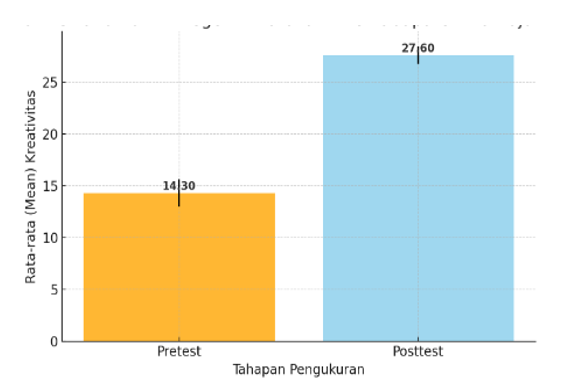
The development of creativity in early childhood is a crucial aspect in education, but often the stimulation provided is not varied enough. In Amatullah Kire State Kindergarten, the level of creativity of children aged 4–5 years still requires optimization through more interactive and exploratory learning media such as clay play. This study aims to describe the application of clay play to children aged 4–5 years, determine the picture of children's creativity before and after the intervention, and test the effect of clay play on increasing children's creativity in Amatullah Kire State Kindergarten. This study used a quantitative approach with a pre-experimental design of the One-Group Pretest-Posttest type. The study sample consisted of 10 children aged 4–5 years who were given treatment in the form of structured clay play activities. Data was collected through creativity observations and analyzed using descriptive statistics and the Wilcoxon Signed Rank Test. The results showed that the application of clay play went very well with high enthusiasm from children. Children's creativity before treatment was in the medium category ("Starting to Emerge") but increased significantly after treatment to the high category ("Always Emerging"). The Wilcoxon test confirmed a significant effect with a significant value of 0.004 (p < 0.05). It was concluded that clay play is effective in enhancing the creativity of children aged 4–5 years. This study provides a practical contribution for early childhood educators in adopting clay as an effective learning method to optimize children's creative potential. Furthermore, these results serve as a scientific reference for the development of an arts-based curriculum at the kindergarten level.
References
Aeni, N. (2024). Pengaruh Metode Permainan Tanah Liat dan Playdough Terhadap Kreativitas Anak Usia Dini. Research in Early Childhood Education and Parenting, 5(1). https://doi.org/10.17509/recep.v5i1.64916
Aisyah, E. N., Harun, H., & Rohman, A. (2023). Learning through play in early children’s education in Friedrich Wilhelm Froebel’s perspective. International Conference on Educational Management and Technology (ICEMT 2022) (pp. 571-582). Atlantis Press. https://doi.org/10.2991/978-2-494069-95-4_66
Aldhilan, D., Rafiq, S., & Afzal, A. (2024). The innovative pedagogical approaches & challenges in the early childhood education: Insights from Saudi Arabia. Gomal University Journal of Research, 40(2), 159-176. http://www.gujr.com.pk/index.php/GUJR/article/view/1745
Apriyansyah, C., Tjalla, A., Saptono, A., Hartati, S., Jalal, F., Sukatmi, S., ... & Kurniawaty, L. (2024). Early childhood education: Integrative holistic early childhood development program implementation. Child Education Journal, 6(2), 76-87. https://doi.org/10.33086/cej.v6i2.5990
Arda Tuncdemir, T. B. (2025). Integrating social-emotional learning through play: Perspectives from early childhood educators. Journal of Research in Childhood Education, 1-19. https://doi.org/10.1080/02568543.2025.2567504
Baduni, K., Khan, O. A., Modlesky, C. M., & Maitre, N. L. (2025). Early motor and cognitive development in typically developing children and those with or at high risk of cerebral palsy: A scoping review. Developmental Medicine & Child Neurology. https://doi.org/10.1111/dmcn.70041
Clemente-Suárez, V. J., Beltrán-Velasco, A. I., Herrero-Roldán, S., Rodriguez-Besteiro, S., Martínez-Guardado, I., Martín-Rodríguez, A., & Tornero-Aguilera, J. F. (2024). Digital device usage and childhood cognitive development: Exploring effects on cognitive abilities. Children, 11(11), 1299. https://doi.org/10.3390/children11111299
Friedman, M., & Muñoz Alvis, J. (2023). Haüy, Weiß, Fröbel: the influence of nineteenth-century crystallography on the mathematics of Friedrich Fröbel’s kindergarten. Part 1: the published materials. Paedagogica Historica, 59(2), 191-211. https://doi.org/10.1080/00309230.2020.1865424
Gamamedaliyanage, A. (2025). Clay and Play: enhancing children's creativity and design skills through sustainable craft workshops and effective teaching. https://www.theseus.fi/handle/10024/888410
Hasanah, U. (2024). Improving fine motor skills through plasticine playing activities at RA Nurul Islam Palmerah West Jakarta. ETNOPEDAGOGI: Jurnal Pendidikan dan Kebudayaan, 1(4), 160-171. https://doi.org/10.62945/etnopedagogi.v1i4.555
Haslip, M. J., & Gullo, D. F. (2018). The changing landscape of early childhood education: Implications for policy and practice. Early Childhood Education Journal, 46(3), 249-264. https://doi.org/10.1007/s10643-017-0865-7
Istikhakimi, I. (2024). Upaya Meningkatkan Kreativitas Anak melalui Metode Bermain Plastisin pada Siswa TK Lab STAI YPBWI Surabaya. WALADI, 2(1), 126-155. https://doi.org/10.61815/waladi.v2i1.450
Kalsum, U., Astawa, I. M. S., Rachmayani, I., & Astini, B. N. (2021). Pengaruh Bermain Konstruktif dengan Media Clay Terhadap Kemampuan Motorik Halus Anak Usia 5-6 Tahun di Desa Maria Utara Kecamatan Wawo Kabupaten Bima. Indonesian Journal of Elementary and Childhood Education, 2(3), 300-307. http://journal.publication-center.com/index.php/ijece/article/view/728
Kurniasari, N. (2025). Developing Early Childhood Curiosity: Experiental Learning within the Framework of Constructivist Philosophy. Social Journal of Studies in Education, 1(01), 48-64. https://journal.haibanasywa.or.id/index.php/sjse/article/view/10
Lin, W. L., & Shih, Y. L. (2016). The developmental trends of different creative potentials in relation to children’s reasoning abilities: From a cognitive theoretical perspective. Thinking Skills and Creativity, 22, 36-47. https://doi.org/10.1016/j.tsc.2016.08.004
Makeleni, S., & Ndu, O. G. (2025). Imperative of Viable Learning Environment for Early Childhood Education: A Literature Review. Cakrawala Dini: Jurnal Pendidikan Anak Usia Dini, 16(2), 237-256. https://doi.org/10.17509/cd.v16i2.86327
Mardiana, B. D. (2024). Pengaruh Kegiatan Paper Clay Terhadap Kemampuan Motorik Halus Pada Anak Pra Sekolah Usia 4-5 Tahun: The Effect Of Paper Clay Activities On Fine Motor Ability In Preschool Children Aged 4-5 Years. Jurnal Ilmiah Kebidanan (Scientific Journal of Midwifery), 10(2), 156-164.
McNair, L. J., & Powell, S. (2021). Friedrich Froebel: a path least trodden. Early Child Development and Care, 191(7-8), 1175-1185. https://doi.org/10.1080/03004430.2020.1803299
Meiliandari, A., & Yunesti, D. (2024). Implementation of Media Clay in developing the creativity of children aged 4-5 years at Pangkalbalam Pembina Kindergarten. ICEJ: Islamic Childhood Education Journal, 3(1), 9–15.
Octarra, H. S., & Hendriati, A. (2018). ‘Old, borrowed, and renewed’: A review of early childhood education policy in post-Reform Indonesia. Policy Futures in Education, 16(1), 80-91. https://doi.org/10.1177/1478210317736207
Qayyum, A., Fatima, R., & Iram, A. (2024). Play-based learning and child cognitive-emotional development in nature-based programs. Annals of Human and Social Sciences, 5(4), 348-365. https://doi.org/10.35484/ahss.2024(5-IV)33
Rahimi, R. A., & Oh, G. S. (2024). Rethinking the role of educators in the 21st century: navigating globalization, technology, and pandemics. Journal of Marketing Analytics, 12(2), 182-197. https://doi.org/10.1057/s41270-024-00303-4
Ramadhani, D. M., & Nurhalimah, E. (2025). The use of clay media to improve color knowledge and science knowledge in the exploration process of early childhood. Golden Ratio of Data in Summary, 5(1), 16-21. https://doi.org/10.52970/grdis.v5i1.841
Sabilla, L. S. (2022). Meningkatkan Kemampuan Motorik Halus Anak Usia Dini Melalui Kreativitas Bermain Plastisin Di Tk Darul Falah. Jurnal Ilmiah Cahaya Paud, 4(2), 44-55. https://doi.org/10.33387/cahayapd.v4i2.4529
Saracho, O. N. (2023). Theories of child development and their impact on early childhood education and care. Early Childhood Education Journal, 51(1), 15-30. https://doi.org/10.1007/s10643-021-01271-5
Septiarsih, E. (2025). The Application of Clay Media-Based Scientific Learning in Improving Children's Collaboration Skills. Journal of Child Learning Innovation, 1(1), 8-19. https://ejournal.unuja.ac.id/index.php/jcli/article/view/11004
Septiarsih, E., Mudiono, A., & Samawi, A. (2026). Eksplorasi Tanah Liat dan Budaya Lokal Sebagai Media Pembelajaran Kreatif Dengan Pendekatan Saintifik. Jurnal Pendidikan: Riset dan Konseptual, 10(1), 214-223. https://doi.org/10.28926/riset_konseptual.v10i1.1425
Skulmowski, A. (2024). Learning by doing or doing without learning? The potentials and challenges of activity-based learning. Educational Psychology Review, 36(1), 28. https://doi.org/10.1007/s10648-024-09869-y
Smedley, S., & Hoskins, K. (2020). Finding a place for Froebel's theories: early years practitioners’ understanding and enactment of learning through play. Early Child Development and Care, 190(8), 1202-1214. https://doi.org/10.1080/03004430.2018.1525706
Solicha, R. A., & Hasibuan, R. (2022). Analisis Pengaruh Media Clay Terhadap Kemampuan Motorik Halus Pada Anak Usia Dini. Indonesian Journal of Instructional Technology, 22-27. https://doi.org/10.49056/ijit.vi.479
Sutapa, P., Ndayisenga, J., & Bin Aman, M. S. (2021). Improving of FineMotor Skills Through Plasticine Playing and Clay in Early Childhood. Turkish Online Journal of Qualitative Inquiry, 12(7).
Tahlia, P. L. A., Maryam, S., & Adelita, D. (2024). Shaping Children's Character in the Era of Revolution 4.0 and Society 5.0 as a Successor to the Nation through Early Childhood Education. Journal of Childhood Development, 4(1), 210-221. https://doi.org/10.25217/jcd.v1i2.1833
Teichert, L., & Helbig, S. (2024). Friedrich Froebel. The Palgrave Handbook of Educational Thinkers (pp. 371-387). Cham: Springer International Publishing. https://doi.org/10.1007/978-3-031-25134-4_42
van Aswegen, E. C., & Pendergast, D. (2023). The impact of interest: an emergent model of interest development in the early years. Early Child Development and Care, 193(13-14), 1335-1349. https://doi.org/10.1080/03004430.2023.2245575
Yunengsih, Y., & Fitri, S. R. A. (2025). Efektivitas Penggunaan Alat Peraga Edukatif (APE) Berbasis Limbah dan Alam Terhadap Pengembangan Motorik Halusdi Kelompok Bermain AZ-ZAHRA. Hikamatzu| Journal of Multidisciplinary, 2(2). https://yasyahikamatzu.com/index.php/hjm/article/view/333
Downloads
Published
How to Cite
Issue
Section
License
Copyright (c) 2026 A Nur Farika Saputri, M. Yusran Rahmat, Arie Martuty

This work is licensed under a Creative Commons Attribution-ShareAlike 4.0 International License.