Interactive Video Tutorial Media: Volleyball Smash Skill Learning Outcomes at Senior High School

https://doi.org/10.51574/ijrer.v5i2.4508
Keywords:
Experimental Study, High School Students, Physical Education, Training Treatment, Volleyball SmashAbstract
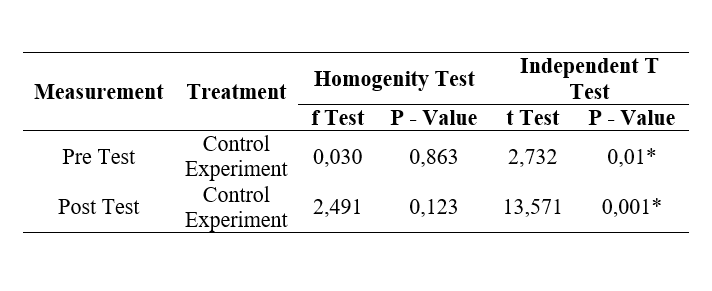
The lack of effective and structured learning media often hinders the development of complex motor skills, particularly volleyball smashing abilities, among high school students. This study aimed to determine the effect of interactive video tutorial media on volleyball smash learning outcomes at Senior High School 1, Takalar. This study employed a quasi-experimental method with a pre-test and post-test control group design. The sample consisted of 40 students divided into an experimental group (n=20) using interactive video tutorials and a control group (n=20) using conventional methods. The research instrument used was a validated volleyball smash skills test. Data analysis included normality tests, homogeneity tests, and t-tests with a significant level of 0.05. The results indicated that the control group showed no significant difference between pre-test and post-test scores, with the average score remaining stable at 10.00 (p=0.231 > 0.05). In contrast, the experimental group experienced a highly significant increase in the average score from 16.05 to 27.05 (p=0.001 < 0.05). These findings provide strong empirical evidence that interactive video tutorials are significantly more effective in helping students visualize and adopt complex biomechanical movements compared to traditional methods. This research confirms that integrating interactive technology is a valid educational solution for optimizing physical education learning outcomes at the senior secondary level.
References
Ahmad, S. (2025). Socio-Educational Impacts of Technology and Media on Youth Behavior and Learning. VFAST Transactions on Education and Social Sciences, 13(4), 48-67. https://doi.org/10.21015/vtess.v13i4.2341
Anwar, N. I. A., Hamzah, A., & Aksir, M. I. (2024). Fitness Education Model to Improve Learning Achievement of PJOK Subjects: A Focus Senior High School Students. ETDC: Indonesian Journal of Research and Educational Review, 3(4), 110-117. https://doi.org/10.51574/ijrer.v3i4.2277
Barikah, K., Hariadi, I., & Rusdiyanto, R. M. (2026). The Effectiveness of Interactive Multimedia in Improving Motivation and Learning Outcomes of Junior High School Physical Education Students: The Effectiveness of Interactive Multimedia in Improving Motivation and Learning Outcomes of Junior High School Physical Education Students. Athena: Physical Education and Sports Journal, 4(1), 86-99. https://doi.org/10.56773/athena.v4i1.92
Crook, A., Mauchline, A., Maw, S., Lawson, C., Drinkwater, R., Lundqvist, K., ... & Park, J. (2012). The use of video technology for providing feedback to students: Can it enhance the feedback experience for staff and students?. Computers & Education, 58(1), 386-396. https://doi.org/10.1016/j.compedu.2011.08.025
Cui, Z., Song, Y., & Du, X. (2024). Multilevel modeling of technology use, student engagement, and fitness outcomes in physical education classes. Frontiers in Psychology, 15, 1458899. https://doi.org/10.3389/fpsyg.2024.1458899
Fogliata, A., Silvestri, F., Marcelli, L., Gallotta, M. C., & Curzi, D. (2025). How body-centering improves the effects of core stability training on the motor skills in adolescent female volleyball players. Journal of Functional Morphology and Kinesiology, 10(2), 144. https://doi.org/10.3390/jfmk10020144
Ha, T., Moon, J., Yu, H., Fan, X., & Paulson, L. (2025). A systematic review of technology-infused physical activity interventions in K-12 school settings: effectiveness, roles, and implementation strategies. International Journal of Behavioral Nutrition and Physical Activity, 22(1), 113. https://doi.org/10.1186/s12966-025-01811-x
Hardika, N., Suhairi, M., Maksum, H., Suhartini, S., & Permana, A. (2024). Development of Learning Media Video Interactive Basic Motion Volleyball Game by Edpuzzle. AL-ISHLAH: Jurnal Pendidikan, 16(2), 2122-2133. https://doi.org/10.35445/alishlah.v16i2.4782
Jastrow, F., Greve, S., Thumel, M., Diekhoff, H., & Süßenbach, J. (2022). Digital technology in physical education: a systematic review of research from 2009 to 2020. German Journal of Exercise and Sport Research, 52(4), 504-528. https://doi.org/10.1007/s12662-022-00848-5
Lee, D. J., & Kim, D. J. (2019). Influences of physical education classes based on flipped learning of self-directed learning abilities and attitude towards these classes, for middle school students. International Journal of Contents, 15(2), 59-74. https://doi.org/10.5392/ijoc.2019.15.2.059
Li, L., & Zeng, D. (2025). Effect of teacher autonomy support on student engagement in physical education classrooms in a blended learning environment: the mediating role of performance expectancy and academic self-efficacy. BMC psychology, 13(1), 475. https://doi.org/10.1186/s40359-025-02685-1
Liu, Z., Yin, H., Cui, W., Xu, B., & Zhang, M. (2022). How to reflect more effectively in online video learning: Balancing processes and outcomes. British Journal of Educational Technology, 53(1), 114-129. https://doi.org/10.1111/bjet.13155
Mödinger, M., Woll, A., & Wagner, I. (2022). Video-based visual feedback to enhance motor learning in physical education—a systematic review. German journal of exercise and sport research, 52(3), 447-460. https://doi.org/10.1007/s12662-021-00782-y
Panjiantariksa, Y. (2024). Effectiveness of Using Video Tutorials in Physical Education Learning: Case Study at MA. Champions: Education Journal of Sport, Health, and Recreation, 2(3), 72-76. https://doi.org/10.59923/champions.v2i3.304
Park, J. (2025). Students’ perceptions toward providing video-enhanced multimodal feedback on oral presentations. Computer Assisted Language Learning, 38(8), 1934-1960. https://doi.org/10.1080/09588221.2024.2344546
Salim, F. A., Postma, D. B. W., Haider, F., Luz, S., Beijnum, B. J. F. Va., & Reidsma, D. (2024). Enhancing Volleyball Training: Empowering Athletes And Coaches Through Advanced Sensing And Analysis. Frontiers In Sports And Active Living, 6(April), 1–18. https://doi.org/10.3389/fspor.2024.1326807
Setyawan, P. B., Kamadi, L., & Haeruddin, S. (2022). Efforts to Improve the Quality of Movement Activities of Physical Education, Sports and Health, During the Covid-19 Pandemic. ETDC: Indonesian Journal of Research and Educational Review, 2(1), 1-9. https://doi.org/10.51574/ijrer.v2i1.315
Suhardiman, M. A., Hudain, M. A., Jamaluddin, J., Nur, M., & Hasyim, H. (2024). Smash Ability in Volleyball Games Senior High School: The Plyometric Training and Leg Muscle Strength. ETDC: Indonesian Journal of Research and Educational Review, 3(3), 148-157. https://doi.org/10.51574/ijrer.v3i3.1881
Taban, Z., & İmamoğlu, M. (2023). The Effect of interactive videos on volleyball education. Journal of Learning and Teaching in Digital Age, 8(2), 267-275. https://doi.org/10.53850/joltida.1211628
Trisnawati, S. A., Ridwan, M., Setiawan, E., & Ahmedov, F. (2024). Integrating interactive video media in physical education: A study on critical thinking and learning motivation. Edu Sportivo: Indonesian Journal of Physical Education, 5(3), 289-305. https://doi.org/10.25299/esijope.2024.vol5(3).19073
Yasriuddin, Y., Nur, M., Gunawan, M. R., Fahrizal, F., & Hudain, M. A. (2024). The Pressure of Smash Training Using the Drill Method for Male Athletes' Volleyball Smash Skills. ETDC: Indonesian Journal of Research and Educational Review, 3(3), 158-165. https://doi.org/10.51574/ijrer.v3i3.1904
Downloads
Published
How to Cite
Issue
Section
License
Copyright (c) 2026 Indra Wisman, Syahruddin Syahruddin, Wahyuni Wahyuni

This work is licensed under a Creative Commons Attribution-ShareAlike 4.0 International License.