UNDERSTANDING THE USE OF DIGITAL TEACHING AIDS (BBM) IN MICROTEACHING OF HIKMAH PEDAGOGY: A CONCEPTUAL PROPOSAL
Digital BBM, Micro Teaching, Wisdom Pedagogy, Critical Thinking, Educational Technology.
DOI:
https://doi.org/10.51574/hayyan.v3i1.4311Keywords:
philosophy of inquiry, value education, Islamic education, higher order thinking skills (KBAT), teaching innovationAbstract
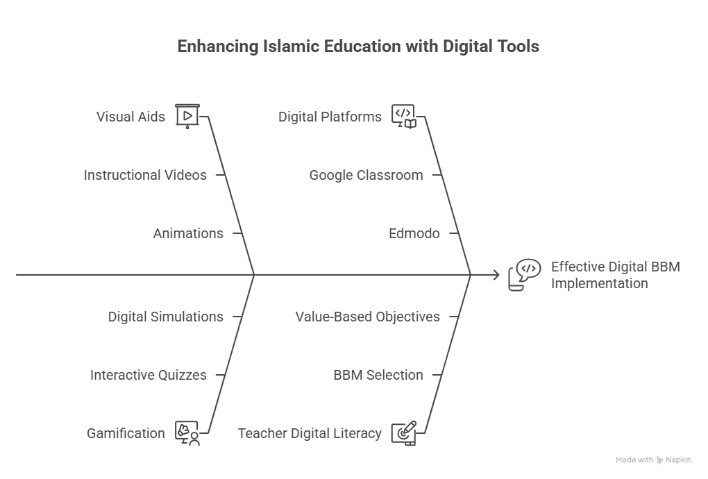
This study aims to understand the use of digital Teaching Aids (BBM) in micro-teaching based on the Wisdom Pedagogy approach in the context of Islamic Education. The analysis focused on the effectiveness of digital BBM, implementation strategies and key challenges faced in the context of values and moral pedagogy. The study findings show that digital BBM such as interactive applications, animated videos, digital whiteboards and virtual platforms can increase student engagement, higher-order thinking skills (HOTS), and support reflective dialogue which is the core of Wisdom Pedagogy. However, there are significant constraints such as teachers' lack of understanding of the concept of wisdom, difficulty accessing BBM that is in line with Islamic values, as well as the level of infrastructure and professional training of teachers which is still insufficient. The study also found that the integration of digital BBM requires a reflective and contextual approach to be in line with the philosophy of Islamic education which emphasizes the development of students' intellect and morals. The contribution of this study is to provide a comprehensive overview of the potential and challenges of using digital BBM in contemporary pedagogy, in addition to suggesting improvements to policies, teacher training and curriculum design that are more relevant to the needs of 21st century education. The results are expected to strengthen microteaching practices that are value-based, reflective and centered on critical thinking in an effort to produce students who are holistic from an intellectual, emotional and spiritual perspective
References
Adilah Kamal Azizi & Hafizhah Zulkifli. (2023). The practice of Hikmah pedagogy in teaching aqidah in primary schools. Jurnal Pendidikan Islam, 6(3): 169–179.
Aini Nasrin Adlin, Nur Amanina Azman, Syasya Karmila Rosli & Syed Najihuddin Syed Hassan. (2024). Issues and challenges in Islamic education in the era of information digitalisation and solutions based on Quran and Hadith guidance. Jurnal Pendidikan Islam, 6: 283–292.
Aminah A. & Fazli F. (2022). Digital BBM and the application of akhlak in Islamic education.
International Journal of Islamic Education, 10(2): 150–165. https://doi.org/10.9876/ijie2022
Azlan Z. & Nurul Huda S. (2022). Research on digital BBM in Islamic education. Journal of Modern Educational Practices, 29(1): 100–115. https://doi.org/10.4512/jmep2022
Hafiz F. & Shaheer H. (2021). The influence of technology in enhancing student understanding of Islamic education. Journal of Educational Pedagogy, 15(3): 40–60. https://doi.org/10.1357/jep2021
Hafizhah Zulkifli & Nor Alniza Azman. (2021). Students' self-assessment on Hikmah pedagogy in Islamic education. Vol. 6(29): e210805.
Hafizhah Zulkifli & Rosnani Hashim. (2019). The development of questioning skills through Hikmah (wisdom) pedagogy. Creative Education, 10(12): 2593–2605.
Hasanah N., Yusop M. R. & Rahim S. A. (2023). Critical thinking and moral reasoning through digital BBM. Journal of Educational Technology, 29(1): 20–35. https://doi.org/10.5678/jedt2023
Hussain M. & Siti Hajar S. (2023). Understanding akhlak in the use of digital BBM in Islamic education. Journal of Islamic Pedagogy, 8(2): 200–215. https://doi.org/10.1098/jip2023
Inas Tasnim Roslan & Hafizhah Zulkifli. (2024). Story texts in Hikmah pedagogy. Jurnal Pendidikan Islam, 8(1): 68–75.
Ishak M. & Ahmad F. (2021). Visualization of concepts in digital BBM for teaching moral values. Asian Education Journal, 30(4): 150–165. https://doi.org/10.6789/aej2021
Ishak R. & Fauzi M. (2024). The application of digital BBM in enhancing students' critical thinking. International Journal of Pedagogical Studies, 17(2): 120–140. https://doi.org/10.6789/ijps2024
Julianah Elman, Abdullah Yusof, Anida Sarudin & Mohd Sufian Ismail. (2023). The use of digital teaching aids in online learning during the pandemic. Journal of Educational Studies, 46: 12–24.
Mohd Rizal A. R. & Zulkifli M. N. (2022). Enhancing student engagement with digital BBM. Journal of Teaching and Learning, 18(1): 45–60. https://doi.org/10.1234/jtl2022
Norazlina A. & Norazah M. (2020). Digital BBM in Islamic education: A review. Jurnal Pendidikan Abad Ke-21, 16(1): 110–130. https://doi.org/10.1234/jpad2020
Nur Syahirah Jarawi & Hafizhah Zulkifli. (2020). Hikmah pedagogy and Higher Order Thinking Skills (HOTS) in Islamic education. ATTARBAWIY: Malaysian Online Journal of Education, 4(2): 90–102.
Nurli Nurlinda N. & Hafidz A. (2024). The application of digital BBM in Hikmah pedagogy. Journal of Pedagogical Approaches, 22(2): 75–90. https://doi.org/10.2345/jpa2024
Pala, F. (2022). The effect of philosophy education for children (P4C) on students' conceptual achievement and critical thinking skills: A mixed-method research. Education Quarterly Reviews, 5(3): 27–41.
Rohaya H. (2021). Student understanding in digital BBM learning. Journal of Digital Education, 25(4): 55–70. https://doi.org/10.6789/jde2021
Shasanah S. & Mohd Noor Z. (2020). The effectiveness of digital BBM in teaching akhlak.
Jurnal Pendidikan Islam dan Teknologi, 10(1): 30–50. https://doi.org/10.2345/jpit2020 Zainal A. & Anwar R. (2021). Digital learning tools in Islamic education: An analytical review.
Journal of Educational Technology, 25(2): 85–105. https://doi.org/10.1245/jedtech2021
Zetty Nurzuliana Rashed, Haslina Hamzah, Noor Shamshinar Zakaria & Kamarulnizam Sani. (n.d.). Challenges and teaching strategies of Islamic education teachers in the 4.0 Revolution era. Jurnal Pendidikan Islam: 72–93.
Zulkifli A., Alias B. B. & Abu C. C. (2022). The use of digital BBM in value-based teaching. Jurnal Pendidikan Islam, 14(2): 80–95. https://doi.org/10.1234/jpi2022
Zulkifli A. & Rosli R. (2023). Challenges in the use of digital BBM in Islamic teaching.
International Journal of Islamic Education, 20(3): 220–235. https://doi.org/10.5678/ijie20
Downloads
Published
Versions
- 2026-05-30 (3)
- 2026-02-28 (2)
- 2026-02-28 (1)