Pseudo-Thinking in Solving Mathematical Problems Based on Field Independent Cognitive Style

https://doi.org/10.51574/ijrer.v5i2.4695
Keywords:
Cognitive Style, Field Independent, Mathematical Problem Solving, Middle School, Pseudo-ThinkingAbstract
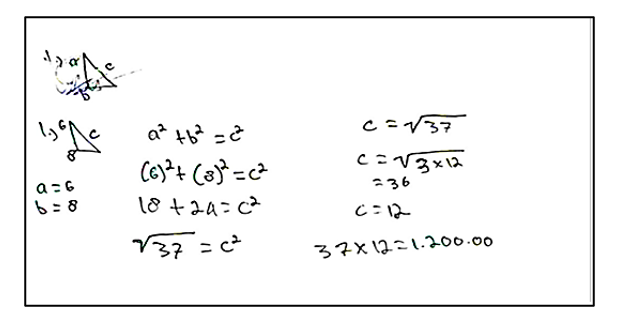
Pseudo-truth thinking often serves as an implicit obstacle in mathematics education, since pupils can provide correct answers without fully comprehending its basic principles. This issue necessitates deeper comprehension, especially for pupils' psychological traits, including cognitive style. This study seeks to elucidate the pseudo-truth cognitive process exhibited by individuals with a Field Independent (FI) cognitive style when addressing arithmetic issues among eighth-grade students at Muhammadiyah Middle School in Parepare. This study used a descriptive qualitative approach. The subject of the study was one student with a FI cognitive style selected through the Group Embedded Figures Test (GEFT). Supporting instruments included a mathematics problem-solving test and clinical interview guidelines. Data validity was guaranteed through method and time triangulation, while data analysis was carried out through the stages of data condensation, data presentation, and conclusion drawing. The research shows that FI participants thought pseudo-analytically. Subjects can isolate problem variables yet intentionally use logic to get perfect responses. The Pythagoras formula and calculation method were disconnected, resulting in severe exponent mistakes. The individuals thought they answered the problem correctly because they followed the mathematical "format," even if the steps were illogical. Metacognitive control and algorithm memorization were also areas of weakness, demonstrating conceptual comprehension problems. This study suggests that educators should be more aware that students' correct answers may not reflect their conceptual knowledge. These findings can help teachers create learning interventions that detect and correct pseudo-thinking based on students' cognitive styles.
References
Adhitya, Y., Wahyudin, W., & Prabawanto, S. (2025). Students' Pseudo-Thinking in Solving the Area of Obtuse Triangles: A Mindset-Based Perspective. Southeast Asian Mathematics Education Journal, 15(2), 161-176. https://doi.org/10.46517/seamej.v15i2.474
Aggarwal, I., Schilpzand, M. C., Martins, L. L., Woolley, A. W., & Molinaro, M. (2023). The benefits of cognitive style versatility for collaborative work. Journal of Applied Psychology, 108(4), 647. https://psycnet.apa.org/buy/2022-85632-001
Agoestanto, A., Sukestiyarno, Y. L., & Rochmad. (2017). Analysis of mathematics critical thinking students in junior high school based on cognitive style. In Journal of Physics: Conference Series (Vol. 824, No. 1, p. 012052). IOP Publishing. https://doi.org/10.1088/1742-6596/824/1/012052
Anggraini, D., Kusmayadi, T. A., & Pramudya, I. (2018). Construction of the mathematical concept of pseudo thinking students. In Journal of Physics: Conference Series (Vol. 1022, No. 1, p. 012010). IOP Publishing. https://doi.org/10.1088/1742-6596/1022/1/012010
Badar, D. M., & Anwar, K. (2025). Analisis Pseudo-Thinking dalam Pemecahan Masalah Matematis Berbasis Etnomatematika Pada Siswa Ditinjau dari Gaya Kognitif. Indiktika: Jurnal Inovasi Pendidikan Matematika, 8(1), 167-180. https://doi.org/10.31851/indiktika.v8i1.18068
Cahdriyana, R. A., Richardo, R., Fahmi, S., & Setyawan, F. (2019). Pseudo-thinking process in solving logic problem. In Journal of Physics: Conference Series (Vol. 1188, No. 1, p. 012090). IOP Publishing. https://doi.org/10.1088/1742-6596/1188/1/012090
Detlefsen, M. (2023). Philosophy of mathematics in the twentieth century. In Philosophy of Science, Logic and Mathematics in the 20th Century (pp. 50-123). Routledge. https://doi.org/10.4324/9781003419518-3
Giancola, M., D’Amico, S., & Palmiero, M. (2023). Working memory and divergent thinking: The moderating role of field-dependent-independent cognitive style in adolescence. Behavioral sciences, 13(5), 397. https://doi.org/10.3390/bs13050397
Heyd-Metzuyanim, E. (2015). Vicious cycles of identifying and mathematizing: A case study of the development of mathematical failure. Journal of the Learning Sciences, 24(4), 504-549. https://doi.org/10.1080/10508406.2014.999270
Hidajat, D., Hasbi, M., & Fitri, F. (2024). Metacognitive Skills of College Students in Mathematics Problem Solving: Overview by Student's Field Dependent. ETDC: Indonesian Journal of Research and Educational Review, 3(2), 196-206. https://doi.org/10.51574/ijrer.v3i2.1393
Jackson, K., Gibbons, L., & Sharpe, C. J. (2017). Teachers’ views of students’ mathematical capabilities: Challenges and possibilities for ambitious reform. Teachers college record, 119(7), 1-43. https://doi.org/10.1177/016146811711900708
Kusmaryono, I., Ubaidah, N., & Basir, M. A. (2020). The role of scaffolding in the deconstructing of thinking structure: A case study of pseudo-thinking process. Infinity Journal, 9(2), 247-262. https://doi.org/10.22460/infinity.v9i2.p247-262
Lestari, W., & Waluyo, E. (2025). Analysis of Students' Errors in Solving Mathematical Problems Based on Field Independent and Field Dependent Cognitive Styles. Jurnal Mercumatika: Jurnal Penelitian Matematika dan Pendidikan Matematika, 9(2). https://doi.org/10.26486/jm.v9i2.4632
Marjud, F., Hasanah, A., Lukman, L., & Harahap, P. A. (2025). A Study Of Differences In Mathematical Reasoning Among Junior High Students With Field Independent And Field Dependent Cognitive Styles. Mathline: Jurnal Matematika dan Pendidikan Matematika, 10(4), 959-972. https://doi.org/10.31943/mathline.v10i4.1049
Marshall, B. L., & Battey, D. (2025). “I want them to see their magic!”: Two teachers working within structural constraints to help cultivate their Black girl students’ positive mathematics identities. The Journal of Mathematical Behavior, 80, 101273. https://doi.org/10.1016/j.jmathb.2025.101273
Muslim, R. I., Usodo, B., & Pratiwi, H. (2021). Pseudo thinking process in understanding the concept of exponential equations. In Journal of Physics: Conference Series (Vol. 1808, No. 1, p. 012043). IOP Publishing. https://doi.org/10.1088/1742-6596/1808/1/012043
Muzaini, M., Hasbi, M., & Nasrun, N. (2021). The Role of Students’ Quantitative Reasoning in Solving Mathematical Problems Based on Cognitive Style. Vygotsky: Jurnal Pendidikan Matematika dan Matematika, 3(2), 87-98.
Nanda, A., & Rani, R. (2025). Exploring the proficiency of basic mathematical facts among primary mathematics teachers. Asian Journal for Mathematics Education, 4(1), 31-55. https://doi.org/10.1177/27527263241307975
Nicolaou, A. A., & Xistouri, X. (2011). Field dependence/independence cognitive style and problem posing: an investigation with sixth grade students. Educational Psychology, 31(5), 611-627. https://doi.org/10.1080/01443410.2011.586126
Nurmaela, A. I., Wahyuni, I., & Tehtae, S. (2024). Students’ Pseudo-Thinking Process in Solving Mathematics Problems in Terms of Learning Style. Jurnal Pendidikan MIPA, 25(2), 601-619. https://doi.org/10.23960/jpmipa/v25i2.pp601-619
Ono, R. (2022). Pseudo-Thinking and Real Thinking. In Thinking: Bioengineering of Science and Art (pp. 211-234). Cham: Springer International Publishing. https://doi.org/10.1007/978-3-031-04075-7_10
Ormerod, R. J. (2023). The logic of semiotics applied to mathematical and social interaction in operational research consulting practice: Towards a foundational view. Systems Research and Behavioral Science, 40(1), 16-42. https://doi.org/10.1002/sres.2828
Prasanna, A. R. (2022). Mathematics, the Common Base for Science. In How to Learn and Practice Science (pp. 59-71). Cham: Springer International Publishing. https://doi.org/10.1007/978-3-031-14514-8_5
Setyaningrum, L., Triyanto, Pramesti, G., & Nurhasanah, F. (2025). Students’ pseudo thinking in solving mathematical problems: Systematic literature review. In AIP Conference Proceedings (Vol. 3333, No. 1, p. 020042). AIP Publishing LLC. https://doi.org/10.1063/5.0290111
Suryanti, L., & Masduki, M. (2024). Exploration students' computational thinking skills in mathematical problem solving based on field independent and dependent cognitive style. Desimal: Jurnal Matematika, 7(3), 475-488. https://doi.org/10.24042/djm.v7i3.23832
Syahraini, A., Priatna, N., & Suhendra, S. (2023). Students' Pseudo-Thinking Process in Solving SPLDV Problems Based on Polya's Stages. Jurnal Analisa, 9(1), 12-21.
Vinner, S. (2014). Concept development in mathematics education. In Encyclopedia of mathematics education (pp. 91-96). Springer, Dordrecht.
Vinner, S. (2019). The misconception fallacy, the pseudo-conceptual and the pseudo-analytical behaviors in mathematical contexts. In Mathematics, Education, and Other Endangered Species: From Intuition to Inhibition (pp. 23-52). Cham: Springer International Publishing. https://doi.org/10.1007/978-3-319-90035-3_5
Downloads
Published
How to Cite
Issue
Section
License
Copyright (c) 2026 Zulfikry Ahmad Rifqy, Abdul Gaffar, Erni Ekafitria Bahar

This work is licensed under a Creative Commons Attribution-ShareAlike 4.0 International License.