Integrating English Language and History Learning Through Visual Arts at Primary School

https://doi.org/10.51574/ijrer.v5i1.4550
Keywords:
ESL, Integrated Learning, Interdisciplinary Learning, Primary Education, Visual ArtsAbstract
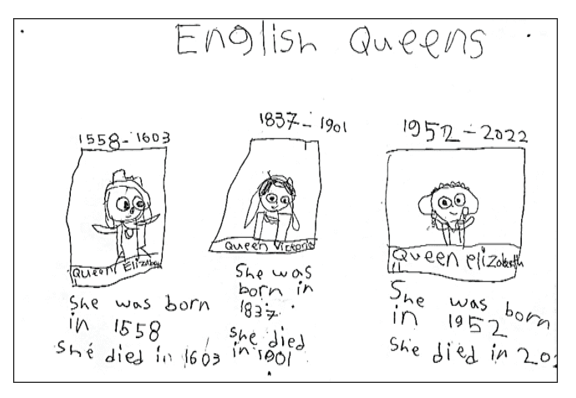
Learning world history in English using an international curriculum (Pearson Edexcel) poses difficulties for elementary school students. At Makassar Independent School (MIS), innovative learning methods are needed to help students understand complex historical material while keeping it engaging and accessible. This study intends to describe the role of creative arts, particularly drawing, as a pedagogical approach in teaching history in English. This study used a descriptive qualitative method. The subjects involved students in grades 2, 4, and 5 in history at Makassar Independent School. Data was collected through classroom observations to see how arts integration was carried out in the learning process. The research findings indicate that teachers have implemented a combination of learning methods, such as inquiry-based learning, discussion, and interactive learning. Drawing served as the final medium of articulation through which students visually expressed their profound understanding of historical topics. Through drawing activities, students were more enthusiastic and able to absorb the subject matter more effectively even though the medium of instruction was English. This study contributes to interdisciplinary learning strategies (arts and history). The results confirm that fine arts can be used as a cognitive tool to validate students' understanding in collaborative schools while also serving as a reference for educators in creating more inclusive and creative history classes.
References
Allen, J. K. (2017). Exploring the role teacher perceptions play in the underrepresentation of culturally and linguistically diverse students in gifted programming. Gifted Child Today, 40(2), 77-86. https://doi.org/10.1177/1076217517690188
Ampartzaki, M. (2023). Utilizing creative and critical thinking to build knowledge and comprehension through inquiry-based and art-based learning: A practical tool for teaching local history in pre-primary and primary education. Pedagogy, Learning, and Creativity. IntechOpen. 10.5772/intechopen.112688
Anggoro, K. J., Sengsri, S., Kongmanus, K., & Patamadilok, S. (2023). An online English learning model integrating the flipped classroom, interactive response systems, and task-based language teaching: Design-based research. The Journal of AsiaTEFL, 20(2), 425-435. https://www.earticle.net/Article/A432426
Aswad, M., Putri, A. M. J., & Sudewi, P. W. (2024). Enhancing Student Learning Outcomes through the Communicative Language Teaching Approach. AL-ISHLAH: Jurnal Pendidikan, 16(4), 5313-5324. https://doi.org/10.35445/alishlah.v16i4.5204
Bacaicoa, I. S., & Llull, J. (2023). Language Awareness and Critical Thinking in the Teaching of History with CLIL. TALK in Multilingual Classrooms: Teachers' Awareness of Language Knowledge in Secondary Education, 211.
Chen, W. (2025). Gamification as a Strategy for Enhancing Long-Term Memory of Low-Frequency Vocabulary in Primary English Education. Research and Advances in Education, 4(4), 51-58. https://www.paradigmpress.org/rae/article/view/1643
Dinham, J. (2024). The Arts as the content-subject for content and language integrated learning (CLIL): how the signature pedagogies of arts education align to CLIL aims. Innovation in Language Learning and Teaching, 18(4), 352-363. https://doi.org/10.1080/17501229.2024.2308825
Drake, S. M., & Reid, J. L. (2018). Integrated curriculum as an effective way to teach 21st century capabilities. Asia Pacific journal of educational research, 1(1), 31-50.
Efendi, A., Ariyani, A., & Asma, N. (2022). The impact of problem-based learning models to improve English achievement at middle-school 2 Karawang Barat. ETDC: Indonesian Journal of Research and Educational Review, 1(4), 530-540. https://doi.org/10.51574/ijrer.v1i4.355
Elmahdi, O., & Hezam, A. M. (2020). Challenges for methods of teaching English vocabulary to non-native students. Advances in Social Sciences Research Journal, 7(5). https://papers.ssrn.com/sol3/papers.cfm?abstract_id=4356246
Fiorella, L., & Kuhlmann, S. (2020). Creating drawings enhances learning by teaching. Journal of Educational Psychology, 112(4), 811. https://doi.org/10.1037/edu0000392
Gandhioke, S., & Singh, C. (2024). English Through Art—Incorporating Art in the ESL/EFL Classroom through Peer Collaboration to Encourage Language Production, Acquisition and Learning Outcomes. Creative Education, 15(9), 1846-1864.
Garcia-Huidobro, J. C. (2018). Addressing the crisis in curriculum studies: Curriculum integration that bridges issues of identity and knowledge. The Curriculum Journal, 29(1), 25-42. https://doi.org/10.1080/09585176.2017.1369442
Green, A. E., Beaty, R. E., Kenett, Y. N., & Kaufman, J. C. (2024). The process definition of creativity. Creativity Research Journal, 36(3), 544-572. https://doi.org/10.1080/10400419.2023.2254573
Hammer, K., Højgaard, H. S., á Steig, B., Wang, A. G., Bergenholtz, H. M., & Rosted, E. E. (2023). Hope pictured in drawings by patients newly diagnosed with advanced cancer. Journal of Clinical Nursing, 32(7-8), 1262-1275. https://doi.org/10.1111/jocn.16274
Hanauer, D. I. (2012). Meaningful literacy: Writing poetry in the language classroom. Language Teaching, 45(1), 105-115. https://doi.org/10.1017/S0261444810000522
Hope, G. (2009). Beyond knowing how to make it work: The conceptual foundations of designing. Design and Technology Education: An International Journal, 14(1), 49-55. https://doi.org/10.24377/DTEIJ.article2293
Hult, F. M. (2017). More than a lingua franca: Functions of English in a globalised educational language policy. Language, Culture and Curriculum, 30(3), 265-282. https://doi.org/10.1080/07908318.2017.1321008
Jee, B. D., Gentner, D., Uttal, D. H., Sageman, B., Forbus, K., Manduca, C. A., ... & Tikoff, B. (2014). Drawing on experience: How domain knowledge is reflected in sketches of scientific structures and processes. Research in Science Education, 44(6), 859-883. https://doi.org/10.1007/s11165-014-9405-2
Kelley, T. R., & Sung, E. (2017). Sketching by design: Teaching sketching to young learners. International Journal of Technology and Design Education, 27(3), 363-386. https://doi.org/10.1007/s10798-016-9354-3
Kianinezhad, N. (2023). Language assessment literacy: The role of self-reflection. Journal of English Language and Culture, 14(1). http://dx.doi.org/10.30813/jelc.v14i1.4662
Kurniawati, K., Wahyuriningsih, I., & Stotlikova, R. (2025). Development of Visual Literacy Assessment Instrument for Elementary School Students. DIDAKTIKA: Jurnal Pendidikan Sekolah Dasar, 8(1), 65-76. https://doi.org/10.21831/didaktika.v8i1.85928
Mahan, K. R. (2022). The comprehending teacher: Scaffolding in content and language integrated learning (CLIL). The Language Learning Journal, 50(1), 74-88. https://doi.org/10.1080/09571736.2019.1705879
Songer, A. D., & Breitkreuz, K. R. (2022). Multi-Disciplined International Service Learning: A Pedagogical Model and Case Study. In Role of Education and Pedagogical Approach in Service Learning (pp. 23-58). Emerald Publishing Limited. https://doi.org/10.1108/S2055-364120220000046015
Vergel, J., Stentoft, D., & Montoya, J. (2017). Extending the theoretical framework for curriculum integration in pre-clinical medical education. Perspectives on Medical Education, 6(4), 246-255. https://doi.org/10.1007/s40037-017-0348-y
Yakaeva, T., Salekhova, L., Kuperman, K., & Grigorieva, K. (2017). Content and language integrated learning: Language scaffolding and speech strategies. Modern journal of language teaching methods, 7(9), 137-143.
Zeybek, H. (2019). Acquistion of Culture and a Historical Approach to the Relationship between Art and Culture. Revista de la Universidad del Zulia, 10(28), 295-314. https://dialnet.unirioja.es/servlet/articulo?codigo=8809781
Downloads
Published
How to Cite
Issue
Section
License
Copyright (c) 2025 Musdalifah Musdalifah

This work is licensed under a Creative Commons Attribution-ShareAlike 4.0 International License.