Differentiated Learning Management in Improving Children's Cognitive Development and Creativity in Kindergarten

https://doi.org/10.51574/ijrer.v5i1.4458
Keywords:
Cognitive Development, Creativity, Differentiated Learning, Early Childhood, Independent CurriculumAbstract
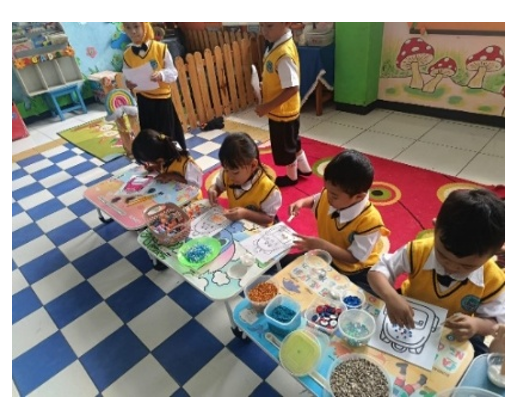
The implementation of the Independent Curriculum at the Early Childhood Education level faces challenges in accommodating the diverse characteristics and unique learning rates of children. This study aims to explain and analyze differentiated learning management and its impact on the cognitive development and creativity of early childhood at the Kindergarten Model in Malang City. The research method used was a qualitative approach with a case study design. The research subjects included the principal and teachers, with data collection techniques using participatory observation, in-depth interviews, and documentation studies. Thematic data analysis was performed via data reduction, data presentation, and conclusion formulation, with its validity assessed through source and method triangulation. The results indicated that differentiated learning was managed systematically through the stages of planning, implementation, and assessment. Differentiation was applied to aspects of content, process, product, and learning environment by adjusting the level of readiness, interests, and learning profiles of children. This implementation has been proven to have a significant positive impact on cognitive development, especially in logical thinking, pre-mathematics, and simple problem-solving skills. In addition, children's creativity increased through meaningful play activities, free exploration, and the use of diverse media such as loose parts. This research provides a practical contribution as a reference for effective implementation strategies for the Independent Curriculum in Early Childhood Education units to create inclusive and child-centered learning.
References
Allen, L., Kelly, B. B., & National Research Council. (2015). Child development and early learning. In Transforming the workforce for children birth through age 8: A unifying foundation. National Academies Press (US). https://www.ncbi.nlm.nih.gov/books/NBK310550/
Arofaturrohman, Y. A., Narimo, S., Muhibbin, A., & Haryanto, S. (2023). Differentiation Learning Innovation in Realizing Students' Creativity. Jurnal Penelitian Pendidikan IPA, 9(SpecialIssue), 467-472. https://jppipa.unram.ac.id/index.php/jppipa/article/view/6159
Asrifan, A., Ilyas, S. N., Hajerah, H., Saodi, S., Amri, N. A., & Dzulfadhilah, F. (2025). Theoretical Insights Into Childhood Education: A Comprehensive Literature Review. Shaping Childhood Through Educational Experiences, 29-54. https://doi.org/10.4018/979-8-3693-9969-9.ch002
Astuti, I., & Afendi, A. R. (2022). Implementation of differentiated learning through play activities in early childhood. EduLine: Journal of Education and Learning Innovation, 2(3), 358-365. https://doi.org/10.35877/454RI.eduline1264
Chen, W. (2025). Problem-solving skills, memory power, and early childhood mathematics: Understanding the significance of the early childhood mathematics in an individual’s life. Journal of the Knowledge Economy, 16(1), 1-25. https://doi.org/10.1007/s13132-023-01557-6
Clarà, M. (2017). How instruction influences conceptual development: Vygotsky's theory revisited. Educational Psychologist, 52(1), 50-62. https://doi.org/10.1080/00461520.2016.1221765
Creswell, J. W., & Creswell, J. D. (2017). Research design: Qualitative, quantitative, and mixed methods approaches. Sage publications.
Damayanti, D., Farihah, U., & Mislikhah, M. (2023). Implementation of Humanistic Learning Theory in Science and Technology Learning Towards Students' Creative Thinking Skills. Education and Sociedad Journal, 1(1), 24-31. https://doi.org/10.61987/edsojou.v1i1.525
Demirci-Ünal, Z., & Öztürk, G. (2025). Is need-based action possible for each child?: Preschool teachers’ differentiated instruction within multicultural classrooms. Early Childhood Education Journal, 53(7), 2699-2718. https://doi.org/10.1007/s10643-024-01753-2
Fakaruddin, F. J., Shahali, E. H. M., & Saat, R. M. (2024). Creative thinking patterns in primary school students’ hands-on science activities involving robotic as learning tools. Asia Pacific Education Review, 25(1), 171-186. https://doi.org/10.1007/s12564-023-09825-5
Fidiasih, L., Triwahyuni, E., & Emyus, A. Z. (2025). Enhancing Critical Thinking and Learning Outcomes: The Impact of Differentiated Learning Strategies in Elementary School. Jurnal Penelitian Pendidikan IPA, 11(4), 147-153. https://doi.org/10.29303/jppipa.v11i4.10611
Geletu, G. M., & Mihiretie, D. M. (2024). The effects of primary school teachers’ professional development activities on differentiated instructional practices and possibilities of elevating students’ learning engagement. Education 3-13, 52(8), 1222-1237. https://doi.org/10.1080/03004279.2022.2143722
Goyibova, N., Muslimov, N., Sabirova, G., Kadirova, N., & Samatova, B. (2025). Differentiation approach in education: Tailoring instruction for diverse learner needs. MethodsX, 14, 103163. https://doi.org/10.1016/j.mex.2025.103163
Hidayat, N., Pratiwi, Y., & Mustaqim, I. (2025). Pembelajaran Berdiferensiasi dalam Kurikulum Merdeka. JIIP-Jurnal Ilmiah Ilmu Pendidikan, 8(7), 7637-7644. https://doi.org/10.54371/jiip.v8i7.8547
Kastanja, J., & Patilima, H. (2024). Optimizing early childhood learning interest through a differentiated learning approach. Journal of Childhood Development, 4(1), 314-320. https://journal.iaimnumetrolampung.ac.id/index.php/jcd/article/view/4031
Keane, T., Boden, M., Chalmers, C., & Williams, M. (2020). Effective principal leadership influencing technology innovation in the classroom. Education and Information Technologies, 25(6), 5321-5338. https://doi.org/10.1007/s10639-020-10217-0
Kupers, E., Lehmann-Wermser, A., McPherson, G., & Van Geert, P. (2019). Children’s creativity: A theoretical framework and systematic review. Review of educational research, 89(1), 93-124. https://doi.org/10.3102/0034654318815707
Leggett, N. (2023). Creative and critical thinking in early childhood. In Integrated education and learning (pp. 109-127). Cham: Springer International Publishing. https://doi.org/10.1007/978-3-031-15963-3_7
Lestari, M. (2024). Implementasi Kurikulum Merdeka di Pendidikan Anak Usia Dini (PAUD): Tinjauan Kritis dari Perspektif Guru. PERNIK, 7(1), 43-51. https://doi.org/10.31851/pernik.v7i1.15582
Lestari, F., Alim, J. A., & Noviyanti, M. (2024). Implementation Of Differentiated Learning To Enhance Elementary School Students' Mathematical Critical And Creative Thinking Skills. International Journal of Elementary Education, 8(1), 178-187. https://doi.org/10.23887/ijee.v8i1.64295
Mahfudz, M. S. (2023). Pembelajaran berdiferesiasi dan penerapannya. SENTRI: Jurnal Riset Ilmiah, 2(2), 533-543. https://doi.org/10.55681/sentri.v2i2.534
Maslin, K., Murcia, K., Blackley, S., & Lowe, G. (2023). Fostering young children's creativity in online learning environments: A systematic literature review. Thinking Skills and Creativity, 47, 101249. https://doi.org/10.1016/j.tsc.2023.101249
Murray, J. (2023). What is the purpose of education? A context for early childhood education. International Journal of Early Years Education, 31(3), 571-578. https://doi.org/10.1080/09669760.2023.2238399
Ngaisah, N. C., & Aulia, R. (2023). Perkembangan pembelajaran berdiferensiasi dalam kurikulum merdeka pada pendidikan anak usia dini. Bunayya: Jurnal Pendidikan Anak, 9(1), 1-25. https://doi.org/10.22373/bunayya.v9i1.16890
Nikkola, T., Kangas, J., & Reunamo, J. (2024). Children's creative participation as a precursor of 21st century skills in Finnish early childhood education and care context. Learning and Individual Differences, 111, 102437. https://doi.org/10.1016/j.lindif.2024.102437
Ninsiana, W., Septiyana, L., & Suprihatin, Y. (2024). Introducing eco-literacy to early childhood students through digital learning. Journal of Education and Learning (EduLearn), 18(1), 89-96. https://doi.org/10.11591/edulearn.v18i1.20678
Pardjono, P. (2016). Active learning: The Dewey, Piaget, Vygotsky, and constructivist theory perspectives. Jurnal Ilmu Pendidikan Universitas Negeri Malang, 9(3), 105376. https://doi.org/10.17977/jip.v9i3.487
Sayidah, I., & Hidayat, H. (2025). Differentiated Learning Management as a Catalyst for Positive School Culture Development in Kindergarten Settings. Journal of Innovation and Research in Primary Education, 4(4), 2273-2283. https://doi.org/10.56916/jirpe.v4i4.2073
Sianturi, B. (2025). Teachers' Perceptions and Challenges in Implementing Differentiated Learning in Kurikulum Merdeka. J-SHMIC: Journal of English for Academic, 12(1), 1-15. https://doi.org/10.25299/jshmic.2025.vol12(1).21490
Sumarmi, S., & Afendi, A. R. (2022). Improving Learning Creativity in Early Childhood Through Learning Media Loose Part: Energetic, Concentrated and Creative. EduLine: Journal of Education and Learning Innovation, 2(3), 392-398. https://doi.org/10.35877/454RI.eduline1262
Surandika, W., Suriansyah, A., & Wahdini, E. (2023). Learning Alignment of School Readiness in One-Year Early Childhood Education Student to first grade of Elementary School. International Journal of Social Science And Human Research, 6(01), 414-425.
Tomlinson, C. A. (2014). The differentiated classroom: Responding to the needs of all learners. Ascd.
Tok, E. (2022). Early childhood teachers’ roles in fostering creativity through free play. International Journal of Early Years Education, 30(4), 956-968. https://doi.org/10.1080/09669760.2021.1933919
Trisnani, N., Zuriah, N., Kobi, W., Kaharuddin, A., Subakti, H., Utami, A., ... & Yunefri, Y. (2024). Pembelajaran berdiferensiasi dalam kurikulum merdeka. PT. Mifandi Mandiri Digital.
Veraksa, N., Colliver, Y., & Sukhikh, V. (2022). Piaget and Vygotsky’s play theories: The profile of twenty-first-century evidence. In Piaget and Vygotsky in XXI century: Discourse in early childhood education (pp. 165-190). Cham: Springer International Publishing. https://doi.org/10.1007/978-3-031-05747-2_10
Zulaikha, I. P. N., & Laeli, A. F. (2023). Differentiated learning in diverse students to meet curriculum targets. International Social Sciences and Humanities, 2(2), 436-441. https://proceeding.unmuhjember.ac.id/index.php/issh/article/view/259
Downloads
Published
How to Cite
Issue
Section
License
Copyright (c) 2025 Endang Ratnawati, Ahmad Yusuf Sobri, Imron Arifin

This work is licensed under a Creative Commons Attribution-ShareAlike 4.0 International License.