Analysis of Tertiary Learners’ Writing Errors through Surface Strategy Taxonomy

https://doi.org/10.51574/ijrer.v5i2.4321
Keywords:
BSEd-English, Descriptive writing, Error analysis, Kalinga, Surface Strategy TaxonomyAbstract
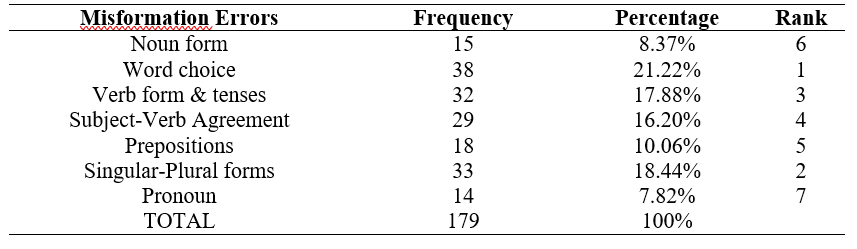
This study analyzed grammatical errors in the descriptive writing of Bachelor of Secondary Education major in English (BSEd-English) students from private higher education institutions (HEIs) in Kalinga Province using the Surface Strategy Taxonomy (SST) by Dulay, Burt, and Krashen. It aimed to identify error types, determine prevalent patterns, and examine factors contributing to learners’ writing difficulties. Guided by Error Analysis Theory, the study employed a descriptive qualitative design and collected data from second- and third-year BSEd-English students during the first semester of Academic Year 2025–2026 through purposive sampling. Findings revealed 383 grammatical errors with misformation (46.74%) and addition (40.99%) as the most frequent, while omission (9.92%) and misordering (2.35%) were less common. Misformation and addition errors—particularly in word choice, singular–plural forms, verb tenses, pronouns, and lexical devices—reflect learners’ struggles with grammar, vocabulary, and sentence construction. Influencing factors included interlingual interference, intralingual transfer, pedagogical, and psychological issues emphasizing the need for improved instruction and feedback. To address these issues, a writing instrument for pre-admission evaluation was developed to strengthen grammar and writing proficiency among incoming English majors. The results provided insights for language instruction, curriculum development, and teacher education policy supporting quality education aligned with Sustainable Development Goal (SDG) 4.
References
Adelita, D., Kurniati, E. Y., & Daulay, S. H. (2023). Difficulties and strategies in producing English writing text: What do EFL students perceive? Education and Human Development Journal, 8(1), 93–108. https://doi.org/10.33086/ehdj.v8i1.3698
Barone, S. (2024). The importance of interlanguage in language teaching: an analysis of its development in l2 learners. Vestnik of Samara State Technical University Psychological and Pedagogical Sciences, 21(3), 81-97. https://doi.org/10.17673/vsgtu-pps.2024.3.6
Codó, E. (2018). The intersection of global mobility, lifestyle and ELT work: A critical examination of language instructors’ trajectories. Language and Intercultural Communication, 18(4), 436-450. https://doi.org/10.1080/14708477.2018.1482905
Damayanti, A., Dewi, S. U., & Prasetyo, W. (2022). Error analysis of college students’ paragraph writing. LinguA LiterA: Journal of English Language Teaching, Learning, and Literature, 5(2), 26–36. https://jurnal.stkippgritrenggalek.ac.id/index.php/lingua/article/view/484
Diani, N. W., Retsi, O. D., Amalia, N., & Luardini, M. A. (2025). Students' Error in Writing Descriptive Text Viewed from Surface Strategy Taxonomy. Jurnal Edulanguage: Jurnal Pendidikan Bahasa, 11(2), 33-46.
Escuadra, D. (2024). Grammar errors in argumentative writing of junior high school ESL students: An analysis. Journal of Humanities and Education Research and Development, 9(1). https://doi.org/10.65023/jherd.v9i1.236
Esmalde, V. S. (2020). Surface strategy taxonomy in error analysis: Basis for grammatical competence enhancement program (GCEP). International Journal of Science and Research, 9(7), 785–792. https://doi.org/10.21275/SR20707113109
Franco, I. B., & Derbyshire, E. (2019). SDG 4 quality education: governing education for sustainable development: towards inclusive and equitable quality education. In Actioning the global goals for local impact: towards sustainability science, policy, education and practice (pp. 57-68). Singapore: Springer Singapore. https://doi.org/10.1007/978-981-32-9927-6_5
Garcia, M. B., & Amado, R. F. (2025). Error analysis in first-year AB English language students’ written compositions. Journal of Interdisciplinary Perspectives, 3(2), 45–60. https://doi.org/10.69569/jip.2024.0596
Ghorbani, M., Jalalvandi, M., & Dowlatabadi, H. R. (2020). Investigating the factors affecting writing skills of students from the teachers’ perspective. Journal of Teaching Persian to Speakers of Other Languages, 9(19), 91–106. https://doi.org/10.30479/jtpsol.2020.12314.1465
Hadi, I. (2021). An error analysis of active and passive voice in English texts of university students in South Jakarta. Jurnal Ilmiah Wahana Pendidikan, 7(2), 9–16. https://doi.org/10.5281/zenodo.4657081
Hakim, F., Waluyo, U., & Soepriyanti, H. (2022). Patterns of grammatical errors in students’ thesis. Journal of English Education Forum, 2(1), 26–32. https://doi.org/10.29303/j.v2i1.274
Hapsari, E. W., Sudarman, S., & Utami, S. (2022). Sources of students’ errors in EFL writing in Indonesia. JADEs Journal of Academia in English Education, 3(2), 141–160. https://doi.org/10.32505/jades.v3i2.4678
Hasbi, M., Inayah, N., Latif, F., & Fahira, A. (2022). Improvement Of Scientific Work Writing In English With The Task-Based Language Teaching Method In The English Education Program. Jurnal Pengabdian Kepada Masyarakat Patikala, 1(3), 115-121. https://doi.org/10.51574/patikala.v1i3.278
Jawed, M., Ali, K., & Ahmed, T. (2025). Exploring the Connection between Presence and Absence of Krashen’s Theory on Learner’s Input and Affective Filters: A Triangulation Approach. Journal of Arts and Linguistics Studies, 3(2), 1811-1839. https://doi.org/10.71281/jals.v3i2.305
Kabigting, R. P. (2020). Utilizing the RAFT strategy: Its effects on the writing performance of Filipino ESL learners. Journal of English Teaching, 6(3), 173–182. https://doi.org/10.33541/jet.v6i3.1982
Keumala, M., & Idami, Z. (2022). Using Surface Strategy Taxonomy (SST) in analyzing students’ errors in conducting recount paragraph. JET (JOURNAL OF ENGLISH TEACHING) ADI BUANA), 7(02), 169-177. https://doi.org/10.36456/jet.v7.n02.2022.6058
Khansa, A. S., & Sutrisno, A. (2019). Grammatical errors in Indonesian university students’ posters in Yogyakarta. Lexicon, 6(2), 190–199. https://doi.org/10.22146/lexicon.v6i2.53153
Kohn, K., & Hoffstaedter, P. (2017). Learner agency and non-native speaker identity in pedagogical lingua franca conversations: Insights from intercultural telecollaboration in foreign language education. Computer Assisted Language Learning, 30(5), 351-367. https://doi.org/10.1080/09588221.2017.1304966
Mehat, S. Z., & Ismail, L. (2021). Malaysian tertiary ESL students’ writing errors and their implications on English language teaching. Asian Journal of University Education, 17(3), 235–242. https://doi.org/10.24191/ajue.v17i3.14504
Ochoa, N. C. (2025). Examining the influence of writing anxiety and writing efficacy on English writing skills among senior high school students: Basis for a writing intervention program. Diversitas Journal, 10(2). https://doi.org/10.48017/dj.v10i2.3262
Özkayran, A., & Yilmaz, E. (2020). Analysis of higher education students’ errors in English writing tasks. Advances in Language and Literary Studies, 11(2), 48–58. https://doi.org/10.7575/aiac.alls.v.11n.2p.48
Pandapatan, S. A. (2022). Surface structure taxonomy on journal texts: The case of Filipino ESL learners. International Journal of Linguistics, Literature and Translation, 5(4), 56-65. https://doi.org/10.32996/ijllt.2022.5.4.8
Rixha, A. I. N., Alhamid, I., Rokhmah, S., & Ukka, S. B. (2021). Surface strategy taxonomy: Grammatical errors analysis in third-semester students’ descriptive essays. Kariwari Smart: Journal of Education Based on Local Wisdom, 1(2), 36–48. https://doi.org/10.53491/kariwarismart.v1i2.39
Rochmadi, I. (2020). Error analysis of English written texts of higher-level EFL learners. IJELAL (International Journal of English Learning and Applied Linguistics), 1(1), 44–55. https://doi.org/10.21111/ijelal.v1i1.5009
Rusmiati. (2019). Surface strategy taxonomy on foreign language writing: A study on verb tense usage. Jurnal Serambi Ilmu, 20(2), 1–10. https://doi.org/10.32672/si.v20i2.1453
Sarmadani, S., Asriati, S. A. M., & Ilmiah, I. (2021). Students’ difficulties in using adjective phrases in writing English texts. Journal of Language Testing and Assessment, 1(1), 105–114. https://doi.org/10.56983/jlta.v1i1.213
Tahiri, A. (2025). Mother Tongue Teaching and Educational Policies for Sustainable Global Quality Education (SDG4). Journal of Lifestyle and SDGs Review, 5(5), e5147-e5147. https://doi.org/10.47172/2965-730X.SDGsReview.v5.n05.pe05147
Tuparan, R. T., & Caturay, W. S., Jr. (2024). An error analysis of English education students’ academic essays. Silliman Journal, 65(1). https://sillimanjournal.su.edu.ph/index.php/sj/article/view/540
Un Nisa, S., & Wani, N. H. (2024). Investigating factors influencing academic writing skills among female students in India. Journal of Southwest Jiaotong University, 59(4). https://doi.org/10.35741/issn.0258-2724.59.4.20
Yu, B., Guo, W. Y., & Fu, H. (2024). Sustainability in English language teaching: strategies for empowering students to achieve the sustainable development goals. Sustainability, 16(8), 3325. https://doi.org/10.3390/su16083325
Zhao, D. (2025). The impact of teacher, peer, and automated writing evaluation feedback on developing deep writing skills: a comparative study. Journal of Computing in Higher Education, 1-35. https://doi.org/10.1007/s12528-025-09469-x
Downloads
Published
How to Cite
Issue
Section
License
Copyright (c) 2026 Kharence Grell Laquiao Dagson

This work is licensed under a Creative Commons Attribution-ShareAlike 4.0 International License.