Pemodelan Struktural Environmental Responsibility Memediasi Eco Literacy dan School Policy Terhadap Green Skills Development Generasi Z

https://doi.org/10.51574/jrip.v5i3.4250
Keywords:
Eco literacy, Environmental responsibility, Green skills, School policyAbstract
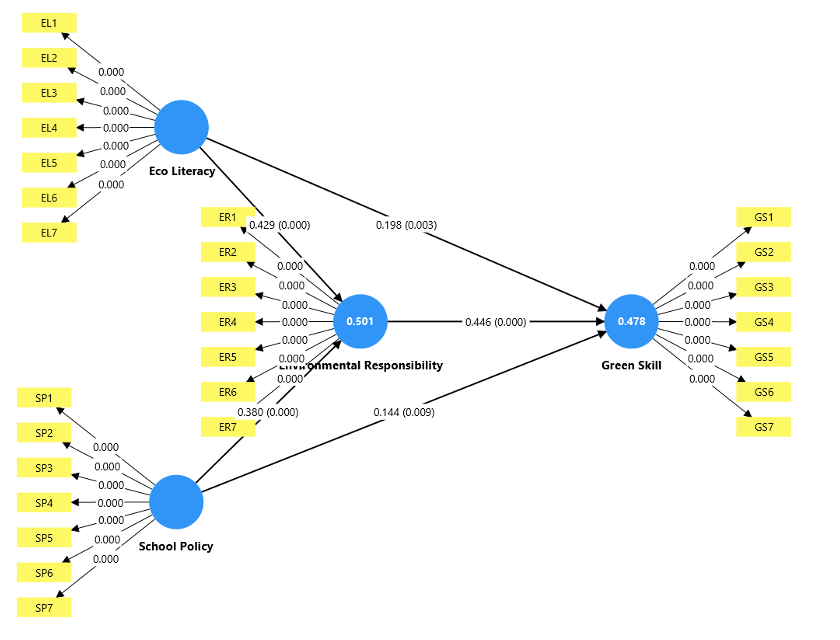
Urgensi penelitian ini ialah perubahan iklim dan degradasi lingkungan telah menjadi isu global yang memerlukan perhatian dari berbagai pihak, termasuk di sektor Pendidikan. Olehnya itu dalam rangka menghadapi tantangan dan isu global ini, green skills development menjadi hal yang sangat penting bagi generasi muda khususnya generasi Z sebagai bekal dalam peningkatan nilai-nilai pro lingkungan dan tuntunan dunia kerja yang semakin berorentasi pada prinsip keberlanjutan. Berdasarkan hal tersebut penting untuk mengeksplorasi faktor-faktor yang dapat mempengaruhi green skills development generasi Z, dimana faktor seperti environmental responsibility, eco literacy dan school policy masih jarang dieksplorasi secara menyeluruh dalam konteks ini. Oleh karena itu, penelitian ini bertujuan untuk mengeksplorasi peran penting environmental responsibility sebagai mediasi eco literacy dan school policy terhadap green skills development generasi Z. Jenis penelitian ini ialah kuantitatif menggunakan metode survey cross-sectional yang pelaksanaannya berlangsung di SMK Negeri yang terdapat di Kabupaten Gowa. Populasinya ialah generasi Z yang berstatus sebagai peserta didik khusunya kelas X yang pengambilan sampelnya menggunakan teknik purposive random sampling. Teknik pengumpulan data yang digunakan ialah kuesioner skala likert dan teknik analisis data yang diterapkan ialah structural equation modelling dengan pendekatan partial least squares (SEM-PLS). Hasil penelitian mengungkankan bahwa terdapat peran serta kontribusi environmental responsibility yang signifikan dalam memediasi pengaruh eco literacy dan school policy terhadap green skill development generasi Z. Olehnya itu meningkatkan environmental responsibility generasi Z merupakan mediator vital dalam mengembangkan green skill generasi Z.
Downloads
References
Acharya, K., Budhathoki, C., Bjonness, B., & Jolly, L. (2020). Policy Perspectives on Green School Guidelines: Connecting School Science with Gardens to Envision a Sustainable Future. Journal of Sustainable Development, 13(3), 102. https://doi.org/10.5539/jsd.v13n3p102
Afifah, U. (2022). Integrasi Pendidikan Lingkungan Hidup Pada Pengembangan Karakter Peduli Lingkungan di Sekolah Dasar. Jurnal Pendidikan Modern, 7(3), 46–57. https://doi.org/10.37471/jpm.v7i3.494
Baihaki, B., Rizalie, A., & Muhyani, M. (2022). Implementation of the Adiwiyata School Program in the Implementation of Environment-Based Curriculum. International Journal of Social Science And Human Research, 5(6), 2364–2375. https://doi.org/10.47191/ijsshr/v5-i6-61
Budiatman, I., & Kurnia, D. (2021). Pola Manajemen Dalam Membangun Sekolah Ramah Lingkungan. Jurnal Basicedu, 5(3), 1427–1436. https://doi.org/10.31004/basicedu.v5i3.940
Bukhari, S., & Jain, M. (2022). Sustainable practices and green competencies. International Journal of Health Sciences, 5122–5130. https://doi.org/10.53730/ijhs.v6ns4.9299
Dharma, S., Ilhamuddin, I., Jaelani, A., & Arriah, F. (2024). Desain Instrumen Pengukuran Literasi Lingkungan Siswa SMA dengan Menggunakan Pendekatan Model Rasch. Jurnal Pendidikan Dan Kebudayaan, 9(2), 218–236. https://doi.org/10.24832/jpnk.v9i2.5126
Diplan, P., Fitriyanto, M., & Agung, P. (2022). Upaya Peningkatan Green Skills Pada Pembelajaran Vokasi Melalui Penerapan Model Project Citizen. Journal of Vocational and Technical Education, 4(1), 1–9. https://doi.org/10.26740/jvte.v4n1.p1-7
Dwi, E., Silvia, E., & Tirtoni, F. (2023). Implementasi Kurikulum Merdeka Belajar Berbasis Pendidikan Karakter Peduli Lingkungan Di Sekolah Adiwiyata. Journal Visipena, 13(2), 130–144. https://doi.org/10.46244/visipena.v13i2.2230
Fitriyanto, M., Anugrah, C., & Kamal, N. M. (2023). Konstruk Green Skills dalam pengembangan Teori KAP. TheJournalish: Social and Government, 4(5), 251–262. https://doi.org/10.55314/tsg.v4i5.614
Fodouop, A., & Kouam, K. (2025). Teachers as environmental educators: Exploring perceptions and practices of green pedagogies in fostering eco-literacy. Journal of Applied Learning & Teaching, 8(1), 37–46. https://doi.org/10.37074/jalt.2025.8.S1.5
Gabriela, J., & Nusa, N. (2024). Hubungan Antara Literasi Ekologi dengan Perilaku Ramah Lingkungan Mahasiswa di Kampus. SCIENING: Science Learning Journal, 5(1), 105–113. https://doi.org/10.53682/slj.v5i1
Gilal, F., Channa, N., & Tunio, M. (2020). Towards an integrated model for the transference of environmental responsibility. Business Strategy and the Environment, 29(6), 2614–2623. https://doi.org/10.1002/bse.2524
Haloho, A., Pardjono, P., Saputro, I., Suyitno, S., & Ariwibowo, B. (2023). Implementation of Green Skills in Vocational Education: Perceptions about Students’ and Teachers’ Behavioral Activities. Jurnal Pendidikan Dan Pengajaran, 56(1), 65–79. https://doi.org/10.23887/jpp.v56i1.57990
Handayani, M., Kamis, A., Ali, M., Wahyudin, D., & Mukhidin, M. (2021). Development of green skills module for meat processing technology study. Journal of Food Science Education, 20(4), 189–196. https://doi.org/10.1111/1541-4329.12231
Hidayat, Z. (2023). Environmental disaster education and communication in Indonesia: A survey among generation Z near Mount Krakatoa. Kasetsart Journal of Social Sciences, 44(1), 231–242. https://doi.org/10.34044/j.kjss.2023.44.1.26
Islamiati, D., Putrawan, I., & Vivanti, D. (2021). Pengaruh New Environmental Paradigm Dan Environmental Sensitivity Terhadap Responsible Environmental Behavior Siswa (Studi Kausal Terhadap Siswa Sman 100 Jakarta). IJEEM - Indonesian Journal of Environmental Education and Management, 6(1), 78–91. https://doi.org/10.21009/ijeem.061.06
Janmaimool, P., & Chudech, S. (2020). Effect of domestic and global environmental events on environmental concern and environmental responsibility among university students. Sustainability (Switzerland), 12(4), 1–13. https://doi.org/10.3390/su12041610
Jarwopuspito, J., Widarto, W., & Yasdin, Y. (2023). Green Skills Literacy Level Analysis Vocational Students in Indonesia. Journal of Advanced Zoology, 44(4), 511–521. https://doi.org/10.17762/jaz.v44i4.338
Kamis, A., Rus, R., Rahim, M., Yunus, F., Zakaria, N., & Affandi, H. (2020). Exploring Green Skills: A Study on the Implementation of Green Skills among Secondary School Students. International Journal of Academic Research in Business and Social Sciences, 7(12), 327–345. https://doi.org/10.6007/ijarbss/v7-i12/3615
Komalasari, A., Aditya, J., Heru, W., & Fajar, E. (2022). Futures for pro-environment and social responsibility activities in Indonesian schools: An Adiwiyata case study. Issues in Educational Research, 32(2), 746–764. https://doi.org/10.1002/sd.344
Liu, F. (2022). Driving Green Consumption: Exploring Generation Z Consumers’ Action Issues on Sustainable Fashion in China. Studies in Social Science & Humanities, 1(5), 25–49. https://doi.org/10.56397/sssh.2022.12.03
Mahapatra, J., & Ravichandran, R. (2023). Students’ Perception on Teaching and Learning of Green Skills for Sustainable Future. Journal of Environmental and Science Education, 3(1), 29–37. https://doi.org/10.15294/jese.v3i1.61084
Mahat, H., Norkhaidi, S., Saleh, Y., Hashim, M., & Nayan, N. (2022). A Study on the Responsibility of Environmental Ethics among Secondary School Students in the 21st Century. International Journal of Educational Methodology, 8(3), 585–593. https://doi.org/10.12973/ijem.8.3.585
Nikolajenko, J., Viederyte, R., & Sneiderienė, A. (2021). The Significance of “green” Skills and Competencies Making the Transition Towards the “greener” Economy. Rural Sustainability Research, 46(341), 53–65. https://doi.org/10.2478/plua-2021-0017
Nurtanto, M., Sofyan, H., Fawaid, M., & Rabiman, R. (2020). Problem-based learning (PBL) in industry 4.0: Improving learning quality through character-based literacy learning and life career skill (LL-LCS). Universal Journal of Educational Research, 7(11), 2487–2494. https://doi.org/10.13189/ujer.2019.071128
Nurwidodo, N., Amin, M., Ibrohim, I., & Sueb, S. (2020). The role of eco-school program (Adiwiyata) towards environmental literacy of high school students. European Journal of Educational Research, 9(3), 1089–1103. https://doi.org/10.12973/EU-JER.9.3.1089
Ogbeibu, S., Jabbour, C., Gaskin, J., Senadjki, A., & Hughes, M. (2021). Leveraging STARA competencies and green creativity to boost green organisational innovative evidence: A praxis for sustainable development. Business Strategy and the Environment, 30(5), 2421–2440. https://doi.org/10.1002/bse.2754
Oktaviana, R., Khiftiyah, U., Yuliani, F., & Utari, W. (2023). Bulletin of Indonesian Islamic Studies Pembentukan Karakter Siswa dalam Konteks Lingkungan Sekolah dan Keluarga serta Komunitas Perspektif Ekologi Bronfenbrenner. Bulletin of Indonesian Islamic Studies, 2(2), 264–273. https://doi.org/10.51214/biis.v2i2.1433
Paudel, J. (2022). Post-Traditional Higher Education of 21st Century: Strengthening Employment and Sustainable Development. Delhi Business Review, 23(2), 1–8. https://doi.org/10.51768/dbr.v23i2.232202201
Priatna, D., & Monk, K. (2021). The results of applied research for solutions to environmental problems, expected! Indonesian Journal of Applied Environmental Studies, 2(1), 67–77. https://doi.org/10.33751/injast.v2i1.3335
Ribeiro, M., Seyfi, S., Elhoushy, S., Woosnam, K., & Patwardhan, V. (2025). Determinants of generation Z pro-environmental travel behaviour: the moderating role of green consumption values. Journal of Sustainable Tourism, 33(6), 1079–1099. https://doi.org/10.1080/09669582.2023.2230389
Rohayati, L., Nurastuti, N., Sari, W., & Handayani, N. (2022). Persepsi Siswa SMK mengenai Tingkat Pemenuhan Green Skills dalam Pembelajaran Praktikum Pengolahan Kue Bekatul. Jurnal Edufortech, 7(1), 95–104. https://doi.org/10.17509/edufortech.v7i1
Rokhmah, U., & Munir, M. (2022). Implementasi Budaya Sekolah Berwawasan Lingkungan Dalam Membentuk Karakter Peduli Lingkungan Siswa Sekolah. Muallimuna : Jurnal Madrasah Ibtidaiyah, 7(1), 63–77. http://dx.doi.org/10.31602/muallimuna.v7i1.5314
Salimi, M., Dardiri, A., & Sujarwo, S. (2021). The profile of students’ eco-literacy at nature primary school. Cypriot Journal of Educational Sciences, 16(4), 1450–1470. https://doi.org/10.18844/cjes.v16i4.5999
Saputri, F., & Ediyono. (2022). Education Framework 2030: Do Vocational School Students Have Green Skills? Jurnal Kependidikan: Jurnal Hasil Penelitian Dan Kajian Kepustakaan Di Bidang Pendidikan, Pengajaran Dan Pembelajaran, 8(3), 605–616. https://doi.org/10.33394/jk.v8i3.5355
Sarbaini, S., Hernawan, A., Darmawan, D., & Ali, M. (2022). Environmental Education Based On Local Values: Its Integration In The Indonesian Elementary School Curriculum. International Journal of Education and Practice, 10(4), 322–333. https://doi.org/10.18488/61.v10i4.3174
Susilawati, W., Darniyanti, Y., Prasetyo, D., Apreasta, L., & Novitasari, A. (2020). Urgency of Adiwiyata School for education as sustainable development. Journal of Education and Learning (EduLearn), 14(4), 543–549. https://doi.org/10.11591/edulearn.v14i4.15584
Thirupathy, S., & Mustapha, R. (2020). Development of Secondary School Students’ Green Skills for Sustainable Development. International Journal of Academic Research in Business and Social Sciences, 10(3), 160–173. https://doi.org/10.6007/ijarbss/v10-i3/7032
Tiwari, P. (2023). Influence of Millennials’ eco-literacy and biospheric values on green purchases: the mediating effect of attitude. Public Organization Review, 23(3), 1195–1212. https://doi.org/10.1007/s11115-022-00645-6
Urbanska, M., Charzynski, P., Gadsby, H., Novak, T., Şahin, S., & Yilmaz, M. (2022). Environmental threats and geographical education: Students’ sustainability awareness—evaluation. Education Sciences, 12(1), 1–15. https://doi.org/10.3390/educsci12010001
Wijayanti, S., Setiawan, A., & Makrufi, A. (2021). Implementation of Muhammadiyah green school as an effort to fulfill constitutional rights. Community Empowerment, 6(7), 1199–1211. https://doi.org/10.31603/ce.4984
Yafi, E., Tehseen, S., & Haider, S. (2021). Impact of green training on environmental performance through mediating role of competencies and motivation. Sustainability (Switzerland), 13(10), 1–15. https://doi.org/10.3390/su13105624
Zhao, X., & An, H. (2023). Research on the Mechanism of Heterogeneous Corporate Environmental Responsibility in Z-Generation Consumers’ Sustainable Purchase Intention. Sustainability (Switzerland), 15(13), 1–13. https://doi.org/10.3390/su151310318
Downloads
Published
How to Cite
Issue
Section
License
Copyright (c) 2025 Nahlah Mustafa Kamal, Surya Dharma

This work is licensed under a Creative Commons Attribution-ShareAlike 4.0 International License.